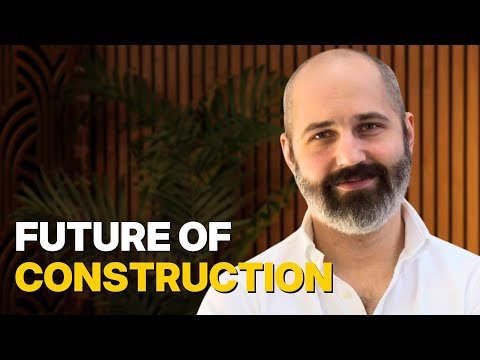
Brian Potter - Future of Construction, Ugly Modernism, & Environmental Review
Dwarkesh Patel (host), Brian Potter (guest)
In this episode of Dwarkesh Podcast, featuring Dwarkesh Patel and Brian Potter, Brian Potter - Future of Construction, Ugly Modernism, & Environmental Review explores why Construction Stagnates: Regulation, Design Tradeoffs, and Future Tech Engineer and Construction Physics author Brian Potter discusses why large-scale projects like Saudi Arabia’s The Line are technically absurd, how buildings’ tightly coupled systems and on‑site constraints make construction uniquely hard to industrialize, and why prefab rarely delivers the promised cost breakthroughs.
Why Construction Stagnates: Regulation, Design Tradeoffs, and Future Tech
Engineer and Construction Physics author Brian Potter discusses why large-scale projects like Saudi Arabia’s The Line are technically absurd, how buildings’ tightly coupled systems and on‑site constraints make construction uniquely hard to industrialize, and why prefab rarely delivers the promised cost breakthroughs.
He explains how regulation (especially environmental review under NEPA), low margins, and project-based economics limit innovation and startup dynamics compared with software, even as robotics, AR, and better materials slowly expand what’s possible.
Potter also explores housing supply, modularity, charter cities, and land-use policy, touches on Georgism and international comparisons (US, Japan, China), and argues that much “civilizational know‑how” in construction and manufacturing remains undocumented.
In a second segment, he analyzes why modern architecture uses less ornamentation, how technology (glass, AC, materials, labor costs) drives aesthetic shifts, and why we shouldn’t pin everything on a cabal of modernist architects.
Key Takeaways
Linear mega‑projects like The Line are geometrically and operationally inefficient.
Cities naturally expand in two dimensions; a one-dimensional 170‑km strip maximizes average travel distances and complicates infrastructure and climate control, while offering little real benefit beyond spectacle.
Get the full analysis with uListen AI
Buildings are highly coupled systems, which makes modularity and innovation hard.
Unlike products like cars or laptops, almost every building system (structure, MEP, envelope, finishes) runs through the same physical volume and interacts, so changing one element often forces redesigns everywhere else.
Get the full analysis with uListen AI
Prefab usually can’t beat site-built construction on cost for mainstream housing.
You can relocate some labor into factories and reduce field labor, but foundation, site work, and materials remain; factory overhead and transportation often cancel most savings, so prefab tends to succeed mainly in higher‑end or performance niches.
Get the full analysis with uListen AI
Project-based, low-margin construction is a brutal environment for startups.
Unlike software, where one build can serve millions, each building is a one‑off tied to a site, full of bespoke coordination and risk; attempts like Katerra show that massive capex for factories is hard to amortize over limited, lumpy volume.
Get the full analysis with uListen AI
Regulation, especially NEPA, acts like a time tax on federal projects without clear benefits.
Environmental impact statements often take 4–8+ years, create legal uncertainty, and are enforced through litigation rather than a clear administrative process, so they mainly slow or scare off projects rather than predictably trading off environment vs. ...
Get the full analysis with uListen AI
Housing supply is fundamentally a supply-and-demand problem, but land-use rules and politics dominate outcomes.
Places that build a lot (e. ...
Get the full analysis with uListen AI
Modern architectural minimalism is driven as much by technology and economics as by taste.
Float glass, air conditioning, and steel/concrete frames enabled glassy, open interiors that occupants like, while high labor costs and maintenance issues made intricate masonry and ornament rarer—even if many people prefer older façades visually.
Get the full analysis with uListen AI
Notable Quotes
“A one-dimensional city is like the worst possible arrangement for transportation.”
— Brian Potter
“Construction is very much on the craft end of the production spectrum.”
— Brian Potter
“You can obviously build with prefab and have a successful business, but in terms of dramatically lowering your cost, you don’t really see that.”
— Brian Potter
“NEPA is basically a documentation requirement. As long as you’ve documented the impacts thoroughly enough, you can kind of do whatever you want.”
— Brian Potter
“This giant civilizational machine that takes in raw materials and spits out finished goods—nobody really knows how it works, and mostly it’s not written down anywhere.”
— Brian Potter
Questions Answered in This Episode
If we accept that prefab won’t deliver mass cost savings, what alternative industrialization paths for construction remain promising?
Engineer and Construction Physics author Brian Potter discusses why large-scale projects like Saudi Arabia’s The Line are technically absurd, how buildings’ tightly coupled systems and on‑site constraints make construction uniquely hard to industrialize, and why prefab rarely delivers the promised cost breakthroughs.
Get the full analysis with uListen AI
How could environmental review be redesigned to genuinely protect ecosystems and climate while enabling fast, large-scale infrastructure build‑out?
He explains how regulation (especially environmental review under NEPA), low margins, and project-based economics limit innovation and startup dynamics compared with software, even as robotics, AR, and better materials slowly expand what’s possible.
Get the full analysis with uListen AI
What specific construction tasks are most ripe for near-term robotics and AR/VR deployment, and how would that change job roles on site?
Potter also explores housing supply, modularity, charter cities, and land-use policy, touches on Georgism and international comparisons (US, Japan, China), and argues that much “civilizational know‑how” in construction and manufacturing remains undocumented.
Get the full analysis with uListen AI
Given how much design is shaped by technology and economics, what policies—if any—could realistically make new buildings more beautiful to the public?
In a second segment, he analyzes why modern architecture uses less ornamentation, how technology (glass, AC, materials, labor costs) drives aesthetic shifts, and why we shouldn’t pin everything on a cabal of modernist architects.
Get the full analysis with uListen AI
What kinds of documentation or “civilizational manuals” for construction and manufacturing would be most valuable to create, and who is best positioned to write them?
Get the full analysis with uListen AI
Transcript Preview
Okay. Today, I have the pleasure of speaking with Brian Potter, who is an engineer and the author of the excellent Construction Physics blog, where he writes about how the construction industry works and why it has been slow to industrialize and innovate. And it's one of my favorite blogs on the internet. I highly, highly recommend that people check it out. Brian, my first question is about The Line project in Saudi Arabia.
(laughs)
What are your opinions?
Okay, yeah. Just this will be a, a, a s- just in no particular order. Um, one, that it's just, you know, interesting that this country, Saudi Arabia, is in the Middle East, just kind of in general, is just so willing to just do these big, crazy ambitious building projects, uh, and just pour just huge amounts of money in, in constructing this, this infrastructure in a way that you don't see a huge amount in, like, the modern world, you know? They do it, China obviously does it, huge amounts. Um, there's some other minor places but in general, you don't see a whole lot of countries doing just these big, massive, uh, incredibly ambitious projects. So like, on that level, it's, like, interesting. It's like, yes, glad to see that you're doing this, but, like, the actual project is clearly insane and makes no sense.
(laughs)
I mean, just from, like, a, a, just the physical arrangement layout, right? Like, there's a reason that cities, like, grow in, like, two dimensions, right? Like-
(laughs)
... a one-dimensional city is like the worst possible arrangement for just, like, transportation, right? It's like your maximum num- maximum amount of distance between any two points. And so, and y- you know, so just from that perspective, it's, like, clearly crazy. Uh, and there's n- there's no real benefit to it other than, you know, perhaps in some, like, weird hypothetical transportation s- situation where you had, like, really fast point to point transportation, uh, some sort of weird bullet train setup, maybe it would make sense. But there's no reason to build (laughs) there, in general, there's no reason to build, like, a city like that, right? Like even if you wanted to build, like, an entirely enclosed thing, which again, doesn't make a huge amount of sense, you would save so much material and effort if you just, you know, just make it a cube. Make it, I would be more interested in a cube-
(laughs)
... than, than The Line. But, uh, yeah, those are sort of my in- initial thoughts on it. I will, I'll be surprised if it, if it ever gets built, but-
The cube, like, from the meme about, like, you could fit all the humans in a cube the size of Manhattan? Or-
Yeah, exa- Yeah or something like that.
(laughs)
Or I mean, yeah, if you're just gonna build this g- big giant mega structure, at least take advantage of what that gets you, which is, like, you know, like, minimum surface area to volume, uh, ratio, stuff like that.
Install uListen to search the full transcript and get AI-powered insights
Get Full TranscriptGet more from every podcast
AI summaries, searchable transcripts, and fact-checking. Free forever.
Add to Chrome