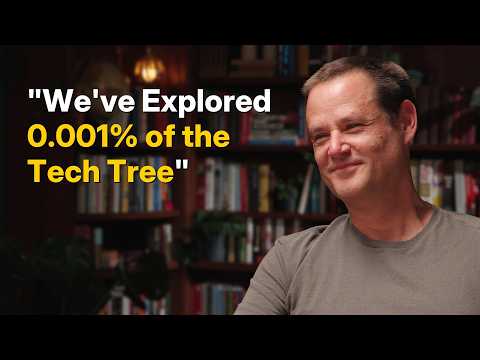
Michael Nielsen – Why aliens will have a different tech stack than us
Dwarkesh Patel (host), Michael Nielsen (guest)
In this episode of Dwarkesh Podcast, featuring Dwarkesh Patel and Michael Nielsen, Michael Nielsen – Why aliens will have a different tech stack than us explores nielsen and Patel on why science progresses beyond verification loops Michelson–Morley didn’t simply “kill the ether”; it filtered competing ether theories, showing how experiments underdetermine theory and why scientists can rationally persist with patched frameworks for decades.
Nielsen and Patel on why science progresses beyond verification loops
Michelson–Morley didn’t simply “kill the ether”; it filtered competing ether theories, showing how experiments underdetermine theory and why scientists can rationally persist with patched frameworks for decades.
Scientific breakthroughs often outpace direct verification—heliocentrism, relativity, and evolution advanced through explanatory unification, new conceptual framings, and enabling background knowledge rather than single decisive experiments.
AI-driven science has successes like AlphaFold, but Nielsen argues much of the achievement is downstream of expensive, slow data acquisition, and that many scientific bottlenecks are about ideas, taste, and program diversity rather than fast feedback loops.
Nielsen proposes that the science/technology “tree” is vastly larger than we assume, implying alien civilizations could develop different technology stacks and that diminishing-returns narratives overlook new-field creation and “restocking” effects.
The conversation closes on the political economy of science (credit assignment, preprints, openness) and on personal/organizational strategies for deep learning: raising stakes, creating forcing functions, and building durable internalization rather than shallow fluency.
Key Takeaways
Experiments rarely map cleanly to a single falsified theory.
Michelson–Morley constrained versions of the ether rather than decisively refuting “the ether,” illustrating how multiple auxiliary hypotheses can keep a research program alive even after surprising results.
Get the full analysis with uListen AI
Scientific communities often converge on interpretations before “final” verification arrives.
Relativity’s community-level shift preceded later clean demonstrations (e. ...
Get the full analysis with uListen AI
The same anomaly-handling playbook can be correct in one case and misleading in another.
Uranus’s discrepancy led to Neptune (a triumph for Newtonian gravity), while Mercury’s led to the nonexistent Vulcan and ultimately general relativity—showing why ex ante heuristics for “which anomaly matters” are weak.
Get the full analysis with uListen AI
Some verification loops are actively hostile for long periods.
Prout’s whole-number atomic weights looked wrong until isotopes were discovered; for decades, better measurements moved values further from the conjecture, demonstrating that “more data” can temporarily mislead.
Get the full analysis with uListen AI
AI can accelerate certain bottlenecks without solving the hardest parts of science.
AlphaFold’s success rests heavily on decades of experimental infrastructure (Protein Data Bank); for many domains, the limiting factor remains conceptual reframing, new primitives, or new fields—not prediction accuracy alone.
Get the full analysis with uListen AI
Deep models may become scientific instruments even when they’re not classic explanations.
Nielsen sketches a spectrum: treat models as non-explanatory predictors, mine them for “little explanations” via interpretability, or develop new scientific practices/operations (distillation, merging) for complex learned objects.
Get the full analysis with uListen AI
The long-run ‘tech tree’ is likely so large that different civilizations won’t converge on one stack.
By analogy to computer science after Church–Turing (e. ...
Get the full analysis with uListen AI
Notable Quotes
“Newton was not the first of the age of reason. He was the last of the magicians.”
— Michael Nielsen (quoting John Maynard Keynes)
“Subtle is the Lord, but malicious he is not.”
— Dwarkesh Patel (referencing Einstein’s remark in the ether-wind context)
“It’s not as though there’s, like, some standard procedure… Great scientists can remain wrong for a very long time.”
— Michael Nielsen
“Most parts of the tech tree are never going to be explored.”
— Michael Nielsen
“It makes friendliness much more rewarding.”
— Michael Nielsen (on gains-from-trade across divergent tech paths)
Questions Answered in This Episode
In the Michelson–Morley era, what specific ‘auxiliary hypotheses’ kept ether theories alive, and how did later evidence finally make them untenable?
Michelson–Morley didn’t simply “kill the ether”; it filtered competing ether theories, showing how experiments underdetermine theory and why scientists can rationally persist with patched frameworks for decades.
Get the full analysis with uListen AI
What were the key social/epistemic factors that made Einstein’s interpretation win out over Lorentz/Poincaré despite early empirical equivalence?
Scientific breakthroughs often outpace direct verification—heliocentrism, relativity, and evolution advanced through explanatory unification, new conceptual framings, and enabling background knowledge rather than single decisive experiments.
Get the full analysis with uListen AI
If AlphaFold is ‘mostly data acquisition,’ what would a genuinely AI-native scientific breakthrough look like in a domain without a giant curated dataset?
AI-driven science has successes like AlphaFold, but Nielsen argues much of the achievement is downstream of expensive, slow data acquisition, and that many scientific bottlenecks are about ideas, taste, and program diversity rather than fast feedback loops.
Get the full analysis with uListen AI
Can you give a concrete example of an operation (distillation/regularization/constraint) that could turn an ‘epicycle-like’ neural model into a Copernican-style conceptual switch?
Nielsen proposes that the science/technology “tree” is vastly larger than we assume, implying alien civilizations could develop different technology stacks and that diminishing-returns narratives overlook new-field creation and “restocking” effects.
Get the full analysis with uListen AI
Which modern ‘anomalies’ (like Pioneer, Mercury, or isotope weights) do you think are most plausibly signaling a new framework rather than measurement/modeling error?
The conversation closes on the political economy of science (credit assignment, preprints, openness) and on personal/organizational strategies for deep learning: raising stakes, creating forcing functions, and building durable internalization rather than shallow fluency.
Get the full analysis with uListen AI
Transcript Preview
Today I'm speaking with Michael Nielsen. You have done many things. You're one of the pioneers of quantum computing, wrote the main textbook in the field of the open science movement. You wrote a book about deep learning that Chris Olah and, uh, Greg Brockman credit them with getting them into the field. Um, more recently, you're a research fellow at the Astera Institute and writing a book about religion, science, and technology. I'm gonna ask you about none of those things. The conversation I wanna have today is, how do we recognize scientific progress? And it's, it's es-especially relevant, uh, for AI because people are trying to close the RL verification loop on scientific discovery.
Mm-hmm.
And what does it mean to close that loop? But in preparing for this interview, I've realized that it's a more mysterious and elusive, um, force even in the history of human science than I understood. And I think a good place to start will be Michelson-Morley and how special relativity is discovered, if it's different than the story that you kind of get off of YouTube videos. Um, anyways, I, I will prompt you that way, and then we'll go in there.
Okay. Yeah, so, I mean, Michelson-Morley is, uh, one of the sort of the, the, the famous results often presented as, as this, this experiment that was done in the 1880s and that helped Einstein, you know, come up with the, the special theory of relativity a little bit later. So, so sort of changing our, our... the way we think about space and, and time and, and our fundamental conception of those things. Um, and there's kind of a, uh, a big gap, I think, between the way Michelson and Morley and other people at the time thought about the experiment and certainly the way in which, uh, Einstein thought or did not think about the experiment. Um, uh, in actual fact, he, uh, uh, stated later in his life he wasn't even sure whether he was aware of the paper at the time. Um, there's a lot of evidence that he, he probably was aware of the paper at the time, but it actually wasn't dispositive for his thinking at all. Uh, something else, uh, completely was, was, was going on. Um, so, uh, uh, what Michelson and Morley thought they were doing was they thought they were testing different theories of, of what was called the ether. So as you go back to the, the, the 1600s, uh, Robert Boyle introduced the idea of the ether, and basically the idea of the ether is, um, you know, we know that, that sound is vibrations in the air. Um, and then Boyle and other people got interested in the question of, like, is, is light vibrations, uh, in something, and they couldn't figure out, uh, what it was. Boyle actually did an experiment where he, he tested whether or not you could propagate light through a vacuum. He found that you could. You couldn't do it with, with, with sound. So he introduced this idea of the ether, and then for the next two hundred or so years, people had, uh, all these kind of conversations about, about what the ether was and what its nature was. And the Michelson and Morley experiment was really an experiment to test different theories of the ether, uh, against one another, um, and i-in particular to find out whether or not there was a so-called ether wind. So the idea was that the, the Earth is passing through, uh, maybe this ether wind, and if it is passing through, uh, the ether wind, sort of this background, um, and you, you shoot a light beam sort of parallel, uh, t-to the direction the ether wind is going in, it'll get accelerated a little bit. Um, and if it's being passed back, uh, sort of in the opposite direction, it'll get slowed down a little bit, and you should be able to, to see this in the results of interference experiments. And what they found, much to their surprise, um, I think, uh, was that in fact there was no ether wind, um, and that ruled out some theories of the ether but, but, but not all, and, and Michelson certainly continued to b- to believe in the ether.
Install uListen to search the full transcript and get AI-powered insights
Get Full TranscriptGet more from every podcast
AI summaries, searchable transcripts, and fact-checking. Free forever.
Add to Chrome