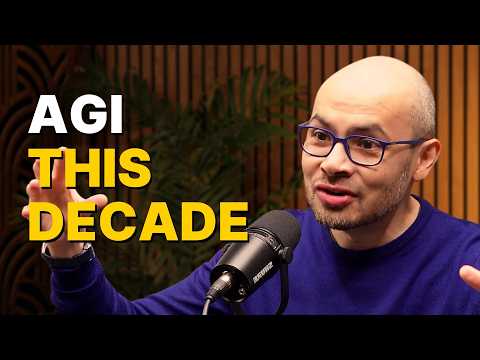
Demis Hassabis — Scaling, superhuman AIs, AlphaZero atop LLMs, AlphaFold
Demis Hassabis (guest), Dwarkesh Patel (host), Narrator
In this episode of Dwarkesh Podcast, featuring Demis Hassabis and Dwarkesh Patel, Demis Hassabis — Scaling, superhuman AIs, AlphaZero atop LLMs, AlphaFold explores demis Hassabis explains path to AGI, scaling, safety, and Gemini Demis Hassabis outlines how large multimodal models plus planning/search (AlphaZero-style RL) are his likely recipe for AGI within the next decade, with current LLMs seen as “unreasonably effective” but still incomplete.
Demis Hassabis explains path to AGI, scaling, safety, and Gemini
Demis Hassabis outlines how large multimodal models plus planning/search (AlphaZero-style RL) are his likely recipe for AGI within the next decade, with current LLMs seen as “unreasonably effective” but still incomplete.
He emphasizes neuroscience-inspired ideas like world models, imagination, and sample-efficient learning, and argues that combining old deep RL advances with new large-model scaling will be crucial.
A large portion of the conversation covers safety: grounding, deception, evals, sandboxes, cybersecurity, responsible scaling, and governance that involves governments, academia, and civil society rather than just private firms.
Hassabis also discusses Gemini’s development, multimodality, robotics, AI-for-science applications like AlphaFold, and how AGI and proto-AGI systems could accelerate future AI research while requiring tight control and oversight.
Key Takeaways
AGI will likely require both scaled multimodal models and explicit planning/search.
Hassabis expects future AGI systems to use large multimodal world models (like Gemini) as priors, with AlphaZero-style planning and search on top to perform deliberate reasoning and goal-directed behavior that current LLMs lack.
Get the full analysis with uListen AI
Neuroscience remains a powerful guide for AI, especially around world models and imagination.
Concepts like reinforcement learning, attention, experience replay, and mental simulation were inspired by neuroscience and will inform unresolved areas such as planning, world-model construction, and imagination-like mental simulation in machines.
Get the full analysis with uListen AI
Scaling has gone further than expected, but its ultimate limits are still empirical.
Large models show emergent abstractions and partial grounding from language alone, which even scaling proponents didn’t fully anticipate; Hassabis argues we must push scaling and innovation in parallel to see whether we hit a soft asymptote or a “brick wall.”
Get the full analysis with uListen AI
Synthetic data and self-play will be central to overcoming data bottlenecks.
DeepMind plans to leverage realistic simulations, self-play between agents, and targeted synthetic data generation to fill gaps in training distributions, using careful data analysis to identify underrepresented regions and reduce bias.
Get the full analysis with uListen AI
Robust safety requires evals for deception and misuse, secure infrastructure, and sandboxes.
Hassabis stresses the need for better benchmarks (e. ...
Get the full analysis with uListen AI
Governance of superhuman systems must extend beyond private companies.
He argues that AGI-scale systems are too consequential to be managed solely by firms; instead, international, UN-level coordination with governments, academia, and civil society is needed to decide acceptable uses and ensure benefits are widely shared.
Get the full analysis with uListen AI
Multimodality and memory will unlock much more useful assistants and real-world impact.
Current chat interfaces only tap a fraction of potential; richer multimodal inputs (video, audio, sensors) and persistent episodic memory, plus better reliability and grounding, are needed before AI can safely handle tasks in science, medicine, and everyday work.
Get the full analysis with uListen AI
Notable Quotes
“I wouldn’t be surprised if we had AGI-like systems within the next decade.”
— Demis Hassabis
“I sort of look at the large models today and I think they’re almost unreasonably effective for what they are.”
— Demis Hassabis
“The brain is an existence proof that general intelligence is possible at all.”
— Demis Hassabis
“You don’t want to be live A/B testing out in the world with these very consequential systems.”
— Demis Hassabis
“This is so consequential, this technology, I think it’s much bigger than any one company or even industry in general.”
— Demis Hassabis
Questions Answered in This Episode
How exactly will AlphaZero-style planning and search be integrated on top of large multimodal models in real-world tasks outside of games?
Demis Hassabis outlines how large multimodal models plus planning/search (AlphaZero-style RL) are his likely recipe for AGI within the next decade, with current LLMs seen as “unreasonably effective” but still incomplete.
Get the full analysis with uListen AI
What concrete evals or benchmarks would convincingly demonstrate that a model is capable of deception or dangerous autonomy before deployment?
He emphasizes neuroscience-inspired ideas like world models, imagination, and sample-efficient learning, and argues that combining old deep RL advances with new large-model scaling will be crucial.
Get the full analysis with uListen AI
How far can synthetic data and self-play realistically go in replacing scarce high-quality human data, especially for complex domains like biology or robotics?
A large portion of the conversation covers safety: grounding, deception, evals, sandboxes, cybersecurity, responsible scaling, and governance that involves governments, academia, and civil society rather than just private firms.
Get the full analysis with uListen AI
At what point should model capability thresholds trigger international governance mechanisms rather than just internal corporate policies?
Hassabis also discusses Gemini’s development, multimodality, robotics, AI-for-science applications like AlphaFold, and how AGI and proto-AGI systems could accelerate future AI research while requiring tight control and oversight.
Get the full analysis with uListen AI
What technical breakthroughs are most needed to move from current chatbots to truly reliable scientific co-discoverers that can propose novel hypotheses, not just solve posed problems?
Get the full analysis with uListen AI
Transcript Preview
... so I wouldn't be surprised if we had AGI-like systems within the next decade. It was pretty surprising to almost everyone, including the people, uh, who first worked on the scaling hypotheses that how far it's gone. In a way, I look at the large models today and I think they're almost unreasonably effective for what they are. It's an empirical question whether that will hit an asymptote or a brick wall. I think no one knows.
When you think about, uh, superhuman intelligence, is it, like, con- still controlled by a private company?
A- as Gemini are becoming more multimodal and we start ingesting audiovisual data as well as text data, I do think our systems are going to start to understand the physics of the real world better. The world's about to become very exciting, I think, in the next few years as we start getting used to the idea what true multimodality means.
Okay. Today, it is a true honor to speak with Demis Hassabis, who is the CEO of DeepMind. Demis, welcome to the podcast.
Thanks for having me.
First question. Given your neuroscience background, how do you think about intelligence? Specifically, do you think it's, like, one higher level general reasoning circuit or do you think it's thousands of independent subskills and heuristics?
Well, it's interesting because intelligence is so, uh, uh, broad and, um, you know, what we use it for is- is so sort of generally applicable. I think that suggests that, you know, there must be some sort of high level, uh, uh, common things in- i- you know, common kind of algorithmic themes, I think, around how the brain processes the world around us. So, um, of course, there- there then there are specialized parts of the brain that- that do specific things, um, but I think there are probably some underlying principles that underpin all of that.
Yeah. How do you make sense of the fact that in these LLMs though, when you give them a lot of data in any specific domain, they tend to get, uh, asymmetrically better in that domain? Uh, w- uh, wouldn't we expect a sort of, like, general improvement across all the- all the different areas as well?
Well, I think you... First of all, I think you do actually sometimes get surprising improvement in other domains when you improve in a specific domain. So for example, uh, when these, uh, large models sort of improve at coding, that can actually improve their general reasoning. So there- there is some evidence of some transfer, although I think we would p- we would like a lot more evidence of that. Um, but also, you know, that's how, uh, the human brain learns too, is if we experience and practice a lo- a lot of things like chess or, you know, writing, creative writing, whatever that is, we also tend to specialize and get better at that specific thing, even though we're using, uh, sort of general learning techniques and general learning systems in order to, uh, sp- you know, to get good at that domain.
Install uListen to search the full transcript and get AI-powered insights
Get Full TranscriptGet more from every podcast
AI summaries, searchable transcripts, and fact-checking. Free forever.
Add to Chrome