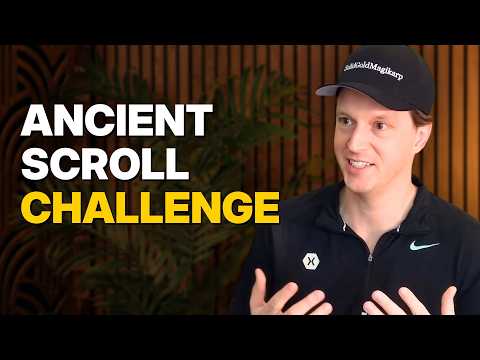
Nat Friedman (Github CEO) — Reading ancient scrolls, open source, & AI
Nat Friedman (guest), Dwarkesh Patel (host), Narrator, Narrator
In this episode of Dwarkesh Podcast, featuring Nat Friedman and Dwarkesh Patel, Nat Friedman (Github CEO) — Reading ancient scrolls, open source, & AI explores nat Friedman on decoding ancient scrolls, AI, and open source leverage Nat Friedman discusses the Vesuvius Challenge, an open competition he’s funding to virtually read carbonized scrolls from Herculaneum using advanced CT scanning and machine learning, potentially doubling surviving texts from antiquity.
Nat Friedman on decoding ancient scrolls, AI, and open source leverage
Nat Friedman discusses the Vesuvius Challenge, an open competition he’s funding to virtually read carbonized scrolls from Herculaneum using advanced CT scanning and machine learning, potentially doubling surviving texts from antiquity.
He explains the technical hurdles of detecting ink and unrolling scrolls digitally, and why a prize model and open participation can accelerate progress more than a closed research team alone.
Friedman reflects on his role in Microsoft’s acquisition of GitHub, the creation of GitHub Copilot with OpenAI’s models, and what that taught him about shipping AI products and empowering developers.
The conversation broadens into how inefficient the world really is, how open source and AI will reshape software and labor, and why alignment, governance, and individual judgment matter in building future technologies.
Key Takeaways
Prize competitions can unlock stalled, high-upside scientific problems.
By turning the Herculaneum scrolls project into an open, well-funded prize (the Vesuvius Challenge), Friedman and Brent Seales hope to attract diverse talent, explore a large solution search space, and solve in a year what might otherwise take Seales’ lab many years.
Get the full analysis with uListen AI
Recovering the scrolls could dramatically expand our knowledge of antiquity.
Historians estimate that successfully reading the 600+ known scrolls—and possibly thousands more still buried—could roughly double the surviving corpus of ancient texts, with potential discoveries ranging from lost literature to early Christian references or works saved from the Library of Alexandria.
Get the full analysis with uListen AI
Technical innovation depends as much on product design as on model capability.
GitHub Copilot only became compelling after multiple prototype iterations—from Q&A bots to clumsy multi-option code generators—evolved into low-latency, inline completions that fit seamlessly into developers’ workflows, showing that UX choices can be as decisive as the underlying model.
Get the full analysis with uListen AI
The world is far less efficient than most people assume.
Friedman rejects the idea that good ideas are always already taken; from hedge-fund “secret” strategies to underfunded archaeology sites, he sees many obvious, high-leverage opportunities left untouched simply because institutions and individuals assume someone else is handling them.
Get the full analysis with uListen AI
Open source excels at infrastructure but struggles with tightly curated user experiences.
He argues that open source governance and coordination costs make it strong for languages, operating systems, and components but weaker for consumer-grade applications that require a single coherent aesthetic and fast, tightly guided iteration with users.
Get the full analysis with uListen AI
AI foundation models will likely proliferate rather than centralize completely.
Because training recipes are relatively copyable, data is largely public, and hardware is commoditized, Friedman expects many strong models rather than a tiny oligopoly, and he doubts that ever-larger, ultra-expensive models will be proportionally more economically valuable.
Get the full analysis with uListen AI
Alignment work needs to be technical, open, and widely shared.
Friedman believes potential AI risks will ultimately require concrete technical solutions—code and methods others can reuse—and worries that today’s alignment research is too closed, leading to a world where open-source capabilities outpace open-source alignment tools.
Get the full analysis with uListen AI
Notable Quotes
“If we could read all of them, then that would give us approximately a doubling of the total texts that we have from antiquity.”
— Nat Friedman
“I just fundamentally don’t believe the world is efficient.”
— Nat Friedman
“We do these things not because they are easy, but because we thought they would be easy.”
— Nat Friedman
“The set of people who really do have great judgment is small, and we should fully empower them to exercise it.”
— Nat Friedman
“An open competition seems like the most efficient way to get it done.”
— Nat Friedman
Questions Answered in This Episode
If the Vesuvius Challenge succeeds and we can read one full scroll, how should scholars and funders prioritize what to scan and excavate next?
Nat Friedman discusses the Vesuvius Challenge, an open competition he’s funding to virtually read carbonized scrolls from Herculaneum using advanced CT scanning and machine learning, potentially doubling surviving texts from antiquity.
Get the full analysis with uListen AI
What kinds of discoveries from the Herculaneum library would most profoundly challenge our current narratives about the classical world or early Christianity?
He explains the technical hurdles of detecting ink and unrolling scrolls digitally, and why a prize model and open participation can accelerate progress more than a closed research team alone.
Get the full analysis with uListen AI
How can product builders systematically find and test the “right” UX patterns for deploying powerful models, rather than over-indexing on impressive demos?
Friedman reflects on his role in Microsoft’s acquisition of GitHub, the creation of GitHub Copilot with OpenAI’s models, and what that taught him about shipping AI products and empowering developers.
Get the full analysis with uListen AI
What governance models or tools could make open source more capable of producing world-class end-user applications without burning out maintainers?
The conversation broadens into how inefficient the world really is, how open source and AI will reshape software and labor, and why alignment, governance, and individual judgment matter in building future technologies.
Get the full analysis with uListen AI
In a world where strong AI models proliferate widely, what is a realistic, actionable path to ensuring that open-source alignment techniques keep pace with open-source capabilities?
Get the full analysis with uListen AI
Transcript Preview
... we have 600 plus kind of roughly intact scrolls that we can open. And I heard, I heard about this and I thought that was incredibly exciting, like the idea that there is information from 2,000 years in the past, we don't know what's in these things. If we could read all of them, then that would give us approximately a doubling of the total texts that we have from antiquity. If there are thousands more papyrus scrolls in there and we, and we now have the techniques to read them, then there's gold in that mud, and you know, it's gotta be dug out. I just fundamentally don't believe the world is efficient and so if I see an opportunity to do something, I used to but I no longer have a reflexive reaction that says, "Oh, that must not be a good idea. If it were a good idea, someone would already be doing it."
Okay. Today, I have the pleasure of speaking with Nat Friedman, who was the CEO of GitHub from 2018 to 2021. Before that he started and sold two companies, uh, companies, Simeon and Xamarin, and he is also the founder of AI Grant and California Yimby. And most recently he is the organizer and funder of the Scroll Prize, which is where we'll start this conversation. So Nat, do you wanna tell the audience about what the Scroll Prize is?
Well, we're, we're calling it the Vesuvius Challenge.
Oh, okay. Got it.
And, uh, this is just this crazy and exciting thing I feel like incredibly honored to have gotten caught up in, but, uh, a couple of years ago, I was reading... It was in the midst of COVID and, uh, I think we were in lockdown and like everybody else, we were falling into internet rabbit holes, and I just started reading about the eruption of Mount Vesuvius in Italy about 2,000 years ago. And it turns out that when Vesuvius erupted, uh, it was AD 79, it destroyed all the nearby towns. Everyone knows about Pompeii, but there was another nearby town called Herculaneum and Herculaneum was sort of like the Beverly Hills to Pompeii, so big villas, big houses, fancy people. And in Herculaneum there was one villa in particular, it was enormous, and it had once been owned by the father-in-law of Julius Caesar, and so well-connected guy. And it was full of beautiful statues and marbles and art but it was also the home to a huge library of papyrus scrolls, and so when the villa was buried, the, the volcano actually, it spit out enormous quantities of mud and ash and it buried Herculaneum, in particular, in something like 20 meters of material. So it wasn't like a thin layer, it was a very thick layer. Those towns were buried and forgotten for hundreds of years. No one even knew exactly where they were until the 1700s, and so in 1750, a farm worker who was digging a well kind of in the outskirts of Herculaneum struck this marble paving stone of a path that had been at this huge villa, and of course he, he was pretty far down when he did that, he was, you know, 60 feet down, and then subsequently this Swiss engineer came in and started digging tunnels from that well shaft and they found all these treasures, and, and that was sort of the spirit at the time, was like looting.
Install uListen to search the full transcript and get AI-powered insights
Get Full TranscriptGet more from every podcast
AI summaries, searchable transcripts, and fact-checking. Free forever.
Add to Chrome