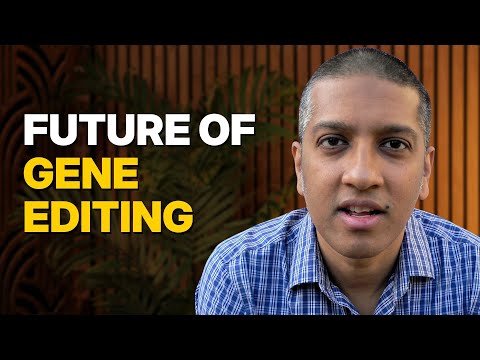
Razib Khan - Genomics, Intelligence, and The Church of Science
Razib Khan (guest), Dwarkesh Patel (host)
In this episode of Dwarkesh Podcast, featuring Razib Khan and Dwarkesh Patel, Razib Khan - Genomics, Intelligence, and The Church of Science explores razib Khan on genes, intelligence, caste, and science’s fading faith Razib Khan and Dwarkesh Patel discuss how modern genomics illuminates intelligence, fertility patterns, caste endogamy, and group differences, and what this implies for the future. They explore extreme Indian jati endogamy, Ashkenazi Jewish achievement, Chinese assimilation, and why certain Indian subgroups dominate elite tech roles. Khan also reflects on male-female variance in intelligence, brain size decline, self-domestication, and realistic trajectories for gene editing and embryo selection. The conversation ends with his concerns about academic science prioritizing comfort over truth, the fragility of modern technological civilization, and practical advice on combining technical depth with historical knowledge and public writing.
Razib Khan on genes, intelligence, caste, and science’s fading faith
Razib Khan and Dwarkesh Patel discuss how modern genomics illuminates intelligence, fertility patterns, caste endogamy, and group differences, and what this implies for the future. They explore extreme Indian jati endogamy, Ashkenazi Jewish achievement, Chinese assimilation, and why certain Indian subgroups dominate elite tech roles. Khan also reflects on male-female variance in intelligence, brain size decline, self-domestication, and realistic trajectories for gene editing and embryo selection. The conversation ends with his concerns about academic science prioritizing comfort over truth, the fragility of modern technological civilization, and practical advice on combining technical depth with historical knowledge and public writing.
Key Takeaways
Current fertility patterns imply mild long-run dysgenic trends for intelligence in developed countries.
People with genotypes associated with higher educational attainment tend to delay or forgo childbearing, leading to negative selection on those alleles; equilibrium could be centuries away, but directionally this is dysgenic under present conditions.
Get the full analysis with uListen AI
Indian jatis exhibit some of the most extreme long-term endogamy known in humans.
Genetic data (e. ...
Get the full analysis with uListen AI
Certain culturally and historically positioned groups can become disproportionate global elites once constraints lift.
Ashkenazi Jews exploded in visible achievement only after 19th‑century emancipation; Khan suggests similar potential for historically enterprising but constrained groups like Fujianese Chinese, while pointing to South Indian Brahmins as an already salient example in global tech and academia.
Get the full analysis with uListen AI
Greater male variance in intelligence likely stems from sex-chromosome biology and developmental instability.
Males have only one X chromosome, so deleterious mutations are unmasked, increasing low-end impairment; additional masculinizing developmental steps and testosterone’s immune tradeoffs increase instability, which can generate more failures but also more extreme high-end outcomes.
Get the full analysis with uListen AI
Gene editing’s near-term promise is in treating Mendelian diseases, not boosting intelligence.
Over the next decade, Khan expects CRISPR and related tools to cure disorders like sickle cell and cystic fibrosis in living adults; editing embryos for polygenic traits like IQ likely requires at least ~20 years and may work better by removing de novo harmful mutations than by adding ‘genius’ variants.
Get the full analysis with uListen AI
Modern science is structurally unequal and deeply class-biased, whatever its egalitarian rhetoric.
Professorships are highly heritable as careers; children of academics and professionals learn tacit strategies early and benefit from nepotistic opportunities (e. ...
Get the full analysis with uListen AI
We are in a metastable, fragile technological phase where primate brains wield civilization-scale power.
Khan views recent digital advances (smartphones, potential VR and brain–computer interfaces) as plausibly step-like; he warns that institutional decay, skill loss (e. ...
Get the full analysis with uListen AI
Notable Quotes
“Science is here for the truth. If that's not the primary focus, why are we funding it?”
— Razib Khan
“If you're not there for the truth, eventually the institution's not going to make it. It's just gonna kind of dissolve.”
— Razib Khan
“Indians just are really good at endogamy for some reason… having a whole society like this is pretty weird.”
— Razib Khan
“There’s no reason you need to be able to do algebraic topology easily. That’s just a freak thing.”
— Razib Khan
“We are in a meta-stable state where you look like a primate, but you have the ability to destroy civilization.”
— Razib Khan
Questions Answered in This Episode
If negative selection on educational-attainment genes continues, how much could average cognitive ability realistically shift over the next few centuries?
Razib Khan and Dwarkesh Patel discuss how modern genomics illuminates intelligence, fertility patterns, caste endogamy, and group differences, and what this implies for the future. ...
Get the full analysis with uListen AI
What concrete historical or ethnographic evidence might eventually explain India’s uniquely strong and persistent jati endogamy?
Get the full analysis with uListen AI
How should societies ethically navigate a future where some parents can edit away harmful mutations or boost traits like intelligence while others cannot?
Get the full analysis with uListen AI
What institutional reforms could reorient academic science back toward truth-seeking rather than status, metrics, and comfort?
Get the full analysis with uListen AI
In a world of potential brain–computer interfaces and uploads, what safeguards—technical or cultural—might prevent the first movers from effectively becoming unaccountable ‘gods’ of new digital realms?
Get the full analysis with uListen AI
Transcript Preview
So, the tweet was, the parishioner would be like the person involved in laboratory, their research institution and God is the truth. And if you're not there for the truth, uh, eventually the l- the institution's not going to make it. It's just gonna kind of dissolve because at the end of the day, if you don't have passion for research, if you don't have passion for the truth, uh, like what's the point? I don't know. England just seemed like the United States, but whiter.
Uh, but by the way, can you guess my jati?
Uh, well, I mean, I know you're Guju, right?
Uh-huh.
Are you like half Patel, half Baniya? I'm just guessing.
Yeah, yeah.
Did I guess right?
Yeah, yeah. Th- that's exactly right.
(laughs)
(laughs)
How did I do that? I don't even know, man. (upbeat music)
All right. Today, I had the pleasure of speaking with Razib Khan. He's one of the top science bloggers in the world. Um, he writes about genetics, history and evolution on his blog, Unsupervised Learnings, and he has a podcast of the same name. Um, and you can find it at razib.substack.com. So, uh, Razib, thanks for coming on the podcast.
Oh, it's my pleasure, man.
Yeah, yeah. So can you, can you give my audience a little bit of background about you, uh, how you got into all this stuff?
Yeah. Um, you know, I've always been interested in topics like history, uh, demographics, et cetera. And, um, I've also been interested in science. I have a scientific background, scientific training. And over the last 20 years, uh, genetics has become just a really big deal, uh, in terms of, you know, just as a tool to do various things, whether it's in the biomedical space or historical inference. And, um, you know, so obviously I'm interested in demographics, historical inference and, um, you know, uh, genetics is a tool I can use as a geneticist. And so I do. Um, so, you know, like, uh, like, like as we're recording right now, I, um, decide to do a bunch of pairwise genetic distances between populations and stuff just because I could for a post, you know? So, uh, you know, I- I- I do a lot of the things by myself where I replicate what's been done. Um, yeah, so I mean, that- that's a lot of what I do. Yeah.
Okay. Interesting. Um, all right, so I'd, I'd just like to jump into it. So, uh, my first question is, assuming there's no gene editing, uh, in the near future, what is the long-term equilibrium for intelligence look like? So there's like multiple visions, right? Like one, one view is like, you know, Charles Murray in Coming Apart. You have, uh, ha- you know, you have fat tails because there's assortative mating. Another is there's like a slight dysgenic effect because there's lower fertility among, uh, higher intelligence people. Um, so what does the equil- equilibrium look like if there's no gene editing?
Install uListen to search the full transcript and get AI-powered insights
Get Full TranscriptGet more from every podcast
AI summaries, searchable transcripts, and fact-checking. Free forever.
Add to Chrome