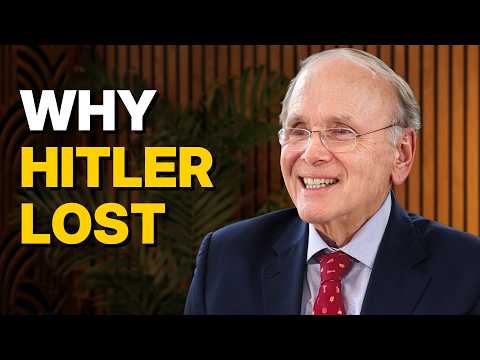
Daniel Yergin — Oil destroyed Hitler, fracking destroyed Putin
Daniel Yergin (guest), Dwarkesh Patel (host)
In this episode of Dwarkesh Podcast, featuring Daniel Yergin and Dwarkesh Patel, Daniel Yergin — Oil destroyed Hitler, fracking destroyed Putin explores how Oil Shaped War, Wealth, and Today’s Geopolitics and Energy Future Daniel Yergin traces how oil underpinned the major events of the 20th century, from World War I and II to the rise of OPEC and the 1973 oil crisis, fundamentally shaping geopolitics and economic development.
How Oil Shaped War, Wealth, and Today’s Geopolitics and Energy Future
Daniel Yergin traces how oil underpinned the major events of the 20th century, from World War I and II to the rise of OPEC and the 1973 oil crisis, fundamentally shaping geopolitics and economic development.
He explains how the US shale and fracking revolution unexpectedly delivered American energy independence, weakened Vladimir Putin’s leverage over Europe, and transformed global power dynamics.
The conversation highlights recurring patterns in energy: boom–bust cycles, outsized entrepreneurial personalities, the political risks of resource nationalism, and the strategic shift now underway toward renewables, data centers, and electricity-hungry AI.
Yergin also reflects on narrative history as a tool to understand contingency and human agency in energy markets, and on how current transitions—from fossil fuels to renewables and from analog to AI—echo earlier upheavals like the advent of oil and electrification.
Key Takeaways
Oil turned from a niche lighting fuel into the core strategic commodity of the 20th century.
Kerosene initially displaced whale oil as a lighting source, but World War I and II revealed oil’s decisive role in mobility, logistics, and warfare—cementing it as central to state power and industrial society.
Get the full analysis with uListen AI
Energy dominance can shift rapidly and reshape geopolitics.
The US moved from oil exporter to massive importer after WWII, then back to effective energy independence through shale; this shift undercut OPEC’s leverage and blunted Putin’s attempt to use gas as a weapon against Europe.
Get the full analysis with uListen AI
Monopolies can enable efficiency and then be dismantled to spur innovation.
Standard Oil standardized quality, drove down prices, and built global logistics, but its breakup under antitrust law created multiple competing firms, more entrepreneurship, and ultimately made Rockefeller even richer as a shareholder.
Get the full analysis with uListen AI
Resource-rich states face structural political and economic risks.
Yergin describes the “obsolescing bargain,” where host countries steadily demand more from foreign oil companies and often nationalize them, and shows how sudden oil wealth can distort economies, fuel conflict, and destabilize regimes (e. ...
Get the full analysis with uListen AI
Energy security is about diversification, not just abundance.
Echoing Churchill, Yergin emphasizes that safety lies in variety: countries need diversified fuel mixes (oil, gas, nuclear, renewables) and diversified suppliers to avoid overdependence on any one supplier or technology.
Get the full analysis with uListen AI
The current “energy transition” is unlike past transitions because it aims at replacement, not just addition.
Historically, new energy sources (oil, gas) layered on top of older ones (coal) rather than eliminating them; today’s climate-driven push seeks to actively displace fossil fuels quickly, colliding with scale, mineral, permitting, and geopolitical constraints.
Get the full analysis with uListen AI
AI and data centers are emerging as a major new driver of electricity demand.
Projections that US data centers could rise from ~4% to ~10% of electricity use by 2030, combined with EVs and reshoring of industry, are transforming a long-flat power sector and raising urgent questions about generation, grids, siting, and permitting.
Get the full analysis with uListen AI
Notable Quotes
“World War II was not an oil war, but there was an oil war within World War II.”
— Daniel Yergin
“The allies floated to victory on a sea of oil.”
— Daniel Yergin (quoting a British foreign minister on World War I)
“No one would be happier to see a ban on US shale production than Vladimir Putin.”
— Daniel Yergin
“The two most important characters in the history of oil are named Supply and Demand.”
— Daniel Yergin
“We need new thinking.”
— Narendra Modi (as recounted by Daniel Yergin)
Questions Answered in This Episode
If the shale revolution had not occurred, how differently would Russia’s war in Ukraine and Europe’s energy security have unfolded?
Daniel Yergin traces how oil underpinned the major events of the 20th century, from World War I and II to the rise of OPEC and the 1973 oil crisis, fundamentally shaping geopolitics and economic development.
Get the full analysis with uListen AI
What concrete policies best help resource-rich developing countries avoid the “resource curse” and Dutch disease when they discover large oil or gas reserves?
He explains how the US shale and fracking revolution unexpectedly delivered American energy independence, weakened Vladimir Putin’s leverage over Europe, and transformed global power dynamics.
Get the full analysis with uListen AI
How far can AI efficiency gains realistically go in offsetting the huge projected surge in data center electricity demand?
The conversation highlights recurring patterns in energy: boom–bust cycles, outsized entrepreneurial personalities, the political risks of resource nationalism, and the strategic shift now underway toward renewables, data centers, and electricity-hungry AI.
Get the full analysis with uListen AI
Given the mineral, permitting, and geopolitical constraints Yergin outlines, what is a plausible, non-idealized timeline for a large-scale transition away from fossil fuels?
Yergin also reflects on narrative history as a tool to understand contingency and human agency in energy markets, and on how current transitions—from fossil fuels to renewables and from analog to AI—echo earlier upheavals like the advent of oil and electrification.
Get the full analysis with uListen AI
What would a truly diversified and resilient 2050 global energy system look like if we took Churchill’s dictum about variety as the central design principle?
Get the full analysis with uListen AI
Transcript Preview
There was an oil war within World War II. When Hitler invaded Russia, he was not only going for Moscow, he was also going for the oil fields of Baku. The kamikaze pilots who would fly their planes into the aircraft carrier, one big reason they were doing that was to save fuel so they wouldn't have to fly back. No one would be happier to see a ban on US shale production than Vladimir Putin. I mentioned the word shale and he erupted and kind of said, "It's barbaric, it's terrible," and he got really angry. I don't think he ever imagined that if he cut off the gas to Europe, that Europe could survive. One projection is that 10% of US electricity by 2030 will be going to data centers. A war that began with cavalry ended up with tanks and airplanes and trucks. The allies floated to victory on a sea of oil.
Today, I have the pleasure to chat with Daniel Yergin. He is literally the world's leading authority on energy. His book, The Prize, won the Pulitzer Prize, about the entire history of oil. His most recent book is The New Map: Energy, Climate and the Clash of Nations. Welcome to the podcast, Doctor Yergin.
Glad to be with you.
My first question is, a book like The Prize, it's literally a history of the entire 20th century, right? Because everything i- in the last 150 years involves oil that's happened since then. How does one begin to write a book like that?
I think you begin by, uh, not realizing what you're doing.
(laughs)
I mean, I agreed to do that book and I said I'd do it in two years, it took me seven. And, uh, the stories just became so compelling and it became woven in with the history of the 20th century. And the funny thing was that some years before that, a publisher had flown up from New York to see me when I was teaching at Harvard, and, uh, said she had a very interesting idea for a book. And I said, "What?" And she said, "A history of the 20th century." I said, "That's an interesting idea," and I thought to myself, "It's rather broad," and actually the century wasn't over yet at that point. Uh, but I think... Somehow I think that was kind of in the DNA of the book. And so-
Mm-hmm.
... I, as I told the story, I, it really was looking... It was not the history of the 20th century, but a history of the 20th century.
Mm-hmm. I, I, I found that there's a lot of books which are nominally about one subject, but the author just feels a need to, like... If you, if you really want to understand my topic, you have to understand basically everything else in the world. Um, and I think a couple of biographies especially, if you read, uh, Kiernan's biography of LBJ or Calkins on Stalin, it's just like, it, it is a, a, it is a history of the entire period in their country's history when this is happening. And I wonder if it was for you, you actually did just want to write about oil and, like, you, you just have to write about what hap- what's happening in the Middle East, what's happening in, uh, Asia. Or is it just like, no, you, you set out to write about World War II and World War I and everything?
Install uListen to search the full transcript and get AI-powered insights
Get Full TranscriptGet more from every podcast
AI summaries, searchable transcripts, and fact-checking. Free forever.
Add to Chrome