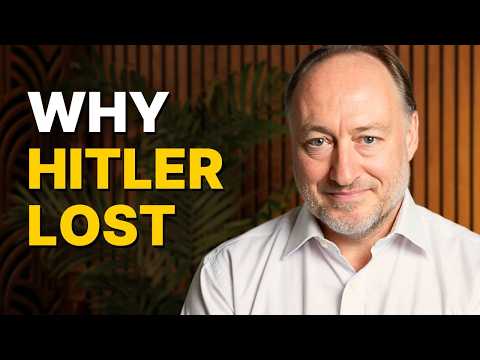
Andrew Roberts — Why Hitler lost WWII, Churchill as applied historian, & Napoleon as startup founder
Andrew Roberts (guest), Dwarkesh Patel (host), Narrator
In this episode of Dwarkesh Podcast, featuring Andrew Roberts and Dwarkesh Patel, Andrew Roberts — Why Hitler lost WWII, Churchill as applied historian, & Napoleon as startup founder explores applied history, nuclear taboos, and startup-style generals reshape war Dwarkesh Patel interviews historian and peer Andrew Roberts about his new book *Conflict* (co‑authored with Gen. David Petraeus), exploring how warfare has evolved from 1945 to Ukraine and beyond. They discuss why the first half of the 20th century was catastrophically violent while the second half avoided great‑power war, focusing on nuclear deterrence and key decisions like Truman’s refusal to use atomic weapons in Korea.
Applied history, nuclear taboos, and startup-style generals reshape war
Dwarkesh Patel interviews historian and peer Andrew Roberts about his new book *Conflict* (co‑authored with Gen. David Petraeus), exploring how warfare has evolved from 1945 to Ukraine and beyond. They discuss why the first half of the 20th century was catastrophically violent while the second half avoided great‑power war, focusing on nuclear deterrence and key decisions like Truman’s refusal to use atomic weapons in Korea.
Roberts outlines the four tenets of strategic leadership, contrasts effective and failed wartime leaders (from Zelenskyy, Churchill, and Napoleon to Maliki, Karzai, and Hitler), and examines how democracies versus dictatorships fight and start wars. They also cover Ukraine, Israel–Gaza, deterrence against China over Taiwan, and how drones, AI, and tech entrepreneurs like Elon Musk are transforming modern conflict.
The conversation then turns to Roberts’s major biographies of Churchill and Napoleon: Churchill as an ‘applied historian’ who used the past to guide grand strategy, and Napoleon as a hyper-competent, tech‑obsessed operator whose mindset resembles that of a modern Silicon Valley founder. Roberts closes with personal reflections on discipline, time management, and why biography is a powerful way to understand history and human agency.
Key Takeaways
Nuclear weapons have constrained great‑power war by forcing limited conflicts.
Roberts argues the ‘luck’ of the latter 20th century is largely explained by the nuclear taboo; leaders repeatedly chose restraint because full escalation risked planetary destruction, a qualitatively different calculation from pre‑1914 arms races.
Get the full analysis with uListen AI
Strategic leadership matters more than raw numbers, weapons, or cities held.
From the Chinese Civil War to Ukraine, Roberts and Petraeus find that victors typically have leaders who (1) get the big idea right, (2) communicate it, (3) implement it aggressively, and (4) continuously adapt it—often beating materially stronger opponents.
Get the full analysis with uListen AI
Bad post‑war planning can squander military victories.
In Iraq, U. ...
Get the full analysis with uListen AI
Deterrence works on rational actors but fails on apocalyptic or absolutist ones.
Roberts distinguishes between actors like Xi Jinping—who update on costs, coalitions, and U. ...
Get the full analysis with uListen AI
Democracies are generally better at winning wars; dictatorships at starting them.
Authoritarian regimes can launch surprise attacks (Barbarossa, Pearl Harbor, Yom Kippur, Hamas 10/7), but their centralized, ideology‑driven decision-making often produces catastrophic strategic errors, whereas democracies benefit from contentious but corrective debate.
Get the full analysis with uListen AI
Future wars will be increasingly automated, data‑driven, and morally disquieting.
Roberts foresees engagements dominated by swarms of autonomous drones and AI systems operating faster than human reaction times, with humans ‘on the loop’ rather than ‘in the loop’—raising questions about control, jamming, and machines that lack conscience.
Get the full analysis with uListen AI
Applied history and biography can sharpen modern strategic judgment.
Churchill’s intensive study of earlier wars directly informed his WWII decisions, and Roberts defends biography as a way to understand how individual choices—Hitler’s ideology, Stalin’s late‑war pragmatism, Zelenskyy’s resolve—redirect vast historical forces.
Get the full analysis with uListen AI
Notable Quotes
““History was a constant echo for him, it gave him endless signposts.””
— Andrew Roberts, on Winston Churchill
““If MacArthur had used nuclear weapons… he might well have actually won that war, but it would have lowered the moral barrier so significantly that nuclear weapons would have been used an awful lot more.””
— Andrew Roberts
““In the future, war will be fought between two sets of drones, and the humans won’t be in the loop because decision-making has to take place far, far faster than the human mind can work.””
— Andrew Roberts
““Hitler again and again put his Nazi ideology before the strategic best interests of the German Reich.””
— Andrew Roberts
““Because we recognize that the skills you need in peace are completely different from the ones you need in war.””
— Andrew Roberts, on why democracies vote out victorious wartime leaders
Questions Answered in This Episode
If nuclear weapons have constrained great‑power war, how should policymakers balance strengthening deterrence with reducing long‑term nuclear risk?
Dwarkesh Patel interviews historian and peer Andrew Roberts about his new book *Conflict* (co‑authored with Gen. ...
Get the full analysis with uListen AI
How can modern democracies deliberately cultivate the kind of strategic leadership Roberts describes, rather than relying on historical ‘luck’ in who emerges?
Roberts outlines the four tenets of strategic leadership, contrasts effective and failed wartime leaders (from Zelenskyy, Churchill, and Napoleon to Maliki, Karzai, and Hitler), and examines how democracies versus dictatorships fight and start wars. ...
Get the full analysis with uListen AI
At what point does incremental, ‘piecemeal’ military aid—like in Ukraine—become strategically self‑defeating compared to early, decisive support?
The conversation then turns to Roberts’s major biographies of Churchill and Napoleon: Churchill as an ‘applied historian’ who used the past to guide grand strategy, and Napoleon as a hyper-competent, tech‑obsessed operator whose mindset resembles that of a modern Silicon Valley founder. ...
Get the full analysis with uListen AI
How should societies govern and ethically constrain autonomous weapons systems once human reaction times are no longer competitive on the battlefield?
Get the full analysis with uListen AI
To what extent should contemporary leaders consciously emulate ‘applied historians’ like Churchill and Napoleon, versus distrusting historical analogies in a rapidly changing technological world?
Get the full analysis with uListen AI
Transcript Preview
One of the reasons I’m proud to be a historian is that Churchill was one. History was a constant echo for him, it gave him endless signposts.
In the startup community, there is a cult of Napoleon that- that has slowly emerged.
Is there? I didn’t know that. Seriously, is there?
Your biography is- is part of the canon here.
(laughs) If MacArthur had used nuclear weapons against the Chinese crossing the Yalu River, then yes, he might well have actually won that war, but it would have lowered the- the moral barrier so significantly that nuclear weapons would have been used an awful lot more. In the future, war will be fought between two sets of drones, and the humans won’t be in the loop because decision-making has to take place far, far faster than the human mind can work.
Today, I have the pleasure of speaking with Andrew Roberts, who is most recently the author of Conflict: The Evolution of Warfare from 1945 to Ukraine. And, um, this book is like Churchill’s, uh, histories of the Second World War, the First World War, in that one of the principal actors in the conflicts discussed here is the co-author, General David Petraeus, who commanded the, uh, US forces in Afghanistan and Iraq as one of your co-authors. And speaking of Churchill, uh, Andrew is also the author of some superb and magnificent biographies of Churchill, Napoleon, King George, and an excellent book about World War II. But first, let’s begin with Conflict. Andrew, welcome to the podcast.
Thank you very much indeed, Dwarkesh. It’s a, uh, honor to be on your show.
So my first question is this: when we look at the first half of the 20th century, it seems like we got unlucky many times in a row, you- you know, World War I, World War II, the Bolshevik Revolution in Russia, the Maoist revolution in China. All those things, um, seem like they didn’t have to happen from reading historians about those topics, that if you reversed a bunch of contingent factors a few years back, they- any one of them could have not happened. And in each of those cases, tens of millions of people died. When we look at the second half of the 20th century, which you write about in these books, it seems like we got lucky again and again, right? So the Cuban Missile Crisis doesn’t go nuclear. We have all these proxy wars that don’t go nuclear or result in a world war. China and India liberalize. Communism falls. What explains why we had such different luck in these two different parts of the century?
Um, the invention of the nuclear bomb.
(laughs)
Uh, it’s- it’s- it’s pretty much as easy as that. You have all of these wars take place in the post-nuclear age after 1945, and so as a result, you have an umbrella under which everybody acts. But although there are hundreds of wars that break out, about 140 wars, they have to be fought in a essentially limited way because of the, uh, existence of nuclear weapons.
Install uListen to search the full transcript and get AI-powered insights
Get Full TranscriptGet more from every podcast
AI summaries, searchable transcripts, and fact-checking. Free forever.
Add to Chrome