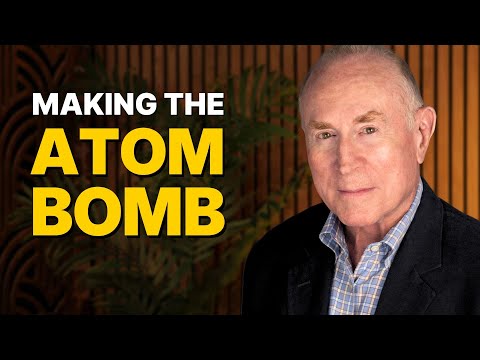
Richard Rhodes — The making of the atomic bomb
Richard Rhodes (guest), Dwarkesh Patel (host), Narrator
In this episode of Dwarkesh Podcast, featuring Richard Rhodes and Dwarkesh Patel, Richard Rhodes — The making of the atomic bomb explores richard Rhodes on nuclear weapons, deterrence, and unintended consequences explored Pulitzer-winning historian Richard Rhodes discusses the scientific, political, and moral history of the atomic and hydrogen bombs, from early nuclear physics to the Manhattan Project and the Cold War arms race.
Richard Rhodes on nuclear weapons, deterrence, and unintended consequences explored
Pulitzer-winning historian Richard Rhodes discusses the scientific, political, and moral history of the atomic and hydrogen bombs, from early nuclear physics to the Manhattan Project and the Cold War arms race.
He explains why the bomb was effectively inevitable once fission was understood, how deterrence theory emerged even before the Manhattan Project, and why thermonuclear weapons represent a true escalation beyond Hiroshima and Nagasaki.
Rhodes traces how institutional incentives, bureaucratic rivalry, and misperceptions shaped nuclear strategy, proliferation, and overkill, while also emphasizing how nuclear weapons paradoxically limited great-power war.
He closes by warning that as long as any country holds nuclear weapons, the risk of use—whether through miscalculation, malfunction, or new doctrines like Putin’s—is unacceptably high.
Key Takeaways
Once fission was understood, the bomb was essentially inevitable.
Across major powers, competent physicists quickly recognized that uranium-235’s chain reaction could yield a compact, city-destroying device; absent WWII the timeline might have stretched, but not the outcome.
Get the full analysis with uListen AI
The hardest part of building a bomb is acquiring fissile material, not design.
Rhodes stresses that simple configurations of highly enriched uranium can yield substantial nuclear yield; the true barrier is industrial-scale enrichment or plutonium production, which remains nation‑state–level hard.
Get the full analysis with uListen AI
Hydrogen bombs are a categorical, not just incremental, escalation.
Where Hiroshima was ~15 kilotons, thermonuclear devices reach tens of megatons, with fireballs miles across and global climatic effects; in many modern weapons, the Hiroshima-class fission device is just a trigger.
Get the full analysis with uListen AI
Deterrence emerged conceptually even before the Manhattan Project.
Early British reports in 1940 already concluded that the only real protection from an atomic bomb was the threat of retaliation with a comparable one—anticipating Cold War nuclear deterrence before any weapon existed.
Get the full analysis with uListen AI
Bureaucratic and service rivalries massively amplified arsenals.
Postwar, the U. ...
Get the full analysis with uListen AI
Non-proliferation has been more successful than many predicted.
Countries like Sweden, Japan, and South Korea explored nuclear weapons but ultimately stopped, trading bombs for U. ...
Get the full analysis with uListen AI
Current nuclear risk is shaped by new doctrines and fragile systems.
Rhodes is particularly worried about strategies like Pakistan’s and Putin’s—using nuclear arsenals to shield conventional aggression—and notes that any complex weapons system will eventually malfunction, keeping the risk of use significantly above zero.
Get the full analysis with uListen AI
Notable Quotes
“You can make a pretty high-level nuclear explosion just by taking two subcritical pieces of uranium. And all this business about secret designs and so forth is hogwash.”
— Richard Rhodes
“As long as any country in the world has nuclear weapons, we're going to continue to be [in a precarious place]. That has been the price of nuclear deterrence.”
— Richard Rhodes
“For the first time in the history of the world, war became something that was historical rather than universal.”
— Richard Rhodes
“Robert Oppenheimer was the best lab director I ever knew.”
— Edward Teller (as recounted by Richard Rhodes
“All you have to do if someone starts showing signs of smallpox is vaccinate everyone around him and make sure they don't go anywhere for a while, and the disease can't spread.”
— Richard Rhodes
Questions Answered in This Episode
If deterrence can, in principle, be maintained with knowledge and latent capacity instead of deployed warheads, what practical path—technical and political—could move nuclear states in that direction?
Pulitzer-winning historian Richard Rhodes discusses the scientific, political, and moral history of the atomic and hydrogen bombs, from early nuclear physics to the Manhattan Project and the Cold War arms race.
Get the full analysis with uListen AI
How should we reinterpret the end of World War II in light of Rhodes’s argument that Soviet entry into the war against Japan was at least as decisive as the atomic bombings?
He explains why the bomb was effectively inevitable once fission was understood, how deterrence theory emerged even before the Manhattan Project, and why thermonuclear weapons represent a true escalation beyond Hiroshima and Nagasaki.
Get the full analysis with uListen AI
What concrete lessons from the Manhattan Project and early nuclear governance should AI researchers and policymakers adopt—and which analogies are dangerously misleading?
Rhodes traces how institutional incentives, bureaucratic rivalry, and misperceptions shaped nuclear strategy, proliferation, and overkill, while also emphasizing how nuclear weapons paradoxically limited great-power war.
Get the full analysis with uListen AI
Given Rhodes’s account of bureaucratic incentives driving nuclear overkill, how can modern democracies design institutions that don’t reward arms racing in new domains like cyber or AI-enabled weapons?
He closes by warning that as long as any country holds nuclear weapons, the risk of use—whether through miscalculation, malfunction, or new doctrines like Putin’s—is unacceptably high.
Get the full analysis with uListen AI
Is there a credible route for non-nuclear powers to gain long-term security without relying on another country’s nuclear umbrella, or does the current system lock them into permanent dependence?
Get the full analysis with uListen AI
Transcript Preview
By 1945, we were so pissed off at the Japanese. We had destroyed their air force, we had destroyed their navy, we had destroyed their army, and yet they wouldn't surrender.
The people who are working on AI right now, they are huge fans of yours. The way they see the progress in the field is exactly like when they start reading this book.
Oppenheimer's worst enemy said to me, "Robert Oppenheimer was the best lab director I ever knew." And then he chased me out of the house.
(laughs)
So... (laughs) You can make a pretty high-level nuclear explosion just by taking two subcritical pieces of uranium. And all this business about secret designs and so forth is, is hogwash. We're still in a very precarious place. And as long as any country in the world has nuclear weapons, we're going to continue to be. That has been the price of nuclear deterrence.
Okay. Today, I have the great honor of interviewing Richard Rhodes, who is the Pulitzer Prize-winning author of The Making of the Atomic Bomb, and most recently, the author of Energy: A Human History. I'm really excited about this one. Um, let's jump in actually at a current event, which is the fact that there's a mo- new movie about Oppenheimer coming out, which I understand you've been consulted about. What did you think of the trailer? What, what are your impressions?
They've really done a good job, I think, of things like the Trinity test device, which was this sphere covered with cables of various kinds. (laughs) And, you know, I had watched Peaky Blinders, uh, where the actor who's playing Oppenheimer also appeared, and he looks so much like Oppenheimer to start with. (laughs)
(laughs)
Oppenheimer was about six feet tall. He was rail-thin, not, not simply in terms of weight, but in terms of structure. They, someone said he could sit in a children's high chair comfortably. So he, but he never weighed more than about 140 pounds.
Wow.
And, and, and that quality is there in the actor, I think. So who knows? It all depends on, on how the director, uh, decided to tell the story. There are so many aspects of the story, you could never possibly squeeze them into one two-hour movie. I think that, uh, we're waiting for the multi-part series that would really tell the, a lot more of the story, not the whole story.
Mm-hmm.
But it looks exciting. Uh, we'll see. There've been some terrible depictions of Oppenheimer, (laughs) been some terrible depictions of the bomb program, and, uh, maybe they'll get this one right.
Yeah. Yeah, hopefully. You know, it is always great when you get an actor who resembles, resembles their role so well. The, Bryan Cranston, for example, who played LBJ, and they have the same physical characteristics of the beady eyes, the big ears. But it, okay, so in, in the case of Oppenheimer, one question I had, since we're talking about him, I understand that there's evidence that's come out that he wasn't a Communist spy, or he wasn't directly a Communist spy. But is there any possibility that he was leaking information to the Soviets, or in some way helping the Soviet program? He was a Communist sympathizer, right?
Install uListen to search the full transcript and get AI-powered insights
Get Full TranscriptGet more from every podcast
AI summaries, searchable transcripts, and fact-checking. Free forever.
Add to Chrome