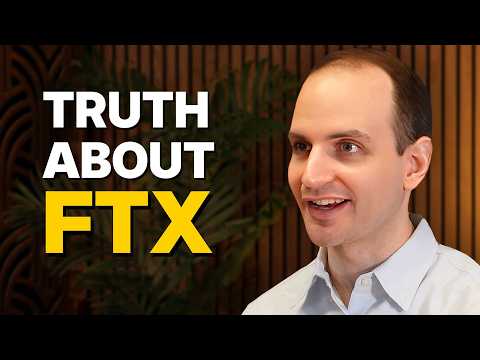
Brett Harrison — FTX US former president speaks out
Brett Harrison (guest), Dwarkesh Patel (host), Narrator, Narrator
In this episode of Dwarkesh Podcast, featuring Brett Harrison and Dwarkesh Patel, Brett Harrison — FTX US former president speaks out explores inside FTX: Brett Harrison on Sam, dysfunction, and rebuilding crypto Brett Harrison, former president of FTX US and ex-Citadel/Jane Street executive, recounts how he joined FTX, what he observed internally, and why he ultimately resigned months before the collapse. He describes a technically strong but dangerously centralized codebase, an organization dominated by a tiny Bahamas-based inner circle, and a CEO increasingly consumed by PR and politics rather than management. Harrison details his attempts to push for governance, staffing, and structural reforms, the hostile response to his ultimatum letter, and how the subsequent fraud revelations blindsided him despite serious organizational red flags. He also explains his new company, Architect, which aims to provide unified, institution-grade infrastructure for trading across centralized and decentralized digital asset venues.
Inside FTX: Brett Harrison on Sam, dysfunction, and rebuilding crypto
Brett Harrison, former president of FTX US and ex-Citadel/Jane Street executive, recounts how he joined FTX, what he observed internally, and why he ultimately resigned months before the collapse. He describes a technically strong but dangerously centralized codebase, an organization dominated by a tiny Bahamas-based inner circle, and a CEO increasingly consumed by PR and politics rather than management. Harrison details his attempts to push for governance, staffing, and structural reforms, the hostile response to his ultimatum letter, and how the subsequent fraud revelations blindsided him despite serious organizational red flags. He also explains his new company, Architect, which aims to provide unified, institution-grade infrastructure for trading across centralized and decentralized digital asset venues.
Key Takeaways
Concentrated technical control is a massive organizational risk.
At FTX, 90%+ of the core code was written by two developers, making the system effectively dependent on a couple of people and almost impossible for others to audit, extend, or safely maintain—exactly the opposite of robust, scalable financial infrastructure.
Get the full analysis with uListen AI
Charismatic PR can mask deep governance and management failures.
Sam Bankman-Fried’s constant media presence and cultivated ‘boy-genius’ image created a reputational flywheel with journalists, investors, and politicians, which helped obscure internal dysfunction, neglect of day-to-day management, and resistance to basic organizational reforms.
Get the full analysis with uListen AI
Red flags in management don’t automatically imply fraud—but they matter.
Harrison repeatedly raised concerns about under-staffing, centralization in the Bahamas, and Sam’s inattention; while he did not infer fraud, he concluded he couldn’t fulfill his responsibilities under those conditions and chose to document his concerns and resign.
Get the full analysis with uListen AI
Even sophisticated insiders can’t easily detect well-concealed financial misconduct.
Given falsified internal records, audited financials, and strong apparent revenue from observable trading volumes, Harrison argues it would have required distrusting auditors, investors, and public data simultaneously to suspect a hidden hole—underscoring the limits of individual due diligence inside a deceptive organization.
Get the full analysis with uListen AI
Crypto market structure remains immature compared to traditional finance.
Despite some exchanges (like FTX) offering relatively clean APIs and margining systems, Harrison notes that many venues have inconsistent behaviors, slow or opaque settlement, and fragmented liquidity—leaving room for dedicated infrastructure providers like Architect.
Get the full analysis with uListen AI
Regulatory engagement and market design innovation can coexist in crypto.
Harrison still views ideas like 24/7 auto‑margining and cross‑collateralization under CFTC oversight as valuable evolutions of derivatives markets, even though FTX’s failure has politically set them back and highlighted the need for independent governance and risk controls.
Get the full analysis with uListen AI
Crypto as an asset class is likely durable, regardless of FTX.
He emphasizes that major trading firms and banks continue to build in crypto, and that his new venture is premised less on price predictions and more on the structural fact that a large, global digital-asset market now exists and needs safer, more professional tooling.
Get the full analysis with uListen AI
Notable Quotes
“It felt like he was spending virtually no time helping the company move forward. It was so much about image and brand and PR.”
— Brett Harrison on Sam Bankman-Fried’s focus as FTX grew
“You are probably gonna be fired for this letter that you wrote. Sam is gonna destroy your professional reputation. Where do you think you're gonna be able to work after FTX?”
— Brett Harrison, recounting what a senior colleague told him after his ultimatum to SBF
“Ninety-plus percent of all the code of FTX was written by these two people… if Gary got hit by a bus… FTX is done.”
— Brett Harrison on FTX’s engineering concentration risk
“Media was primed for the archetype that was Sam… and it all sort of fed into this flywheel of building up Sam's image over time in a way that didn't necessarily need to match the underlying reality.”
— Brett Harrison on SBF’s reputation and media dynamics
“When you have a very small group of individuals who intentionally put forth schemes that deceive employees, investors, and auditors, what can you do?”
— Brett Harrison on the difficulty of detecting the fraud from inside
Questions Answered in This Episode
Given what Brett observed, what concrete governance or board structures could realistically have constrained FTX’s inner circle before the collapse?
Brett Harrison, former president of FTX US and ex-Citadel/Jane Street executive, recounts how he joined FTX, what he observed internally, and why he ultimately resigned months before the collapse. ...
Get the full analysis with uListen AI
How should senior hires in high-growth startups adjust their personal due diligence when founders insist on unusually centralized control?
Get the full analysis with uListen AI
What balance should crypto exchanges strike between aggressive marketing/PR and conservative, boring operational focus—and how can outsiders tell which side they’re on?
Get the full analysis with uListen AI
Does Architect’s model meaningfully reduce custody and counterparty risk for users compared to holding assets directly on centralized exchanges?
Get the full analysis with uListen AI
In light of FTX, should regulators re-think how quickly they permit novel market structures like auto‑liquidation and cross‑margining, or did the FTX case mostly expose governance rather than design flaws?
Get the full analysis with uListen AI
Transcript Preview
You are probably gonna be fired for this letter that you wrote. Sam is gonna destroy your professional reputation. Like, where do you think you're gonna be able to work after FDX? It, it was, he was threatening me. (screen whooshes) When I knew Sam, when he was 21, 22 years old, he was, like, a happy, healthy-looking kid. When I got to FDX, I saw someone who was very different than that person I remembered. And it felt like he was spending virtually no time helping the company move forward. It was so much about image and brand and PR. Media was primed for the archetype that was Sam. Doesn't matter how little time he spent with the company, doesn't matter how he treated employees internally. Architect, it makes it really easy to access kind of all corners of the digital asset ecosystem. (screen whooshes)
Okay, today I have the pleasure of speaking with Brett Harrison, who is now the founder of Architect, which provides traders with infrastructure for accessing digital markets. Before that, he was the president of FTX US, and before that he was the head of ETF technology at Citadel, and he has a large amount of experience in leadership positions in finance and tech, so this is gonna be a very interesting conversation. Thanks for coming on to Lunar Society, Brett.
Yeah, thanks for, uh, coming out to Chicago.
Yeah, (laughs) my pleasure, my pleasure. Is the growth of ETFs a good thing for the health of markets? There's one view that as there's more passive investing, you're kind of diluting the power of smart money, and in fact, what these active investors are doing with their fees is subsidizing the price discovery that makes markets efficient, and with passive investing, you're sort of free-riding off of that. Um, you were head of ETF technology at Citadel, so you're the perfect person to ask this. Is it bad that there's so much passive investing?
I think on net it's good. I think that most investors in the market shouldn't be trying to pick individual stock names, and the best thing people can do is invest in sort of diversified instruments. And it is far, far, far less expensive to invest in, like, indices now than it ever was in, in history because of the advent of ETFs.
Yeah. And so maybe it's good for individual investors to put their money in passives, uh, uh, investments, but what about, like, the health of the market as a whole? Is it hampered by how much money goes into passive investments?
Uh, it's hard to, it's hard to be able to tell what it would look like if there was less money in passive investment now.
Yeah.
I, I do think one of the potential downsides is ending up creating extra-correlated activity between instruments purely by virtue of them being included in index products.
Mm-hmm.
Uh, so, you know, if, like, when Tesla gets added to the S&P 500, like, Tesla doesn't, like, suddenly become a different company-
Install uListen to search the full transcript and get AI-powered insights
Get Full TranscriptGet more from every podcast
AI summaries, searchable transcripts, and fact-checking. Free forever.
Add to Chrome