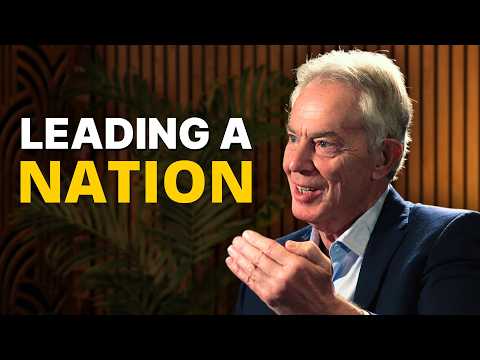
Tony Blair — Why political leaders keep failing at major change
Dwarkesh Patel (host), Tony Blair (guest)
In this episode of Dwarkesh Podcast, featuring Dwarkesh Patel and Tony Blair, Tony Blair — Why political leaders keep failing at major change explores tony Blair explains why political leaders rarely deliver real change Tony Blair argues that modern leaders fail at major change because they enter office as great persuaders but lack the executive skills, policy depth, and focus needed to govern effectively. Government systems aren’t a left- or right-wing conspiracy, he says, but a “conspiracy for inertia” and distraction that pushes politicians toward short-term politics over long-term policy. Blair stresses that real transformation requires clear prioritization, high‑quality teams, deep intellectual work on policy design, and the courage to withstand criticism and vested interests. He repeatedly highlights the AI and broader tech revolution as the central, underappreciated challenge that will reshape governance, public services, and geopolitics.
Tony Blair explains why political leaders rarely deliver real change
Tony Blair argues that modern leaders fail at major change because they enter office as great persuaders but lack the executive skills, policy depth, and focus needed to govern effectively. Government systems aren’t a left- or right-wing conspiracy, he says, but a “conspiracy for inertia” and distraction that pushes politicians toward short-term politics over long-term policy. Blair stresses that real transformation requires clear prioritization, high‑quality teams, deep intellectual work on policy design, and the courage to withstand criticism and vested interests. He repeatedly highlights the AI and broader tech revolution as the central, underappreciated challenge that will reshape governance, public services, and geopolitics.
Key Takeaways
Winning elections and governing well demand very different skill sets.
Campaigning rewards persuasion, messaging, and opposition; effective governance requires CEO-like skills—focus, prioritization, team-building, and execution—which many leaders never develop, leading to underperformance once in office.
Get the full analysis with uListen AI
Government systems naturally resist change, so leaders must be unusually forceful and selective.
Blair describes the state as a “conspiracy for inertia” and a “conspiracy of distraction”; only leaders who ruthlessly prioritize, insist on quality people in key roles, and push through vested interests can overcome this structural drag.
Get the full analysis with uListen AI
Ambitions are not policies; real change requires hard intellectual work.
Most leaders articulate high-level aspirations but fail to translate them into detailed, workable policies; Blair argues that policymaking is an intensely intellectual endeavor and that without this work, visions stay as slogans.
Get the full analysis with uListen AI
AI and the tech revolution must become governments’ central strategic focus, not a side issue.
Blair contends AI is the biggest technological shift since the Industrial Revolution and will transform economies, public services, and security; current governments are unprepared for an AI-driven crisis and lack necessary technical understanding.
Get the full analysis with uListen AI
Effective public policy often requires deep partnership with the private and expert sectors.
From COVID vaccines to AI risk, Blair argues governments should rely on private-sector and technical experts for solutions and options, while retaining responsibility for value-laden decisions such as regulation, trade-offs, and lockdowns.
Get the full analysis with uListen AI
Leadership and governance quality can decisively change a country’s trajectory.
Using cases like Lee Kuan Yew’s Singapore, Deng’s China, Poland vs. ...
Get the full analysis with uListen AI
The modern state should be redesigned to be more strategic and innovation‑driven.
Blair advocates “reimagining the state” so that government sets frameworks and enables competition and technological adoption—e. ...
Get the full analysis with uListen AI
Notable Quotes
“The problem with government is that it’s not a conspiracy of the left or right; it’s a conspiracy for inertia.”
— Tony Blair
“When you decide, you divide.”
— Tony Blair
“Ambitions in politics are very easy to have because they’re just general expressions of good intention. The problem comes when you try to turn those into policies.”
— Tony Blair
“Politics at one level is very crude… but when it comes to policy, it’s a really intellectual business.”
— Tony Blair
“If you don’t have the time to get the right answer, you are going to fail, because in the end you won’t have the right policy.”
— Tony Blair
Questions Answered in This Episode
How can political systems be redesigned to reward long-term policymaking over short-term political theater?
Tony Blair argues that modern leaders fail at major change because they enter office as great persuaders but lack the executive skills, policy depth, and focus needed to govern effectively. ...
Get the full analysis with uListen AI
What concrete structures or institutions would best bridge the gap between AI ‘changemakers’ and government policymakers?
Get the full analysis with uListen AI
If governments are inherently inertial, what practical steps can citizens or civil society take to push leaders toward serious reform rather than mere ambition?
Get the full analysis with uListen AI
How far should democratic states go in partnering with large technology firms on critical public functions like healthcare, education, and security?
Get the full analysis with uListen AI
Given the mixed performance during COVID, what specific reforms would be needed to ensure governments can competently handle an AI-related global crisis?
Get the full analysis with uListen AI
Transcript Preview
Today, I have the pleasure of speaking with Tony Blair, who was, of course, Prime Minister of the UK from 1997 to 2007, and now leads the Tony Blair Institute, which advises dozens of governments on improving governance, reform, adding technology. My first question, I wanna go back to your time in office, and when you first got in, you had these large majorities, what are the constraints on a prime minister, despite the fact that they have these large majorities? Is it your- the other members of your party are fighting against you? Is it the deep state? Like, what part w- is constraining you at that point?
The biggest constraint is the politics, and in particular, the political leadership's probably the only walk of life in which someone is put into an immensely powerful and important position with absolutely zero-
(laughs)
... (laughs) qualifications or experience. I mean, I'd never had a ministerial appointment before.
Mm-hmm.
I- my, my one and only was being prime minister, which, you know, is great if you want to start at the top, but it, it's, uh, it's that that's most difficult. So you come in, and you're often, you often come in as... When you're running for office, you have to be the great persuader. The moment you get into office, you really have to be the great chief executive, and those two skill sets are completely different. And a lot of political leaders fail because they've failed to make the transition. And, you know, that, those executive skills, which are about focus, prioritization, good policy, building the right team of, of people who can actually help you govern, um, because the moment you become the government, you end up leaving aside the saying becomes less important-
Mm-hmm.
... than the doing, whereas when you're in opposition, you're running for office, so it's all about saying.
Yeah.
So all of these things mean that it's a much more difficult, much more focused, and, um, you know, it's, it's suddenly, you're thrust into this completely new environment when you come in, and that's what makes it... That's the hardest thing. And then, of course, you know, you, you do have a situation in which the system, as a system, it's not that it's a con- it, it, I, I'm not a believer that there's this great deep state theory.
(laughs)
We can talk about that, but that's not the problem with government. The problem with government is that it's not a conspiracy, either left wing or right wing, it's a conspiracy for inertia. The thing about s- government systems is that they always think, "We're permanent, you, you've come in as the elected politician, you're temporary," and-
Mm-hmm.
... you know, "We know how to do this. And if you only just let us alone, we would carry on managing the status quo in the right way."
Yeah.
Install uListen to search the full transcript and get AI-powered insights
Get Full TranscriptGet more from every podcast
AI summaries, searchable transcripts, and fact-checking. Free forever.
Add to Chrome