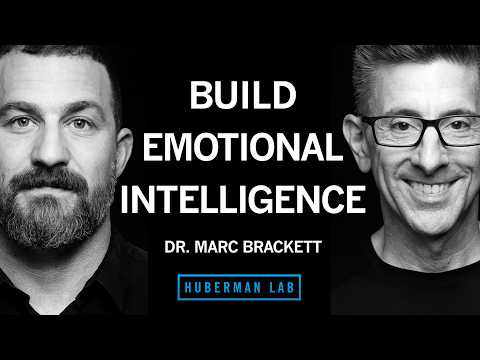
How to Better Regulate Your Emotions | Dr. Marc Brackett
Dr. Marc Brackett (guest), Andrew Huberman (host)
In this episode of Huberman Lab, featuring Dr. Marc Brackett and Andrew Huberman, How to Better Regulate Your Emotions | Dr. Marc Brackett explores emotion regulation tools: mindset, labeling, co-regulation, and Meta-Moment practice Emotion regulation is reframed as changing your relationship to emotions—using them wisely toward goals—rather than trying to eliminate feelings like anxiety or anger.
Emotion regulation tools: mindset, labeling, co-regulation, and Meta-Moment practice
Emotion regulation is reframed as changing your relationship to emotions—using them wisely toward goals—rather than trying to eliminate feelings like anxiety or anger.
Brackett emphasizes that emotions aren’t “good” or “bad,” but their expression must be calibrated to person and context; rigid mindsets (“anxiety is bad,” “vulnerability is weak”) fuel dysregulation.
A core skill is precision: building emotional vocabulary (e.g., stress vs pressure vs fear vs anxiety) to improve strategy choice, communication, and getting needs met.
Effective regulation relies on deliberate pauses (the “Meta-Moment”), combined with strategies such as mindfulness/meditation for stress tolerance, cognitive reframing, and seeking social support.
The conversation highlights systemic emotion-skills training in schools and leadership culture, critiques “quick-fix” emotional content online, and warns about social disconnection and AI-as-therapist trends.
Key Takeaways
Regulation is not removal; it’s a different relationship to the feeling.
Brackett argues people misinterpret regulation as “getting rid of” anxiety or anger; often the healthiest move is acknowledging it (“hello, anxiety”) and choosing how to respond rather than trying to erase it.
Get the full analysis with uListen
Use goals to guide regulation (PRIME) rather than reacting automatically.
PRIME frames regulation goals as Prevent, Reduce, Initiate, Maintain, and Enhance emotions, helping people decide what they’re trying to accomplish before selecting tactics.
Get the full analysis with uListen
Strategy choice depends on emotion, person, and context—not a single universal fix.
Brackett rejects “the one strategy that works,” emphasizing that what helps anxiety may not help anger, and what works alone may fail in a meeting, classroom, or family setting.
Get the full analysis with uListen
Adopt a “no bad emotions” mindset while keeping expression context-specific.
Anxiety can signal what matters; anger can signal injustice; happiness can be healthy but problematic if pursued rigidly—what matters is intensity, duration, and situational fit.
Get the full analysis with uListen
Build emotional vocabulary to improve outcomes and reduce miscommunication.
Distinguishing fear (immediate danger), stress (too many demands/too few resources), pressure (stakes depend on performance), and anxiety (uncertainty about the future) clarifies what you need and which tool to use.
Get the full analysis with uListen
The Meta-Moment creates the space to respond as your “best self.”
The practice is pause + breath + envision the best version of yourself in that role (parent/partner/leader) + act through that lens, shifting from habitual reactions to deliberate responses.
Get the full analysis with uListen
Vulnerability is most helpful when paired with a strategy, not just “emotion dumping.”
Brackett models sharing difficult feelings while also sharing what you’re doing about them, which signals capability and teaches others regulation rather than spreading dysregulation.
Get the full analysis with uListen
Notable Quotes
“A lot of people think emotion regulation is getting rid of a feeling. It's not what it is. It's just having another relationship to it.”
— Dr. Marc Brackett
“You’d become psychotic if you did that all day long.”
— Dr. Marc Brackett
“There are no bad emotions. It's what we do with our emotions that makes them harmful or difficult for us to live our lives.”
— Dr. Marc Brackett
“We have to move from automatic, habitual, unhelpful reactions to deliberate, conscious, helpful responses.”
— Dr. Marc Brackett
“Vulnerability… is not helpful when it's not accompanied by the strategy.”
— Dr. Marc Brackett
Questions Answered in This Episode
How do you decide, in real time, whether the right PRIME goal is Reduce vs Maintain vs Initiate an emotion (especially in high-stakes conversations)?
Emotion regulation is reframed as changing your relationship to emotions—using them wisely toward goals—rather than trying to eliminate feelings like anxiety or anger.
Get the full analysis with uListen AI
In the Meta-Moment, what are concrete prompts for defining “best self” without turning it into perfectionism or emotional suppression?
Brackett emphasizes that emotions aren’t “good” or “bad,” but their expression must be calibrated to person and context; rigid mindsets (“anxiety is bad,” “vulnerability is weak”) fuel dysregulation.
Get the full analysis with uListen AI
How can schools teach emotion skills rigorously without drifting into “constant check-ins” that become rumination or performative sharing?
A core skill is precision: building emotional vocabulary (e. ...
Get the full analysis with uListen AI
Where’s the boundary between healthy reframing and self-gaslighting—what warning signs should people watch for?
Effective regulation relies on deliberate pauses (the “Meta-Moment”), combined with strategies such as mindfulness/meditation for stress tolerance, cognitive reframing, and seeking social support.
Get the full analysis with uListen AI
Brackett says boys often suppress while girls often ruminate; what specific interventions best reduce each pattern without pushing kids into the other extreme?
The conversation highlights systemic emotion-skills training in schools and leadership culture, critiques “quick-fix” emotional content online, and warns about social disconnection and AI-as-therapist trends.
Get the full analysis with uListen AI
Transcript Preview
A lot of people think emotion regulation is getting rid of a feeling. It's not what it is. It's just having another relationship to it. I've had anxiety or lived with it for a lot of my life, but sometimes I just say hello to it. It's like, "Hey, how you doing today?" And it goes away pretty quickly, or it just sits there. I think that's the other thing about emotion regulation that people kinda misunderstand. They think it's like, "I gotta check in with how I'm feeling all day long and then regulate. Check in, regulate." Like, you'd become psychotic if you did that all day long.
Mm-hmm.
Most of the time, our emotions are in the background. You know, like, if you thought about your feelings all day long, you wouldn't be able to do this podcast. Like, that's unproductive. Emotions matter when there's a shift in our environment or the relationships... You know, if you said something that offended me, boom, I'm activated. I'm feeling angry or kinda shocked. Then I have to make a choice in that moment, like, how do I manage it? That's where the magic happens.
Welcome to the Huberman Lab Podcast, where we discuss science and science-based tools for everyday life. [music] I'm Andrew Huberman, and I'm a professor of neurobiology and ophthalmology at Stanford School of Medicine. My guest today is Dr. Marc Brackett. Dr. Marc Brackett is a professor of psychology at Yale University, where he is also the director of Yale's Center for Emotional Intelligence. He's an expert in the science of emotions and how to apply that to improve communication and relationships and performance in school and work. One common problem around discussions of emotions and emotional intelligence is that they are often vague and, frankly, somewhat soft and cliché, but not when Marc Brackett explains emotional intelligence as he does today because he talks about the practical tools that emerge from the science of emotional intelligence that you can use to improve your emotional life, both with yourself and with others. And he's not just going to tell us to feel our emotions more deeply. While that could be important in certain settings, his research in and out of the laboratory is really focused on the small things that we can all do, both in moments of emotion, but also on our own, that can greatly increase our ability to understand what we're feeling, communicate it effectively, and to be better listeners, especially in moments that would otherwise create tension or confusion. In fact, what he shares today are life skills, the sort of life skills that make everything, school, friendships, romantic relationships, professional life, and family life, far more effective and enriching. So I'm confident that you'll come away from today's episode with Marc Brackett knowing what to do and when to use the tools that you'll learn, and they are indeed very powerful to improve your life. Before we begin, I'd like to emphasize that this podcast is separate from my teaching and research roles at Stanford. It is, however, part of my desire and effort to bring zero cost to consumer information about science and science-related tools to the general public. In keeping with that theme, today's episode does include sponsors. And now for my discussion with Dr. Marc Brackett. Dr. Marc Brackett, welcome.
Install uListen to search the full transcript and get AI-powered insights
Get Full TranscriptGet more from every podcast
AI summaries, searchable transcripts, and fact-checking. Free forever.
Add to Chrome