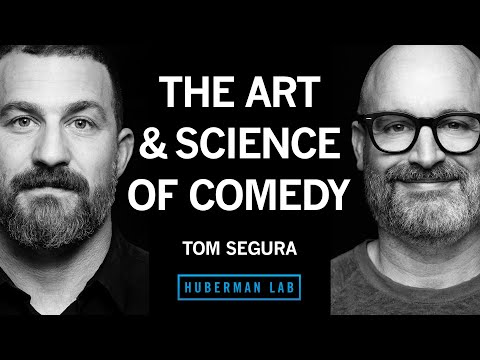
The Science & Art of Comedy & Creativity | Tom Segura
Andrew Huberman (host), Tom Segura (guest)
In this episode of Huberman Lab, featuring Andrew Huberman and Tom Segura, The Science & Art of Comedy & Creativity | Tom Segura explores tom Segura Dissects Comedy, Dark Thoughts, and Creative Brain States Andrew Huberman and comedian Tom Segura explore how neuroscience and psychology intersect with stand-up comedy, creativity, and performance. They connect exercise, arousal, and brain chemistry to creative work, and discuss how state changes before going on stage influence crowd reaction. Segura explains his real writing process, crowd work, and why vulnerability, risk of bombing, and abandoning old material are essential to great stand-up. They also unpack emotional contagion in crowds, the neurobiology of humor, darkness in comedy, and how childhood experiences and insecurity fuel a lifelong obsession with making people laugh.
Tom Segura Dissects Comedy, Dark Thoughts, and Creative Brain States
Andrew Huberman and comedian Tom Segura explore how neuroscience and psychology intersect with stand-up comedy, creativity, and performance. They connect exercise, arousal, and brain chemistry to creative work, and discuss how state changes before going on stage influence crowd reaction. Segura explains his real writing process, crowd work, and why vulnerability, risk of bombing, and abandoning old material are essential to great stand-up. They also unpack emotional contagion in crowds, the neurobiology of humor, darkness in comedy, and how childhood experiences and insecurity fuel a lifelong obsession with making people laugh.
Key Takeaways
Exercise before cognitively demanding work measurably improves mental performance and mood.
Huberman explains that moving large muscle groups (running, lifting, high-intensity intervals) triggers adrenaline, which then signals the vagus nerve and boosts dopamine and norepinephrine in the brain. ...
Get the full analysis with uListen
Segura’s stand-up is built on kernels of ideas, not fully scripted jokes.
Rather than writing long-form jokes word-for-word, Segura captures a core premise (often a single word on a set list) and then builds the bit live on stage. ...
Get the full analysis with uListen
Cutting ties with successful old material is essential for creative evolution.
Segura deliberately retires material once it’s recorded, even when most of his live audiences have never heard it. ...
Get the full analysis with uListen
Audience state and emotional contagion can make or break a show.
Segura prefers to follow a strong comic rather than someone who bombed, because a killing set “warms” the room and puts the crowd into a unified, ready-to-laugh state that he can ride. ...
Get the full analysis with uListen
Humor is processed like taste: fast, involuntary, and hard to rationally change.
Drawing on neuroscience and Segura’s experience, they argue that jokes trigger rapid “yum / yuck / meh” evaluations similar to taste or smell. ...
Get the full analysis with uListen
Using and revealing dark thoughts in art is healthier than repressing them.
Segura argues that channeling dark fantasies or impulses into comedy is a safer, more honest way to deal with the universal “dark side” than pretending it isn’t there. ...
Get the full analysis with uListen
Insecurity, being the “new kid,” and a craving to be liked often drive comics.
Segura moved schools frequently as a child and learned to survive socially by making new classmates laugh. ...
Get the full analysis with uListen
Notable Quotes
“The most elite comics are completely willing to bomb at these workout shows. They know you have to be willing to eat shit to come up with something really good.”
— Tom Segura
“You can joke about whatever you want. What you can’t dictate is how people will react to it.”
— Tom Segura
“Comedy is almost involuntarily subjective. You don’t think your way into a laugh later. Either it hits you in the moment, or it doesn’t.”
— Tom Segura
“If you learn to be vulnerable on stage, your performances will get exponentially better. The audience senses that and will go with you more places.”
— Tom Segura
“So many comics fall under the banner of ‘please like me.’ You just want people to like you. It sounds pathetic, but it’s true.”
— Tom Segura
Questions Answered in This Episode
You described some bits mysteriously ‘dying’ over time even when delivered the same way. If you recorded and analyzed those sets, what specific changes in your own emotional state, timing, or audience composition do you think you’d actually see?
Andrew Huberman and comedian Tom Segura explore how neuroscience and psychology intersect with stand-up comedy, creativity, and performance. ...
Get the full analysis with uListen AI
When you use THC for idea generation, how do you distinguish between thoughts that only feel brilliant when you’re high and those that will truly survive the sober stage test? Have you noticed patterns in what ‘type’ of high ideas tend to work?
Get the full analysis with uListen AI
You emphasized that ultra-clean comics sometimes have the darkest offstage behavior. What’s your framework for drawing a line between using dark thoughts productively in art and potentially normalizing harmful ideas for audiences?
Get the full analysis with uListen AI
Given your belief that humor is like taste—fast and involuntary—how do you think younger comics should respond when their material clashes with evolving cultural norms? Should they adapt their ‘menu,’ or double down and accept a smaller but more aligned audience?
Get the full analysis with uListen AI
You and Andrew both linked insecurity and being the ‘new kid’ to a drive to perform and teach. If you could design a healthier version of that for your sons—one that fuels ambition without the same level of pain—what experiences or mindsets would you intentionally give them, and which would you try to shield them from?
Get the full analysis with uListen AI
Transcript Preview
Welcome to the Huberman Lab Podcast, where we discuss science, and science-based tools for everyday life. I'm Andrew Huberman, and I'm a professor of neurobiology and ophthalmology at Stanford School of Medicine. My guest today is Tom Segura. Tom Segura is a renowned comedian, writer, and director. During today's episode, we explore the neuroscience and psychology behind comedy, and we explore the creative process more generally. Tom shares his approach to capturing and developing ideas into narratives that are at once funny and thought-provoking. We discuss the interplay between daily life observations and larger cultural dynamics when developing comedy routines. We spend a fair bit of time discussing the neurobiological basis of humor, and what data and brain lesion patients have taught us about why we find certain ideas novel, funny, or exciting. We also talk about how this relates to the activation reward circuits in the brain, and the seemingly automatic way that things are either funny or not funny to people, suggesting that humor is like taste or smell. You really can't negotiate what works for you or what doesn't. We also discuss emotional contagion and how skilled performers like Tom become masters at reading, shifting, and dancing with the collective energy of crowds, whether in small comedy clubs or large arena shows. So if you're a creative or you're curious about human psychology, or if you simply love to laugh, you'll come away from today's episode having learned a ton of useful information about the creative process and human nature. Before we begin, I'd like to emphasize that this podcast is separate from my teaching and research roles at Stanford. It is, however, part of my desire and effort to bring zero cost to consumer information about science and science-related tools to the general public. In keeping with that theme, this episode does include sponsors. And now for my discussion with Tom Segura. Tom Segura, welcome-
Thanks for having me.
... 'cause we'll let people know who don't already know, yes, we are related.
Yes, we are related. People have asked me so many times the details, and I, you know, I was trying to, like... 'cause I learned about it obviously later, that it was, like, my mom's great-grandmother-
Mm-hmm.
... and your father's great-grandmother-
Mm-hmm.
... were first cousin. They're both Basque, so Northern Spain cousins, and then, you know, generations later, they moved to South America-
Yep.
Yours to Argentina, mine to Peru-
Yep.
... and that's how we're cousins.
Yep.
Yeah, I guess distant cousins, but, uh-
And my dad was on the podcast a little while ago, so-
How did that go? 'Cause I remember we talked about him coming on.
Yeah, it was great. I mean, he's a theoretical physicist by training, so we got to talk about physics-
Jesus Christ.
... but we also got to talk about life. And, uh, I learned a lot from him.
Install uListen to search the full transcript and get AI-powered insights
Get Full TranscriptGet more from every podcast
AI summaries, searchable transcripts, and fact-checking. Free forever.
Add to Chrome