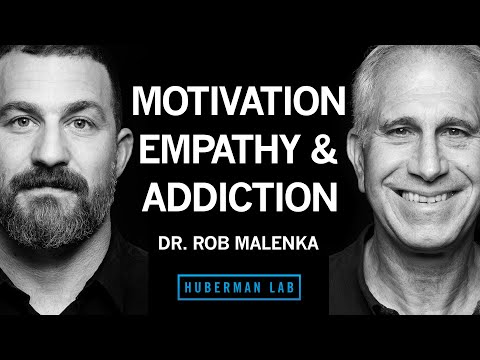
How Your Brain’s Reward Circuits Drive Your Choices | Dr. Robert Malenka
Andrew Huberman (host), Robert Malenka (guest)
In this episode of Huberman Lab, featuring Andrew Huberman and Robert Malenka, How Your Brain’s Reward Circuits Drive Your Choices | Dr. Robert Malenka explores dopamine, Serotonin, And Social Bonds: How Reward Shapes Behavior Andrew Huberman interviews psychiatrist and neuroscientist Dr. Robert Malenka about how the brain’s reward and social circuits work, with a focus on dopamine, serotonin, and oxytocin.
Dopamine, Serotonin, And Social Bonds: How Reward Shapes Behavior
Andrew Huberman interviews psychiatrist and neuroscientist Dr. Robert Malenka about how the brain’s reward and social circuits work, with a focus on dopamine, serotonin, and oxytocin.
They explain how the dopamine system evolved to tag experiences as important, driving learning, motivation, addiction, and social behavior, and how context and plasticity radically reshape its function over time.
Malenka describes addiction as drug‑driven hijacking of normal reward learning, discusses individual vulnerability, and shows how drugs like MDMA expose distinct roles for dopamine versus serotonin in reinforcement and social connection.
The conversation extends to social reward, empathy, autism spectrum disorder, and emerging psychedelic therapies, emphasizing both scientific promise and serious cautions around over‑hyping or unsafe use.
Key Takeaways
Dopamine marks importance and salience, not just pleasure
Dopamine neurons in the ventral tegmental area (VTA) project to the nucleus accumbens and other regions to signal that something in the environment is important—not merely pleasurable. ...
Get the full analysis with uListen
Addictive liability depends on both amount and speed of dopamine
The risk that a drug becomes addictive (“addictive liability”) scales with how much dopamine it releases in the nucleus accumbens and how rapidly that release occurs. ...
Get the full analysis with uListen
Wanting and liking can diverge, explaining compulsive but unenjoyable use
Drugs and rewarding behaviors can become powerfully reinforcing even when they stop feeling good. ...
Get the full analysis with uListen
Reward circuits are highly plastic and context‑dependent
The same cue can flip from appetitive to aversive depending on recent history—Huberman’s Thanksgiving example: turkey and pie smells are enticing before the meal and repulsive afterward. ...
Get the full analysis with uListen
Social interaction is a major natural activator of reward circuitry
Non‑aggressive, non‑sexual social interactions are strongly reinforcing in social species and engage the same reward circuitry as food and drugs. ...
Get the full analysis with uListen
Empathy has measurable precursors in animal models
Malenka’s group uses mice to study “behavioral antecedents of empathy”: a bystander mouse develops pain behaviors after spending an hour with a mouse in pain (social transfer of pain), and a mouse in pain experiences partial pain relief after interacting with a morphine‑treated, pain‑free mouse (social transfer of analgesia). ...
Get the full analysis with uListen
MDMA separates dopaminergic reinforcement from serotonergic prosocial effects
MDMA causes massive release of both dopamine and serotonin by reversing their transporters, but it has higher affinity for the serotonin transporter. ...
Get the full analysis with uListen
Notable Quotes
“It’s not an accident that sugary, high‑fat foods are highly reinforcing. There has to be a mechanism in the brain that tells us that.”
— Dr. Robert Malenka
“A single administration of a drug of abuse like cocaine or morphine can cause changes in reward‑circuit connections that last days to weeks.”
— Dr. Robert Malenka
“You can’t develop a problem with a substance if you never take it. By definition.”
— Dr. Robert Malenka
“Liking something means it actually feels good. Wanting means you work to get it again. And those can come apart.”
— Dr. Robert Malenka
“What is more important for the survival of the human species than empathy and compassion?”
— Dr. Robert Malenka
Questions Answered in This Episode
In your mouse models, how far can you push the ‘generosity’ or ‘compassion’ behaviors—will a hungry or mildly stressed mouse still work to help another mouse, and what does that say about human trade‑offs between self‑interest and empathy?
Andrew Huberman interviews psychiatrist and neuroscientist Dr. ...
Get the full analysis with uListen AI
Given that single cocaine exposures can induce weeks‑long plasticity in reward circuits, do you think one‑time, supervised psychedelic or MDMA sessions could induce beneficial plasticity in social or emotional circuits that are comparably long‑lasting?
They explain how the dopamine system evolved to tag experiences as important, driving learning, motivation, addiction, and social behavior, and how context and plasticity radically reshape its function over time.
Get the full analysis with uListen AI
You mentioned that some individuals experience alcohol as a ‘magic elixir’ from the very first drink—what specific genetic or developmental factors do you suspect make certain brains so immediately susceptible while others are relatively protected?
Malenka describes addiction as drug‑driven hijacking of normal reward learning, discusses individual vulnerability, and shows how drugs like MDMA expose distinct roles for dopamine versus serotonin in reinforcement and social connection.
Get the full analysis with uListen AI
If MDMA’s prosocial effects are largely serotonergic and its addictive liability largely dopaminergic, how close do you think we are to a medication that produces the social/empathic benefits without meaningful abuse potential—and what would the biggest safety concern still be?
The conversation extends to social reward, empathy, autism spectrum disorder, and emerging psychedelic therapies, emphasizing both scientific promise and serious cautions around over‑hyping or unsafe use.
Get the full analysis with uListen AI
In autism spectrum disorder, how confident are you that reduced social motivation is primarily a reward‑circuit issue rather than, say, sensory overload or anxiety about social cues—and how might you design experiments (in humans or animals) to disentangle those possibilities?
Get the full analysis with uListen AI
Transcript Preview
Welcome to the Huberman Lab Podcast, where we discuss science and science-based tools for everyday life. I'm Andrew Huberman, and I'm a professor of neurobiology and ophthalmology at Stanford School of Medicine. Today my guest is Dr. Robert Malenka. Dr. Robert Malenka is a professor of psychiatry and behavioral sciences at Stanford University School of Medicine. He is both a medical doctor, an MD, and a researcher, a PhD. His laboratory is famous for having discovered some of the key components allowing neuroplasticity, that is the nervous system's ability to change in response to experience. In addition, Dr. Malenka's research is considered central to the textbook knowledge about how reward systems in the brain are organized and function. Indeed, Dr. Malenka's research over the last 10 or 15 years has merged what was once two disparate fields, the first being the study of neuroplasticity, again, the nervous system's ability to change in response to experience, and the other field being the field of dopamine as it relates to pleasure and addiction. His laboratory has shown, for instance, that when we seek out particular forms of pleasure, regardless of whether or not they are healthy for us, that changes the way that our reward circuitry works, and actually changes the way that dopamine is released and how it impacts the brain. And his work has also informed how we seek out healthy pleasures, including healthy food and social connection. Today's discussion explores all of these topics and by the end of today's discussion, you will have a rich understanding of how neurochemicals like dopamine and serotonin work in parallel to reinforce, that is, to increase the probability that we will engage in certain types of thinking and behaviors. So if you are somebody interested in neuroplasticity, that is, how the nervous system can change in response to experience, and/or you are interested in reward systems, what motivates us, and what we are likely to pursue in the future given our choices of past, and if you are interested in things like social connection, and empathy, or lack thereof, today's discussion encompasses all of those topics. It is worth mentioning that Dr. Malenka is a true luminary in all of the fields I just mentioned, as well as several other fields. In fact, when you look out on the landscape of modern neuroscience, what you'll discover is that a very large percentage of the top laboratories studying neuroplasticity and reward systems and so on all stemmed from having trained in Dr. Malenka's laboratory. So it's a real honor and pleasure to be able to host him today, and I'm sure that our discussion is going to greatly enrich the way that you think about brain function, neuroplasticity, and reward. Before we begin, I'd like to emphasize that this podcast is separate from my teaching and research roles at Stanford. It is, however, part of my desire and effort to bring zero-cost-to-consumer information about science and science-related tools to the general public. In keeping with that theme, I'd like to thank the sponsors of today's podcast. Our first sponsor is ROKA. ROKA makes eyeglasses and sunglasses that are of the absolute highest quality. The company was founded by two all-American swimmers from Stanford, and everything about ROKA eyeglasses and sunglasses were designed with performance in mind. I've spent a lifetime working on the biology of the visual system, and I can tell you that your visual system has to contend with an enormous number of challenges in order for you to be able to see clearly. ROKA understands those challenges, and the biology of the visual system such that they've designed sunglasses and eyeglasses that always allow you to see with crystal clarity. Now initially, ROKA eyeglasses and sunglasses were designed for sports performance, and as a consequence, all of their glasses are designed to be very lightweight and to not slip off your face if you get sweaty. However, the design of the glasses include some that are specifically for sport and others whose aesthetic really allows you to use them for sport as well as out to dinner or to work, et cetera, and that's how I use them. If you'd like to try ROKA eyeglasses and sunglasses, you can go to roka.com, that's R-O-K-A .com, and enter the code Huberman to save 20% off your first order. Again, that's ROKA, R-O-K-A, .com and enter the code Huberman at checkout. Today's episode is also brought to us by Levels. Levels is a program that lets you see how different foods and behaviors affect your health by giving you real-time feedback on your diet using a continuous glucose monitor. One of the most important factors impacting your immediate and long-term health is the way that your body manages its blood glucose, or sometimes referred to as blood sugar, levels. To maintain energy and focus throughout the day, you want to keep your blood glucose steady without big spikes or dips. Using Levels, you can monitor how different types of foods, and different food combinations, as well as food timing, and things like exercise combine to impact your blood glucose levels. I started using Levels a little over a year ago and it gave me a lot of insight into how specific foods were spiking my blood sugar and then leaving me feeling tired for several hours afterwards, as well as how the spacing of exercise and my meals was impacting my overall energy. And in doing so, it really allowed me to optimize how I eat, what I eat, when I exercise, and so on, such that my blood glucose levels and energy levels are stable throughout the day. If you're interested in learning more about Levels and trying a continuous glucose monitor yourself, go to levels.link/huberman. Right now, Levels is offering an additional two free months of membership. Again, that's levels.link, L-I-N-K, /huberman to get two free months of membership. And now for my discussion with Dr. Robert Malenka. Dr. Malenka, Rob, welcome.
Install uListen to search the full transcript and get AI-powered insights
Get Full TranscriptGet more from every podcast
AI summaries, searchable transcripts, and fact-checking. Free forever.
Add to Chrome