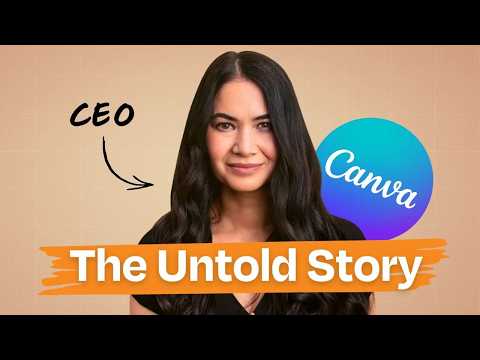
She turned 100+ rejections into a $42B company | Melanie Perkins
Lenny Rachitsky (host), Melanie Perkins (guest)
In this episode of Lenny's Podcast, featuring Lenny Rachitsky and Melanie Perkins, She turned 100+ rejections into a $42B company | Melanie Perkins explores from 100 investor rejections to Canva’s $42B column‑B empire Melanie Perkins, CEO and co-founder of Canva, explains how she built a $42B global design platform by obsessing over a ‘column B’ future: envisioning an ideal world first, then working backwards into concrete steps.
From 100 investor rejections to Canva’s $42B column‑B empire
Melanie Perkins, CEO and co-founder of Canva, explains how she built a $42B global design platform by obsessing over a ‘column B’ future: envisioning an ideal world first, then working backwards into concrete steps.
She breaks down Canva’s internal operating system—crazy big goals, mission pillars, chaos-to-clarity decks, and rigorous customer feedback loops—that turn huge, vague ambitions into shippable products.
Perkins also shares hard-earned lessons from two years of not shipping during a massive rewrite, more than 100 investor rejections, and the importance of protecting her energy to sustain long-term execution.
Underpinning it all is Canva’s “two-step plan”: build one of the world’s most valuable companies and use its success and equity to do the most good, including large-scale poverty alleviation and free tools for schools and nonprofits.
Key Takeaways
Start with the world you want, not the resources you have.
Perkins contrasts “column A” (stacking today’s bricks) with “column B” (imagining a magical future and then building towards it), arguing that transformative companies begin by designing the future reality they want to exist, then constructing a ladder of small, concrete steps to get there.
Get the full analysis with uListen AI
Turn rejection into an asset by systematically upgrading your pitch.
After 100+ investor rejections, Perkins folded every criticism into her deck—market size, differentiation, problem explanation—so that future pitches pre-answered objections; the vision stayed the same, but articulation and clarity improved dramatically.
Get the full analysis with uListen AI
Operationalize vision with clear mission pillars and measurable goals.
Canva’s mission (“empower the world to design”) is decomposed into explicit pillars—everyone, anything, every ingredient, every language, every device—then into annual, numeric goals (e. ...
Get the full analysis with uListen AI
Accept that timelines will be wrong, but stay committed to direction.
From a ‘six-month’ rewrite that took two years to long-range 2026 decks, Perkins emphasizes that while time estimates are often wildly off, continued compounding effort in the same direction eventually makes many of the original ‘crazy’ goals real.
Get the full analysis with uListen AI
Embed customer voice deeply: requests, tests, and closed feedback loops.
Canva collects over a million feature requests a year, tallies them, routes them to product teams, and explicitly “closes the loop” on 200+ requests annually; this, plus constant user testing, drives everything from small features (gradient text) to major products (Sheets, AI access for teachers).
Get the full analysis with uListen AI
Build company rituals that celebrate progress toward big goals.
To keep motivation high on long journeys, Canva creates vivid celebrations tied to milestones—smashing plates, releasing doves, themed festivals—so teams feel punctuated moments of success on the way up the “ladder to the moon.”
Get the full analysis with uListen AI
Fuse profit and purpose through a concrete, structural giving plan.
Perkins’ two-step plan—build one of the world’s most valuable companies and do the most good—shows up in the 1% pledge, donating 30% of founder equity via the Canva Foundation, hundreds of millions committed to GiveDirectly, and $1. ...
Get the full analysis with uListen AI
Notable Quotes
“It was really clear in my mind that it was the future and I thought the investors were wrong.”
— Melanie Perkins
“A crazy big goal is something you feel completely inadequate before, but you want to work really hard to will it into existence.”
— Melanie Perkins
“Most planning is done by looking at the bricks and trying to stack them. Column B is imagining the castle on the hill and then working backwards.”
— Melanie Perkins
“We have a two-step plan: build one of the world’s most valuable companies and do the most good we can do.”
— Melanie Perkins
“Everything good was once imagined. If you don’t imagine it, you can’t will it into existence.”
— Melanie Perkins
Questions Answered in This Episode
How can a founder distinguish between a genuinely ‘crazy big’ but viable vision and wishful thinking that isn’t grounded enough to pursue?
Melanie Perkins, CEO and co-founder of Canva, explains how she built a $42B global design platform by obsessing over a ‘column B’ future: envisioning an ideal world first, then working backwards into concrete steps.
Get the full analysis with uListen AI
What concrete steps can early-stage teams take to implement a chaos-to-clarity process when they have very limited time and resources?
She breaks down Canva’s internal operating system—crazy big goals, mission pillars, chaos-to-clarity decks, and rigorous customer feedback loops—that turn huge, vague ambitions into shippable products.
Get the full analysis with uListen AI
How should companies balance visionary, mission-pillar-driven roadmaps against immediate customer feature requests and short-term revenue needs?
Perkins also shares hard-earned lessons from two years of not shipping during a massive rewrite, more than 100 investor rejections, and the importance of protecting her energy to sustain long-term execution.
Get the full analysis with uListen AI
What are the risks of deeply intertwining philanthropy with company equity and strategy, and how can other founders responsibly replicate Canva’s two-step plan?
Underpinning it all is Canva’s “two-step plan”: build one of the world’s most valuable companies and use its success and equity to do the most good, including large-scale poverty alleviation and free tools for schools and nonprofits.
Get the full analysis with uListen AI
In a world increasingly shaped by AI, how can product teams ensure AI features are genuinely useful rather than just bolted on to impress investors or press?
Get the full analysis with uListen AI
Transcript Preview
There's a very famous story about Canva. Early on, you pitched over 100 investors and over 100 investors said no to you.
It was really clear in my mind that it was the future and I thought the investors were wrong, (laughs) frankly. But investors also gave really helpful feedback, and feedback often in the form of rejection. They would say, "Oh, your market's not big enough," and I would say, "It's gonna be huge." And I'd add a new page in my pitch deck that said how big the market I believed was. And then they'd say, "You're the same as some other company." And I would say, "Hey, now I've got a new slide in my pitch deck that shows all the players and the huge gap in the market that we believe we're gon- going to fill."
One of your values, crazy big goals. (laughs) I love that as a value.
The thing that I love about a crazy big goal is that you feel completely inadequate before it. You want to work really hard to will it into existence. I really like to start by just imagining what is the future that you actually want. Right now, I have a wall in my house, in my office, which is my vision for what I'd like the world to look like in 2050.
I heard from one of your team members, Melissa Tan, that there's a deck like this e- for every project you kick off, there's this big vision deck.
And so we have this concept of chaos to clarity. Every idea starts in the chaos side, and then you have to work all the way to the other side, which is clarity. That very first step at the far end of chaos was quite a embarrassing step actually, because you don't have mastery at that point. You don't have all the answers.
A lot of people think of Canva as, like, a design graphics for, you know, social media and then marketing and things like that. But you also have spreadsheets, docs, whiteboards, charts, AI coding tool.
It was funny looking back from really old decks. We were trying to do AI before AI was actually a thing.
(instrumental music) Today, my guest is Melanie Perkins, CEO and co-founder of Canva. Melanie is on track to be the most successful female tech founder in history, and one of the most successful founders, period. Canva's currently valued at over $42 billion, making over $3.3 billion in revenue a year. They've been profitable for eight years straight and are one of the hottest private tech companies in the world right now. But it wasn't always this way. Melanie was rejected by over 100 investors when she was trying to raise her first round. Their team spent two years rewriting their entire code base and were unable to ship any new features for over two years, something they expected to just take six months. And they even went through a big pivot early on from a yearbook publishing platform to the Canva that you know today. Melanie does not do a lot of podcasts. She shares stories that I've never heard before and lessons that I'm still thinking about. This is a really rare opportunity to learn from a legendary founder. A huge thank you to Cameron Adams and Melissa Tan for suggesting topics for this conversation. If you enjoy this podcast, don't forget to subscribe and follow it in your favorite podcasting app or YouTube. And if you become an annual subscriber of my newsletter, you get a year free of 17 incredible products, including Devin, Lovable, Replit, Bolt, Innit, and Linear, Superhuman, Descript, Whisperflow, Gamma, Perplexity, Warp, Granola, Magic Patterns, Raycast, ChatBRD, and Mobben. Head on over to lennysnewsletter.com and click Product Pass. With that, I bring you Melanie Perkins after a short word from our sponsors. My podcast guests and I love talking about craft and taste and agency and product market fit. You know what we don't love talking about? SOC 2. That's where Vanta comes in. Vanta helps companies of all sizes get compliant fast and stay that way with industry-leading AI, automation, and continuous monitoring. Whether you're a startup tackling your first SOC 2 or ISO 27001, or an enterprise managing vendor risk, Vanta's Trust Management Platform makes it quicker, easier, and more scalable. Vanta also helps you complete security questionnaires up to five times faster so that you could win bigger deals sooner. The result? According to a recent IDC study, Vanta customers slashed over $500,000 a year and are three times more productive. Establishing trust isn't optional. Vanta makes it automatic. Get $1,000 off at vanta.com/lenny. Last year, 1.3% of global GDP flowed through Stripe. That's over $1.4 trillion. Stripe helps ambitious founders start companies and scale them from pre-seed to IPO and beyond. Used by 78% of the Forbes AI50, Stripe provides financial infrastructure for payments, billing, and software to platforms and marketplaces so they can monetize faster, experiment with pricing, and grow revenue. With Stripe, businesses achieve massive global scale faster than they would otherwise. And at the beginning of that journey is where Stripe Startups comes in. Stripe Startups is a program designed to support early stage venture-backed businesses as they build, iterate, and scale. Founders enrolled in Stripe Startups get access to credits to offset Stripe fees, expert insights, and a focused community of other founders building on Stripe. You can learn more and apply for the program today at stripe.com/startups. Melanie, thank you so much for being here and welcome to the podcast.
Install uListen to search the full transcript and get AI-powered insights
Get Full TranscriptGet more from every podcast
AI summaries, searchable transcripts, and fact-checking. Free forever.
Add to Chrome