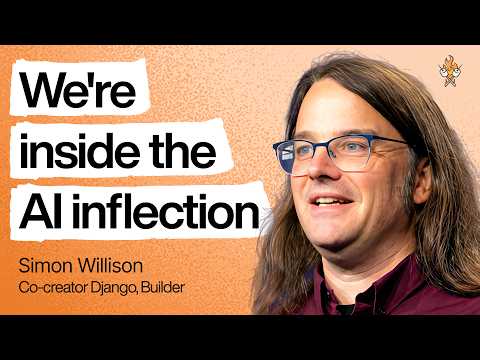
An AI state of the union: We’ve passed the inflection point & dark factories are coming
Simon Willison (guest), Lenny Rachitsky (host)
In this episode of Lenny's Podcast, featuring Simon Willison and Lenny Rachitsky, An AI state of the union: We’ve passed the inflection point & dark factories are coming explores aI coding agents crossed threshold; dark factories and security risks rise Willison argues November 2025 marked an inflection where coding agents became reliable enough that “most of the time” turned into “almost all of the time,” enabling massive output with less direct typing and more orchestration.
AI coding agents crossed threshold; dark factories and security risks rise
Willison argues November 2025 marked an inflection where coding agents became reliable enough that “most of the time” turned into “almost all of the time,” enabling massive output with less direct typing and more orchestration.
He distinguishes “vibe coding” (hands-off, don’t read or understand the code) from “agentic engineering” (professional use of agents with rigorous practices), and predicts a shift toward “dark factories” where teams may neither type nor read code.
As code becomes cheap, the bottlenecks move to product thinking, validation, usability testing, and human cognitive limits, creating new pressures and burnout risks even as work becomes more fun.
He outlines concrete practices for high-quality AI-assisted development—especially automated tests (red/green TDD), strong project templates, and building a personal library of reusable experiments and “things you know how to do.”
Willison warns the biggest near-term danger is prompt-injection-style vulnerabilities (the “lethal trifecta”), predicting an eventual “Challenger disaster” driven by normalization of deviance and overconfidence from near-misses.
Key Takeaways
Treat November-level agents as workflow-changing, not just “better autocomplete.”
Willison’s core claim is that a small capability jump crossed a reliability threshold, making agent loops (write→run→test→fix) practical enough to reshape team processes and expectations.
Get the full analysis with uListen AI
Use “vibe coding” only where the blast radius is you.
He endorses hands-off prototyping for personal tools but says shipping to others without understanding risks (security, scraping, reliability) is irresponsible.
Get the full analysis with uListen AI
The next frontier is “dark factory” engineering: quality without reading code.
Experiments like StrongDM’s rely on heavy simulation, swarm testing, and automated validation to compensate for “nobody writes code” and even “nobody reads code” rules—while still aiming for professional standards.
Get the full analysis with uListen AI
As code gets cheap, validation and human attention become the scarce resource.
Rapid prototyping (multiple implementations quickly) is now easy; proving what’s best still requires real user testing and careful product judgment that AI simulations can’t yet replicate credibly.
Get the full analysis with uListen AI
Senior engineers may gain the most—mid-level may be most exposed.
He cites the view that experts can amplify deep experience, juniors can onboard faster with AI help, and mid-career engineers may face the biggest squeeze if they don’t develop stronger judgment and systems thinking.
Get the full analysis with uListen AI
Automated tests are the key control surface for agentic code quality.
He argues dropping tests is a mistake; agents should write and run tests, and “red/green TDD” is a compact instruction that reliably improves outcomes and reduces regressions.
Get the full analysis with uListen AI
Prompt injection isn’t “solvable” by filters; design for containment.
Willison says 97% detection is a failing grade when the remaining 3% can exfiltrate sensitive data; the practical strategy is removing one leg of the “lethal trifecta,” often by constraining outbound actions and privileges.
Get the full analysis with uListen AI
Notable Quotes
“Today, probably ninety-five percent of the code that I produce, I didn't type it myself.”
— Simon Willison
“We had what I call the inflection point... we went from that to almost all of the time it does what you told it to do.”
— Simon Willison
“The next rule, though, is nobody reads the code.”
— Simon Willison
“I can fire up four agents in parallel... and by eleven AM, I am wiped out.”
— Simon Willison
“You can get to, like, ninety-seven percent effectiveness... I think that's a failing grade.”
— Simon Willison
Questions Answered in This Episode
What specifically changed in GPT 5.1 / Claude Opus 4.5 that made November 2025 feel like a threshold rather than a gradual improvement?
Willison argues November 2025 marked an inflection where coding agents became reliable enough that “most of the time” turned into “almost all of the time,” enabling massive output with less direct typing and more orchestration.
Get the full analysis with uListen AI
In a “dark factory” where nobody reads code, what minimum set of safeguards (tests, simulations, audits, threat modeling) would you require before shipping to real users?
He distinguishes “vibe coding” (hands-off, don’t read or understand the code) from “agentic engineering” (professional use of agents with rigorous practices), and predicts a shift toward “dark factories” where teams may neither type nor read code.
Get the full analysis with uListen AI
StrongDM spent roughly $10k/day on tokenized user simulation—when does that ROI make sense, and what cheaper approximations might still catch the same classes of bugs?
As code becomes cheap, the bottlenecks move to product thinking, validation, usability testing, and human cognitive limits, creating new pressures and burnout risks even as work becomes more fun.
Get the full analysis with uListen AI
If code quality signals (tests/docs) become cheap to generate, what new “proof of usage” or trust signals should open-source projects adopt?
He outlines concrete practices for high-quality AI-assisted development—especially automated tests (red/green TDD), strong project templates, and building a personal library of reusable experiments and “things you know how to do.”
Get the full analysis with uListen AI
What does an effective “agentic engineering” skill ladder look like for the vulnerable mid-level cohort you described, and what should they practice weekly?
Willison warns the biggest near-term danger is prompt-injection-style vulnerabilities (the “lethal trifecta”), predicting an eventual “Challenger disaster” driven by normalization of deviance and overconfidence from near-misses.
Get the full analysis with uListen AI
Transcript Preview
A lot of people woke up in January and February and started realizing, "Oh, wow, I can churn out ten thousand lines of code in a day." It used to be you'd ask ChatGPT for some code, and it would spit out some code, and you have to run it and test it. The coding agents, they take that step for you. The open question for me is how many other knowledge work fields are actually prone to these agent loops?
Now that we have this power, people almost underestimate what they can do with it.
Today, probably ninety-five percent of the code that I produce, I didn't type it myself. I write so much of my code on my phone, it's wild. I can get good work done walking the dog along the beach. My New Year's resolution, every previous year, I've always told myself, "This year I'm gonna focus more. I'm gonna take on less things." This year, my ambition was take on more stuff and be more ambitious.
Such an interesting contradiction. AI is supposed to make us more productive. It feels like the people that are most AI-filled are working harder than they've ever worked.
Using coding agents well is taking every inch of my twenty-five years of experience as a software engineer. I can fire up four agents in parallel and have them work on four different problems. By eleven AM, I am wiped out.
You have this prediction that we're gonna have a massive disaster at some point. You call it the Challenger disaster of AI.
Lots of people knew that those little O-rings were unreliable, but every single time you get away with launching a space shuttle without the O-rings failing, you institutionally feel more confident in what you're doing. We've been using these systems in increasingly unsafe ways. This is gonna catch up with us. My prediction is that we're gonna see a Challenger disaster.
Today my guest is Simon Willison. Simon, in my opinion, is one of the most important and useful voices right now on how AI is changing the way that we build software and how professional work is changing broadly. What I love about Simon is that he doesn't just pontificate in the clouds. He's been what you'd call a 10X engineer for over twenty years. He co-created Django, the web framework that powers Instagram, Pinterest, Spotify, and thousands of other platforms. He coined the term prompt injection, popularized the ideas of AI slop and agentic engineering, and amongst his hundred-plus open source projects, he created Datasette, a data analysis tool that has become a staple of investigative journalism. What makes Simon rare is that very few engineers have made the leap from the old way of building to the new way as fully and visibly as he has. And as he's leaned into this new way of building, he's been sharing everything he's learning in real time through his incredible blog, SimonWillison.net. Simon does not do a lot of podcasts, and this conversation opened my mind up in a bunch of new ways. I am so excited for you to get to learn from Simon. Don't forget to check out LennysProductPass.com for an incredible set of deals available exclusively to Lenny's Newsletter subscribers. With that, I bring you Simon Willison. [gentle music] Simon, thank you so much for being here, and welcome to the podcast.
Install uListen to search the full transcript and get AI-powered insights
Get Full TranscriptGet more from every podcast
AI summaries, searchable transcripts, and fact-checking. Free forever.
Add to Chrome