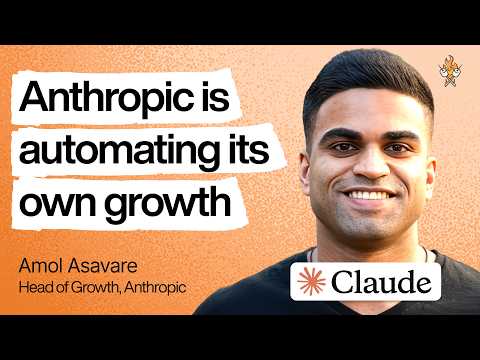
Head of Growth (Anthropic): “Claude is growing itself at this point”
Lenny Rachitsky (host), Amol Avasare (guest)
In this episode of Lenny's Podcast, featuring Lenny Rachitsky and Amol Avasare, Head of Growth (Anthropic): “Claude is growing itself at this point” explores anthropic growth leader on activation, automation, safety, and future roles Anthropic’s growth org looks traditional on paper (acquisition, activation, monetization) but Amol says most effort goes to “success disasters,” where rapid growth breaks systems that must be urgently repaired.
Anthropic growth leader on activation, automation, safety, and future roles
Anthropic’s growth org looks traditional on paper (acquisition, activation, monetization) but Amol says most effort goes to “success disasters,” where rapid growth breaks systems that must be urgently repaired.
AI product activation is uniquely hard because capabilities evolve faster than onboarding and users often don’t know what to ask for, so Anthropic uses targeted onboarding questions and “good friction” to route users to the right value.
Anthropic is actively automating growth experimentation via CASH (Claude Accelerates Sustainable Hypergrowth), with Claude generating, building, and analyzing small experiments at roughly a junior-PM win rate—improving quickly as models advance.
As engineering productivity jumps most from AI tooling (e.g., Claude Code), PM and design become the bottleneck, pushing teams toward more PMs and/or “mini-PM” engineers for small projects.
Anthropic’s focus on coding and B2B, paired with a safety-first mission (including PBC structure) and a highly transparent “notebook channel” culture, is presented as a core competitive advantage rather than a constraint.
Key Takeaways
In hypergrowth, growth work becomes firefighting of “success disasters.”
Amol estimates ~70% of his time is spent on problems caused by things going too well (capacity, UX scaling issues, monetization edge cases), even while metrics look uniformly green.
Get the full analysis with uListen AI
Activation is the biggest AI-product bottleneck because users under-ask and models over-improve.
Users often default to trivial queries, while model capabilities shift faster than product teams can translate them into onboarding and guided workflows, making “capability diffusion” a core product challenge.
Get the full analysis with uListen AI
Add friction when it helps match the right user to the right value.
Anthropic and Amol’s prior work (Mercury, Masterclass) show that extra steps—questions, quizzes, split forms—can increase completion by reducing cognitive load and improving personalization, as long as it’s value-adding rather than annoying.
Get the full analysis with uListen AI
AI-first businesses should bias toward larger growth bets, not just micro-optimizations.
Amol argues AI-first product value can be 100–1000x higher in a couple years, so teams should avoid “missing the forest” by over-indexing on small wins—even if 1% improvements are massive at scale.
Get the full analysis with uListen AI
Automated experimentation is arriving first in growth because loops are measurable and repeatable.
CASH operationalizes an experiment loop (opportunity → build → QA/brand → analysis), already producing wins on copy/UI tweaks with humans approving outputs today and less review needed as brand/safety constraints become machine-checkable.
Get the full analysis with uListen AI
Engineering gets the most AI leverage right now, squeezing PM and design bandwidth.
If 5 engineers become “15–20 engineers worth” of output, the same PM/designer capacity can’t keep up; Anthropic responds by hiring more PMs and deputizing product-minded engineers as mini-PMs for sub–2-week projects.
Get the full analysis with uListen AI
Use AI to surface misalignment and coach performance—not just write docs.
Amol runs scheduled agents to scan Slack and key metrics, flag coordination risks, summarize weekly performance for his reports, and even generate feedback “as his manager,” treating AI as a (sometimes noisy) coaching layer that is rapidly improving.
Get the full analysis with uListen AI
Notable Quotes
“Historically, we were very much the smallest, least well-funded player in this space. ... It’s a complete miracle that we’ve gotten to the stage that we have.”
— Amol Avasare
“Roughly 70% of what I spend my time on is what we internally refer to as success disasters.”
— Amol Avasare
“Activation is a really big challenge in AI.”
— Amol Avasare
“Adding friction and adding the right steps leads to higher conversion... Just cut all the steps and get them into the product—like that doesn’t work most times.”
— Amol Avasare
“We are starting to look at how do we automate growth... CASH... Claude Accelerates Sustainable Hypergrowth.”
— Amol Avasare
Questions Answered in This Episode
What are concrete examples of Anthropic “success disasters” (e.g., what broke) and how did the growth team triage them?
Anthropic’s growth org looks traditional on paper (acquisition, activation, monetization) but Amol says most effort goes to “success disasters,” where rapid growth breaks systems that must be urgently repaired.
Get the full analysis with uListen AI
For Claude’s onboarding, which specific questions create the highest lift in activation, and how do you decide the “right” amount of friction?
AI product activation is uniquely hard because capabilities evolve faster than onboarding and users often don’t know what to ask for, so Anthropic uses targeted onboarding questions and “good friction” to route users to the right value.
Get the full analysis with uListen AI
In CASH, what’s the exact human-in-the-loop workflow today, and what’s the first part you expect to fully automate without review?
Anthropic is actively automating growth experimentation via CASH (Claude Accelerates Sustainable Hypergrowth), with Claude generating, building, and analyzing small experiments at roughly a junior-PM win rate—improving quickly as models advance.
Get the full analysis with uListen AI
How do you evaluate the win rate of Claude-run experiments vs. humans (metrics, guardrails, and when you override the model’s recommendation)?
As engineering productivity jumps most from AI tooling (e. ...
Get the full analysis with uListen AI
You mentioned capability overhang—what practices help your team update priors fast enough to keep onboarding aligned with new model releases?
Anthropic’s focus on coding and B2B, paired with a safety-first mission (including PBC structure) and a highly transparent “notebook channel” culture, is presented as a core competitive advantage rather than a constraint.
Get the full analysis with uListen AI
Transcript Preview
A lot of companies claim to be the fastest-growing companies of all time. Anthropic actually is. You guys were at a billion ARR at the start of 2025. The last number I've seen is 19 billion ARR. That's 1 to $19 billion in 14 months.
Historically, we were very much the smallest, least well-funded player in this space. We didn't have the free cash flow or the distribution of a Meta or Google. We didn't have the first mover advantage of an OpenAI. It's a complete miracle that we've gotten [chuckles] to the stage that we have.
Give us just a glimpse of what it's like to be leading growth inside of Anthropic.
It's the hardest job I've had in my life. To come into Anthropic, you need to understand that 50, 60, 70% of how you operated in the past, just throw it out the door.
One of the cleverest growth moves y'all made was this idea of importing memory from ChatGPT.
Activation is a really big challenge in AI. We are starting to look at how do we automate growth. Our growth platform team is driving this effort called CASH, which is Claude Accelerates Sustainable Hypergrowth. How can we use Claude to automate growth experimentation? And it's delivering results.
You're basically living in the future.
We always talk about the exponential. The product value that we will deliver in two years' time is probably, like, 1000x what it is today. The funniest thing is I've noticed internally linear charts are just not cool. Everything is log linear. Just show me a log linear scale.
Today my guest is Amol Avasare. Amol is head of growth at Anthropic, which is on the most unprecedented growth run in history. In the past 14 months, they grew from 1 billion to over 19 billion in annual recurring revenue. Just in the past few months, their revenue doubled. They've been growing 10X year over year. This is unheard of at this scale. By the time this episode comes out, their revenue will be even higher. To put this scale in perspective, companies like Atlassian and Palantir and Snowflake, which have been around for 15 to 20 years, each do something like $4.5 to 6 billion in ARR. Anthropic is adding this much ARR every few months. And if that isn't interesting enough to you, Amol, who leads growth at Anthropic, is an incredible human. He previously led growth at Mercury and Masterclass. Before that, he was a founder and an investment banker, and most interestingly, something that most people don't know about him is that Amol suffered a severe brain injury. He had to spend nine months relearning how to walk and work and just not be nauseous all the time. He shared this story in a guest post in my newsletter a number of years ago. We actually chat about this during the conversation. These are my favorite kind of conversations because Amol and his team are living in the future, and he's come to tell us where things are heading and what's gonna change. And in this episode, Amol shares an unprecedented look at how a company like Anthropic operates and grows, including how they think about growth, what parts of the job they've automated, the future of the product and growth roles, how Amol got the job in the first place by cold emailing Mike Krieger, and so much more. Amol is wonderful, and just try to count the number of times that he blew my mind during this conversation. Before we get into it, don't forget to check out lennysproductpass.com for an incredible set of deals available exclusively to Lenny's Newsletter subscribers. With that, I bring you Amol Avasare. [gentle music] Amol, thank you so much for being here, and welcome to the podcast.
Install uListen to search the full transcript and get AI-powered insights
Get Full TranscriptGet more from every podcast
AI summaries, searchable transcripts, and fact-checking. Free forever.
Add to Chrome