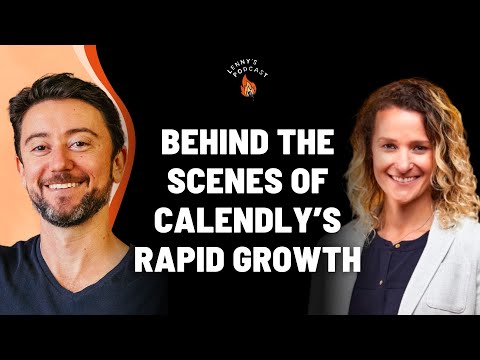
Behind the scenes of Calendly’s rapid growth | Annie Pearl (CPO)
Annie Pearl (guest), Lenny Rachitsky (host)
In this episode of Lenny's Podcast, featuring Annie Pearl and Lenny Rachitsky, Behind the scenes of Calendly’s rapid growth | Annie Pearl (CPO) explores calendly’s CPO reveals product strategy, PLG-to-sales shift, and growth Chief Product Officer Annie Pearl shares how Calendly structures its product organization, plans roadmaps, and uses OKRs to align company-wide execution.
Calendly’s CPO reveals product strategy, PLG-to-sales shift, and growth
Chief Product Officer Annie Pearl shares how Calendly structures its product organization, plans roadmaps, and uses OKRs to align company-wide execution.
She explains Calendly’s evolution from a purely product-led growth engine to layering on a fast-growing sales-led motion, including how they think about PQLs and enterprise buyers.
Annie details their product strategy framework, heavy focus on clear ICPs and personas, and how this focus drives prioritization and trade-offs.
She also offers concrete advice on breaking into product management, running effective planning and discovery, and maintaining a strong product culture in a fast-scaling, fully-remote company.
Key Takeaways
Use multiple paths to transition into product management, but internal moves are often most effective.
Annie outlines four main paths—APM programs, junior PM roles (often internal), shadowing/SME roles, and joining early-stage startups—and notes that the most common success pattern she’s seen is people in adjacent roles proactively partnering with PMs and informally doing PM work before transferring.
Get the full analysis with uListen AI
A clear, explicit product strategy centered on where to play unlocks real prioritization.
Using the Playing to Win framework, Calendly defined markets, segments, and personas (e. ...
Get the full analysis with uListen AI
Tie OKRs from the company level down through departments to avoid siloed execution.
Calendly evolved from no OKRs, to product-only OKRs, to a small set of company-wide OKRs with tightly integrated cross-functional plans and dependency mapping, which significantly improved alignment and execution across teams.
Get the full analysis with uListen AI
When layering sales on top of PLG, hire for the motion and buyer you actually have now.
Early on, Calendly’s sales reps worked mostly inbound and PQLs and sold to team leads, not CIOs; Annie emphasizes hiring reps with experience in similar inbound, department-head-focused motions rather than classic heavy outbound, CIO-focused enterprise sellers.
Get the full analysis with uListen AI
Viral PLG growth eventually plateaus; future growth often comes from team and enterprise use.
Although ~70% of Calendly signups still come from viral links, the fastest-growing segment is multi-user teams and departments; product and sales are now heavily oriented around departmental and organizational deployments instead of only solo users.
Get the full analysis with uListen AI
Structure product development into distinct, commit-worthy phases to improve predictability.
Calendly breaks work into discovery, solutioning, build, and launch/measure/iterate, and only commits to dates for the phase they actually understand (e. ...
Get the full analysis with uListen AI
Reinforce focus and customer centricity through culture, rituals, and templates—not just slogans.
Principles like “focus wisely” are embedded in Calendly’s review templates, strategy docs, and rituals like OPA (opportunity/problem assessment sessions) and competitive war-gaming, ensuring teams continuously anchor on target users, problems, and differentiated solutions.
Get the full analysis with uListen AI
Notable Quotes
“Strategy is really just an integrated set of choices that outline how you're going to win in whatever marketplace you choose.”
— Annie Pearl
“The ability to say no is going to allow you to make sure you're building something that's going to be amazing for the people that matter most and not something that's going to be average or okay for a lot of different people.”
— Annie Pearl
“70% of our sign-ups come through that viral loop that you referred to.”
— Annie Pearl
“When you transition from kind of PLG to sales-led, the buyer is usually just the department head… selling into this audience is different than selling into IT.”
— Annie Pearl
“Our vision, our winning aspiration, is to become the best place to schedule, prepare for, and follow up on your external meetings.”
— Annie Pearl
Questions Answered in This Episode
How do you practically decide when to stop serving a large horizontal audience and double down on a narrower set of ICPs without alienating existing users?
Chief Product Officer Annie Pearl shares how Calendly structures its product organization, plans roadmaps, and uses OKRs to align company-wide execution.
Get the full analysis with uListen AI
What are some concrete examples where Calendly’s OPA process or four-phase lifecycle (discovery → solutioning → build → launch) changed the trajectory of a project?
She explains Calendly’s evolution from a purely product-led growth engine to layering on a fast-growing sales-led motion, including how they think about PQLs and enterprise buyers.
Get the full analysis with uListen AI
How do you define, detect, and operationalize product-qualified leads (PQLs) in a way that keeps both product and sales aligned?
Annie details their product strategy framework, heavy focus on clear ICPs and personas, and how this focus drives prioritization and trade-offs.
Get the full analysis with uListen AI
What signals should an early-stage PLG company look for to know it’s truly time to invest in a formal sales-led motion and enterprise features?
She also offers concrete advice on breaking into product management, running effective planning and discovery, and maintaining a strong product culture in a fast-scaling, fully-remote company.
Get the full analysis with uListen AI
If you’re building a new product today, how would you design your org and processes differently from day one based on what you’ve learned at Box, Glassdoor, and Calendly?
Get the full analysis with uListen AI
Transcript Preview
Strategy is really just an integrated set of choices that outline how you're going to win in whatever marketplace you choose, right? And so a good product strategy is going to answer questions like, what's your sort of winning aspiration? But maybe more importantly, where are you going to play? You know, what are the markets you're going to go after? What are the segments of those markets? What are the personas in those segments of those markets? And then how are you going to win with that target audience?
(intro music plays) Welcome to Lenny's Podcast, where I interview world-class product leaders and growth experts to learn from their hard-won experiences building and growing today's most successful products. Today my guest is Annie Pearl. Annie is currently chief product officer at Calendly. Before that, she was chief product officer at Glassdoor, and before that she was director of product management at Box. She's also a member of Skip, a community for chief product officers, and she's on the board of two different companies. In our conversation we cover a lot of ground, including how Calendly builds product, how Calendly has grown, including the wild story of how they got their first 1,000 users, and also how they built a sales team on top of what historically has been a very product-led growth company. Annie also shares a ton of great advice on how to get into product management. I learned a ton from Annie, and I know you'll too. Annie also shares a few killer tips for using Calendly, which I loved, and so with all that I bring you Annie Pearl after a short word from our wonderful sponsors. Today's episode is brought to you by Miro, an online collaborative whiteboard that's designed specifically for teams like yours. I have a quick request. Head on over to my Miro board at miro.com/lenny and let me know which guests you'd want me to have on this year. I've already gotten a bunch of great suggestions, which you'll see when you go there, so just keep it coming. And while you're on the Miro board, I encourage you to play around with the tool. It's a great shared space to capture ideas, get feedback, and collaborate with your colleagues on anything that you're working on. For example, with Miro, you can plan out next quarter's entire product strategy. You can start by brainstorming, using sticky notes, live reactions, a voting tool, even an estimation app to scope out your team's sprints. Then your whole distributed team can come together around wireframes, draw ideas with the pen tool, and then put full mocks right into the Miro board. And with one of Miro's ready-made templates, you can go from discovery and research, to product roadmaps, to customer journey flows, to final mocks, all in Miro. Head on over to miro.com/lenny to leave your suggestions. That's m-i-r-o dot com slash lenny. This episode is brought to you by Coda. You've heard me talk about how Coda is the doc that brings it all together, and how it can help your team run smoother and be more efficient. I know this firsthand, because Coda does that for me. I use Coda every day to wrangle my newsletter content calendar, my interview notes for podcasts, and to coordinate my sponsors. More recently, I actually wrote a whole post on how Coda's product team operates, and within that post they shared a dozen templates that they use internally to run their product team, including managing the roadmap, their OKR process, getting internal feedback, and essentially their whole product development process is done within Coda. If your team's work is spread out across different documents and spreadsheets and a stack of workflow tools, that's why you need Coda. Coda puts data in one centralized location, regardless of format, eliminating roadblocks that can slow your team down. Coda allows your team to operate on the same information and collaborate in one place. Take advantage of this special limited time offer just for startups. Sign up today at coda.io/lenny and get $1,000 startup credit on your first statement. That's C-O-D-A dot I-O slash Lenny to sign up, and get a startup credit of $1,000. Coda.io/lenny. Annie, welcome to the podcast.
Install uListen to search the full transcript and get AI-powered insights
Get Full TranscriptGet more from every podcast
AI summaries, searchable transcripts, and fact-checking. Free forever.
Add to Chrome