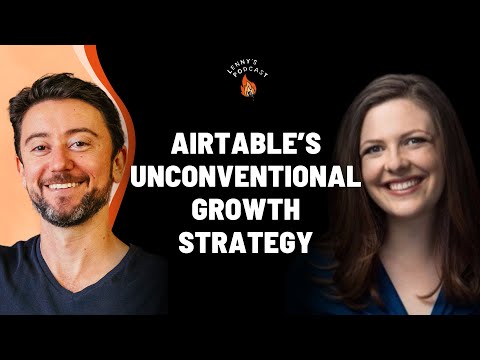
Lessons from Airtable’s unconventional growth strategy | Zoelle Egner
Zoelle Egner (guest), Lenny Rachitsky (host), Narrator, Narrator, Lenny Rachitsky (host)
In this episode of Lenny's Podcast, featuring Zoelle Egner and Lenny Rachitsky, Lessons from Airtable’s unconventional growth strategy | Zoelle Egner explores airtable’s early growth: tiny team, huge impact through champions Zoelle Egner shares how Airtable grew from a tiny early team into a trusted, widely adopted product by obsessing over quality, customer success, and word-of-mouth. She explains why Airtable invested in customer success before sales, how they identified and nurtured internal champions, and why seemingly small brand signals (like polished emails or billboards) helped them ‘punch above their weight’. Zoelle also contrasts high-ROI tactics (deep customer conversations, templates, targeted swag) with common low-ROI distractions (flashy sponsorships, category creation for its own sake, vanity PR). Throughout, she emphasizes treating marketing and customer success as a unified function whose core job is making customers successful enough to evangelize the product.
Airtable’s early growth: tiny team, huge impact through champions
Zoelle Egner shares how Airtable grew from a tiny early team into a trusted, widely adopted product by obsessing over quality, customer success, and word-of-mouth. She explains why Airtable invested in customer success before sales, how they identified and nurtured internal champions, and why seemingly small brand signals (like polished emails or billboards) helped them ‘punch above their weight’. Zoelle also contrasts high-ROI tactics (deep customer conversations, templates, targeted swag) with common low-ROI distractions (flashy sponsorships, category creation for its own sake, vanity PR). Throughout, she emphasizes treating marketing and customer success as a unified function whose core job is making customers successful enough to evangelize the product.
Key Takeaways
Treat quality and polish as core growth levers, not nice-to-haves.
Small details—clean copy, good visuals, thoughtful sample content tailored to a specific audience—signal that you’re serious, competent, and customer-centric, which builds trust and makes a small startup feel enterprise-ready.
Get the full analysis with uListen AI
Invest early in customer success, even before sales.
Airtable built its motion by deeply supporting early users, helping them design real workflows, and turning them into internal champions who drove viral expansion and later made enterprise sales almost inevitable.
Get the full analysis with uListen AI
Find and supercharge champions; they’re more important than buyers early on.
Airtable focused on ‘tinkerers’ inside companies—people who’d build bases, solve real problems, and share them—then later went to IT with proof of broad internal usage to close large deals.
Get the full analysis with uListen AI
Turn customer success insights into scalable content and templates.
By converting bespoke implementations into generalized templates and documentation, Airtable transformed 1:1 learnings into 1:many education, easing adoption and enabling others to self-serve complex use cases.
Get the full analysis with uListen AI
Use PR and launches for credibility and momentum, not direct growth.
Press rarely drives signups; it shines as a tool for hiring and improving cold outbound response. ...
Get the full analysis with uListen AI
Beware low-ROI marketing vanity plays like generic sponsorships and category-creation.
Conference sponsorships and forcing a new software ‘category’ often consume disproportionate resources for little return; elevating a profession or community (like customer success or DevOps) usually yields far more durable impact.
Get the full analysis with uListen AI
Talk to customers constantly with a lightweight, repeatable system.
A simple weekly habit—sending a short ‘can we chat for 10 minutes? ...
Get the full analysis with uListen AI
Notable Quotes
“The magic of Airtable is always seen in its specificity.”
— Zoelle Egner
“If we could do it there, you can do it anywhere.”
— Zoelle Egner
“No one cares about your company. What they care about is themselves.”
— Zoelle Egner
“A lot of people think Airtable is pure PLG and miss the huge customer success component that was always very, very important in the early days.”
— Zoelle Egner
“Your job as a founder is basically being repeater-in-chief.”
— Zoelle Egner (paraphrasing a common idea discussed with Lenny)
Questions Answered in This Episode
How can a very early-stage startup practically decide when to hire its first customer success person and what that role should own?
Zoelle Egner shares how Airtable grew from a tiny early team into a trusted, widely adopted product by obsessing over quality, customer success, and word-of-mouth. ...
Get the full analysis with uListen AI
What concrete signals should founders look for to identify true internal champions versus enthusiastic but low-leverage users?
Get the full analysis with uListen AI
How do you balance the desire for fast shipping with the need for enough polish to build trust when your team and resources are tiny?
Get the full analysis with uListen AI
If templates aren’t reliably a top-of-funnel growth engine, when are they worth investing in and how should success be measured?
Get the full analysis with uListen AI
How can a startup thoughtfully ‘elevate a profession’ (like customer success or DevOps) without it turning into obvious self-serving marketing?
Get the full analysis with uListen AI
Transcript Preview
... there is sometimes a recommendation or an instinct to just, like, ship things super, super quickly and get them out there. And I'm not saying don't move fast. Obviously, you need to move fast in the early days. But, like, make sure someone rereads your email so that it sounds good. Invest in having, like, a decent photo or a decent illustration. If you have sample content, this is actually a big one, sample content for your productivity app, as an example, take the time to not have it be, like, Jane Doe 12 times in the name list. Have it be references to your industry so that people are like, "Oh, hey, that's a joke about Steve Jobs. I'm a designer. This person is thinking about me." It's small stuff, but it tells that person, like, "The people who worked on this were thinking about me as a customer. They built it with me in mind, and that means that it is more likely that this is going to fit my needs than something generic." And that builds up both the brand trust that we've talked about, but also through the personality of the company and makes people want to root for you. And frankly, when you are small, you need everyone...
(laughs)
... (laughs) rooting for you that you can possibly get.
(intro music plays) Welcome to Lenny's Podcast, where I interview world-class product leaders and growth experts to learn from their hard-won experiences building and scaling today's most successful companies. Today, my guest is Zoelle Egner. Zoelle was one of the earliest employees at Airtable, where she led their early marketing and customer success teams, and generally just helped Airtable grow into the legendary business that it is today. She also spent time at Box. She's advised dozens of startups on marketing and growth, and is now head of marketing and growth at a startup called Blockparty. In our conversation, Zoelle shares how to punch above your weight as a startup, the most effective and impactful growth and marketing tactics throughout Airtable's history, including their use of billboards, marketing investments that are often high ROI and those that are rarely a good use of time, why PR launches are actually useful to startups, and also when they aren't, and a lot more. It was so much fun chatting with Zoelle, and I'm really excited for you to learn from her. With that, I bring you Zoelle Egner after a short word from our wonderful sponsors. Today's episode is brought to you by OneSchema, the embeddable CSV importer for SaaS. Customers always seem to want to give you their data in the messiest possible CSV file, and building a spreadsheet importer becomes a never-ending sink for your engineering and support resources. You keep adding features to your spreadsheet importer, but customers keep running into issues. Six months later, you're fixing yet another date conversion edge case bug. Most tools aren't built for handling messy data, but OneSchema is. Companies like Scale AI and Pave are using OneSchema to make it fast and easy to launch delightful spreadsheet import experiences, from embeddable CSV import to importing CSVs from an SFTP folder on a recurring basis. Spreadsheet import is such an awful experience in so many products. Customers get frustrated by useless messages like, "Error on line 53," and never end up getting started with your product. OneSchema intelligently corrects messy data so that your customers don't have to spend hours in Excel just to get started with your product. For listeners of this podcast, OneSchema is offering a $1,000 discount. Learn more at oneschema.co/lenny. This episode is brought to you by Pando, the always-on employee performance platform. How much do you love the performance review process? Mm, yeah. It's time-consuming, subjective, biased, and there's rarely any transparency. With the rapid shift to distributed work, it's a struggle to create the structure and transparency that you want to help your employees have the highest impact and growth in their careers. Pando is disrupting the old paradigm of performance management, introducing a continuous, employee-centric approach so employees stay engaged, see their progression in real time, and know exactly when and how they can level up. With Pando, managers can leverage competency-based frameworks to effectively coach and develop their teams and align on consistent growth standards, resulting in higher quality feedback and higher performing teams. Visit pando.com/lenny for more info, and get a special discount when you sign up and reference this podcast. That's pando.com/lenny. Zoelle, welcome to the podcast.
Install uListen to search the full transcript and get AI-powered insights
Get Full TranscriptGet more from every podcast
AI summaries, searchable transcripts, and fact-checking. Free forever.
Add to Chrome