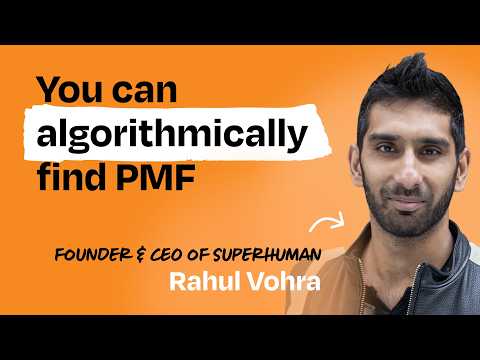
Superhuman's secret to success | Rahul Vohra (CEO and founder)
Lenny Rachitsky (host), Rahul Vohra (guest), Narrator
In this episode of Lenny's Podcast, featuring Lenny Rachitsky and Rahul Vohra, Superhuman's secret to success | Rahul Vohra (CEO and founder) explores superhuman’s CEO reveals playbook for speed, virality, and product fit Rahul Vohra, founder and CEO of Superhuman, walks through the unconventional principles behind building Superhuman and his earlier company Rapportive, from word‑of‑mouth driven virality to an algorithmic approach to product‑market fit.
Superhuman’s CEO reveals playbook for speed, virality, and product fit
Rahul Vohra, founder and CEO of Superhuman, walks through the unconventional principles behind building Superhuman and his earlier company Rapportive, from word‑of‑mouth driven virality to an algorithmic approach to product‑market fit.
He explains how deep focus on speed, careful positioning, and obsessive attention to detail (down to custom typography) became Superhuman’s core differentiators, and why they manually onboarded users for years before shifting to self‑serve.
Rahul shares frameworks for reclaiming founder time (the switch log), redesigning the CEO role via a president hire, applying game design (not gamification) to productivity software, and using the Sean Ellis survey to literally compute and raise product‑market fit.
The conversation closes with how Superhuman is building on AI and moving upmarket into the enterprise, plus tactical decision-making tools like the Single Decisive Reason (SDR) framework.
Key Takeaways
Virality is mostly word of mouth, not growth hacks.
From LinkedIn’s growth team, Rahul learned that no product maintains a viral factor >1 for long; features like address-book import top out around 0. ...
Get the full analysis with uListen AI
You can measure and deliberately increase product–market fit.
Using the Sean Ellis question (“How would you feel if you could no longer use this product? ...
Get the full analysis with uListen AI
Founders must design their own role to stay in their ‘zone of genius.’
Rahul’s switch-log time-tracking revealed he was spending only ~6–7% of his week on product, design, tech, and marketing. ...
Get the full analysis with uListen AI
Manual onboarding can be a powerful temporary substitute for growth machinery.
Superhuman insisted on 1:1 concierge onboarding for years, building extreme engagement, retention, and word of mouth while avoiding early investment in complex self-serve flows. ...
Get the full analysis with uListen AI
Game design beats gamification for engagement.
Rahul distinguishes intrinsic from extrinsic motivation and shows why badges/points often backfire. ...
Get the full analysis with uListen AI
Positioning comes before pricing, and ‘expensive but worth it’ can be optimal.
After deciding to own the high-end “fastest email” position, Superhuman used the Van Westendorp pricing method. ...
Get the full analysis with uListen AI
AI value is often surprising and must be discovered empirically.
Some AI features Rahul expected to be hits underperformed, while seemingly ‘commodity’ features like Write with AI became heavily used (≈37 uses/user/week). ...
Get the full analysis with uListen AI
Notable Quotes
“There is no such thing as a truly viral product.”
— Elliot Schmukler (as recounted by Rahul Vohra)
“The true secret behind virality is word of mouth. It’s the virality you can’t measure.”
— Rahul Vohra
“To get to product–market fit, you have to deliberately not act on the feedback of many of your early users.”
— Rahul Vohra
“Your calendar says what you thought you were going to do, but it’s really only your trail of work that describes what you actually did.”
— Rahul Vohra
“Multiple low‑quality reasons rarely add up to a high‑quality reason to do something.”
— Rahul Vohra
Questions Answered in This Episode
How would you apply Superhuman’s product–market fit engine to a non-SaaS or marketplace business?
Rahul Vohra, founder and CEO of Superhuman, walks through the unconventional principles behind building Superhuman and his earlier company Rapportive, from word‑of‑mouth driven virality to an algorithmic approach to product‑market fit.
Get the full analysis with uListen AI
What signals should a founder watch for to know it’s time to hire a president or restructure their own role?
He explains how deep focus on speed, careful positioning, and obsessive attention to detail (down to custom typography) became Superhuman’s core differentiators, and why they manually onboarded users for years before shifting to self‑serve.
Get the full analysis with uListen AI
Where is the line between useful manual onboarding and over-investing in white-glove service that will never scale?
Rahul shares frameworks for reclaiming founder time (the switch log), redesigning the CEO role via a president hire, applying game design (not gamification) to productivity software, and using the Sean Ellis survey to literally compute and raise product‑market fit.
Get the full analysis with uListen AI
How can more traditional B2B tools practically incorporate game design principles without feeling gimmicky?
The conversation closes with how Superhuman is building on AI and moving upmarket into the enterprise, plus tactical decision-making tools like the Single Decisive Reason (SDR) framework.
Get the full analysis with uListen AI
As AI models evolve, what parts of Superhuman’s current AI roadmap does Rahul expect will break, commoditize, or need to be completely rethought?
Get the full analysis with uListen AI
Transcript Preview
Let's talk about product market fit.
You have to deliberately not act on the feedback of many of your early users. And this is at the same time as listening to people intensely and building what people want. That's what we're here to do, is to make something that people want. But it can't be all people, and the question becomes how do you listen to them? And then even of what they say, what do you pay attention to and what don't you? The trick here is...
You're not doing what a lot of CEOs think they need to be doing with their time. A lot of CEOs think they need to spend time on hiring or org building, and you intentionally, "I will spend time on product and marketing design."
So this is a technique that I call the switch log. And it's borne out of the observation that your calendar says what you thought you were going to do, but it's really only your trail of work that describes what you actually did. How can we capture that? So I came up with the following idea: What if I just did whatever the heck I wanted?
What's the most pivotal moment in your career, in your life?
I learned the real secret behind virality. There is no such thing as a truly viral product. What then is the true secret? It is...
(instrumental music) Today my guest is Rahul Vohra. Rahul is the founder and CEO of Superhuman, and one of the most thoughtful and insightful and articulate founders that I've met. As you'll see in our conversation, it's hard not to be captivated by Rahul's storytelling skills, and also his really insightful takes on how to build great products and teams. This episode is for anyone who's looking to build their product taste, help their teams move faster, learn how to think better from first principles, and also learn about Superhuman's very unique approach to building their company, including why they manually onboarded every single new user for years and why they decided to stop, why they ignored most of their customer feedback on their way to finding product market fit, and also how you can use his approach to finding product market fit for your own company. Also the power of game design in building great products, a very contrarian take on pricing strategy, what Rahul has learned about building scaled products on top of AI and LLMs, and so much more. A huge thank you to Ed Sims, Conrad Erwin, Belle Trenchard, and Gaurav Vohra for suggesting questions and topics for this conversation. If you enjoy this podcast, don't forget to subscribe and follow it in your favorite podcasting app or YouTube. Also, if you become a yearly subscriber of my newsletter, you get a year free of Superhuman that you can start using immediately. You also get a year free of Notion, Perplexity Pro, Granola, and Linear. Check it out at lennysnewsletter.com With that, I bring you Rahul Vohra. This episode is brought to you by Eppo. Eppo is a next generation A/B testing and feature management platform built by alums of Airbnb and Snowflake for modern growth teams. Companies like Twitch, Miro, ClickUp, and DraftKings rely on Eppo to power their experiments. Experimentation is increasingly essential for driving growth and for understanding the performance of new features, and Eppo helps you increase experimentation velocity while unlocking rigorous deep analysis in a way that no other commercial tool does. When I was at Airbnb, one of the things that I loved most was our experimentation platform, where I could set up experiments easily, troubleshoot issues, and analyze performance all on my own. Eppo does all that and more with advanced statistical methods that can help you shave weeks off experiment time, an accessible UI for diving deeper into performance, and out of the box reporting that helps you avoid annoying prolonged analytic cycles. Eppo also makes it easy for you to share experiment insights with your team, sparking new ideas for the A/B testing flywheel. Eppo powers experimentation across every use case, including product, growth, machine learning, monetization, and email marketing. Check out Eppo at geteppo.com/lenny and 10X your experiment velocity. That's geteppo.com/lenny. This episode is brought to you by the Fundrise flagship fund. Full disclosure: real estate investing is boring. Prediction markets are exciting, meme coins are a thrill ride, even the stock market can swing wildly on a headline. Hello, DeepZeke. But with real estate investing, there's no drama or adrenaline or excuses to refresh your portfolio every few minutes. Just bland and boring stuff like diversification and dividends. So you won't be surprised to learn that the Fundrise flagship real estate fund is a complete snoozefest. The fund holds $1.1 billion worth of institutional caliber real estate managed by a team of pros focused on steadily growing your net worth for decades to come. See? Boring. That's the point. You can start investing in minutes, and with as little as $10 by visiting fundrise.com/lenny. Carefully consider the investment objectives, risks, charges, and expenses of the Fundrise flagship fund before investing. Find this information and more in the fund's prospectus at fundrise.com/flagship. This is a paid ad. Rahul, thank you so much for being here. Welcome to the podcast.
Install uListen to search the full transcript and get AI-powered insights
Get Full TranscriptGet more from every podcast
AI summaries, searchable transcripts, and fact-checking. Free forever.
Add to Chrome