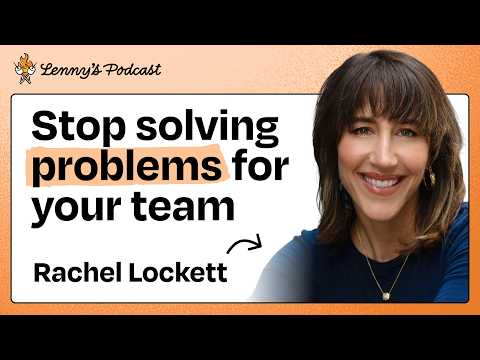
A guide to difficult conversations, building high-trust teams, and designing a life you love
Lenny Rachitsky (host), Rachel Lockett (guest), Narrator, Narrator
In this episode of Lenny's Podcast, featuring Lenny Rachitsky and Rachel Lockett, A guide to difficult conversations, building high-trust teams, and designing a life you love explores transforming Tech Leadership Through Coaching, Conflict Skills, And Purposeful Design Executive coach Rachel Lohse joins Lenny to unpack how technical leaders can evolve from being the smartest problem-solver in the room to becoming effective coaches who unlock their team’s potential. She introduces core coaching skills—active listening and powerful questioning (via the GROW model)—and demonstrates them live with Lenny. They dig into preventing burnout by deliberately designing roles around personal gifts, managing co-founder dynamics and difficult conversations, and creating operating rhythms like a one-page plan that align vision, strategy, and execution. Throughout, Rachel emphasizes that business-building is fundamentally human work, and that attending to relationships, emotions, and purpose leads to better performance and richer lives.
Transforming Tech Leadership Through Coaching, Conflict Skills, And Purposeful Design
Executive coach Rachel Lohse joins Lenny to unpack how technical leaders can evolve from being the smartest problem-solver in the room to becoming effective coaches who unlock their team’s potential. She introduces core coaching skills—active listening and powerful questioning (via the GROW model)—and demonstrates them live with Lenny. They dig into preventing burnout by deliberately designing roles around personal gifts, managing co-founder dynamics and difficult conversations, and creating operating rhythms like a one-page plan that align vision, strategy, and execution. Throughout, Rachel emphasizes that business-building is fundamentally human work, and that attending to relationships, emotions, and purpose leads to better performance and richer lives.
Key Takeaways
Great leaders coach more than they advise.
Leaders who always provide answers train teams to depend on them and become bottlenecks. ...
Get the full analysis with uListen AI
Active listening and powerful questions dramatically improve 1:1s.
Rachel breaks listening into three levels (self-focused, word-focused, and global) and shows how level-three listening plus the GROW framework (Goal, Reality, Options, Way forward) helps people surface their own solutions, feel deeply understood, and commit to action.
Get the full analysis with uListen AI
Design your role around your gifts to avoid burnout.
Sustained energy comes from spending ~80% of your time in activities that align with your natural strengths. ...
Get the full analysis with uListen AI
You—not your manager—own your career and your gifts.
Managers are hired to ensure you perform in your role, not to architect your ideal job. ...
Get the full analysis with uListen AI
Healthy conflict aims at mutual understanding, not winning.
Most people enter tough conversations armored up to prove they’re right, which triggers defensiveness and stalemate. ...
Get the full analysis with uListen AI
Co-founder relationships need structure, self-awareness, and ritual.
Given how often startups fail due to co-founder conflict, Rachel recommends shared language around strengths (e. ...
Get the full analysis with uListen AI
Simple operating rhythms and a one-page plan increase clarity and alignment.
Tying vision, values, strategy, KPIs, annual goals, and quarterly goals into a single, visible one-page plan—and reviewing it on a regular cadence—helps everyone know what truly matters, how their work ladders up, and which “inconvenient truths” need to be addressed.
Get the full analysis with uListen AI
Notable Quotes
“When you try to advise and have the answer all the time, you're not actually equipping your team to solve the hard problems.”
— Rachel Lohse
“Professionals have feelings. We operate in tech like this is all logical, but it's completely emotional.”
— Rachel Lohse
“The goal of any conflict is to create mutual understanding, not to convince the other person they're wrong.”
— Rachel Lohse
“It's no one else's job to help you live in your gifts. Your manager’s job is to help you perform the job you were hired to do.”
— Rachel Lohse
“The quality of our relationships determines the quality of our life.”
— Rachel Lohse
Questions Answered in This Episode
In my current role, what would it tangibly look like to spend 80% of my time in my gifts, and what concrete changes would that require over the next 6–12 months?
Executive coach Rachel Lohse joins Lenny to unpack how technical leaders can evolve from being the smartest problem-solver in the room to becoming effective coaches who unlock their team’s potential. ...
Get the full analysis with uListen AI
Where am I still behaving like the ‘answer person’ instead of a coach, and how is that limiting my team’s ownership and growth?
Get the full analysis with uListen AI
What difficult conversation have I been avoiding, and how would it change if I approached it using the NVC steps of observation, feelings, needs, and request?
Get the full analysis with uListen AI
If my co-founder or closest work partner were totally honest, what would they say I do that both empowers and frustrates them—and how can we create a regular ritual to talk about those dynamics?
Get the full analysis with uListen AI
Looking at my company today, could every team member succinctly explain our vision, top strategic priorities, and how their work connects—and if not, how might a one-page plan and quarterly rhythm help?
Get the full analysis with uListen AI
Transcript Preview
When clients come to you, what is the biggest gap they have that is keeping them from being successful as leaders?
Most leaders, especially technical leaders, assume they have to have all the answers. People have climbed the ladder because they've been dependable, reliable, the smartest person in the room. But great leaders know that when you try to advise and have the answer all the time, you're not actually equipping your team to go solve the hard problems. You're training your team to come to you with all of the hard problems.
Difficult conversations are difficult. How do we help people make them less difficult?
We operate in tech like we're supposed to give all of ourselves, all of our time, all of our energy to this endeavor, and it's purely logical. That's not at all true. It's completely emotional. Professionals have feelings. People, when they wanna have a conflict, they come in ready to prove their point. There's a misguided view that the goal is to convince the other person that what they're doing is wrong. Actually, the goal of any conflict is to create mutual understanding.
Talk about what you've learned about helping leaders in tech avoid burnout.
When people are in their gifts and their strengths, they have more energy. We all have more energy when we're operating from the things we naturally are good at. It's no one else's job to help you live in your gifts. What I notice in big companies is people are often annoyed or frustrated with their management for not making their job more interesting. No, your manager's job is to help you perform in the job you were hired to do. It's your job to navigate your career.
The power of this is this makes your life so much better.
Lenny, let's try it. So I want you to tell me a challenge, something that you're struggling with.
The main thing I struggle with these days is just... Today, my guest is Rachel Lockett, an executive coach and former long-time HR leader at Pinterest and at Stripe. She works with CEOs and founders and leaders at tech companies on both ways that they are emotional and positive, intelligence, resilience, and courage, and what they do, setting vision and strategy, prioritizing and building trusted and accountable teams. She's someone I've heard a lot about over the years from other podcast guests, and this conversation is powerful. It's jam-packed with advice and tips and frameworks that'll make you a better leader and also a better person. We even do a couple of live coaching sessions to demonstrate some of Rachel's approaches. And as you'll see, I had a number of epiphanies during this conversation. If you enjoy this podcast, don't forget to subscribe and follow it in your favorite podcasting app or YouTube. It helps tremendously. And if you become an annual subscriber of my newsletter, you get a year free of a ton of incredible products, including Dev and Lovable, Replit, Bolt, Innit, and Linear, Superhuman, Descript, Whisperflow, Gamma, Perplexity, Warp, Granola, Magic Patterns, Raycast, ChatPR, DeMob, and, and Stripe Atlas. Head on over to lennysnewsletter.com and click Product Pass. With that, I bring you Rachel Lockett after a short word from our sponsors. 1.3%, it's a small number, but in the right context, it's a powerful one. Stripe processed just over $1.4 trillion last year. That figure works out to be about 1.3% of global GDP. It's a lot, but it's also just 1.3%. Stripe handles the massive scale and complexity of many of the world's fastest-growing enterprises, including 78% of the Forbes AI50 and more than half of the Fortune 100. There's a reason I've had more leaders from Stripe on this podcast than any other company. They know how to build great products that scale and that people love. Stripe is also a lot more than just payments. They've also got a category-leading billing solution and a highly optimized checkout experience built specifically to increase your checkout conversion. Enterprises like Atlassian, Figma, and Urban use Stripe to create fully branded and customized checkout pages with access to more than 125 global payment methods. Join the ranks of industry leaders like Salesforce, OpenAI, and Pepsi that are using Stripe to grow faster and grow GDP. Learn how Stripe can help your business grow at stripe.com. My podcast guest tonight love talking about craft and taste, and agency and product market fit. You know what we don't love talking about? SOC 2. That's where Vanta comes in. Vanta helps companies of all sizes get compliant fast and stay that way with industry-leading AI, automation, and continuous monitoring. Whether you're a startup tackling your first SOC 2 or ISO 27001, or an enterprise managing vendor risk, Vanta's trust management platform makes it quicker, easier, and more scalable. Vanta also helps you complete security questionnaires up to five times faster so that you can win bigger deals sooner. The result? According to a recent IDC study, Vanta customers slashed over $500,000 a year and are three times more productive. Establishing trust isn't optional. Vanta makes it automatic. Get $1,000 off at vanta.com/lenny. Rachel, thank you so much for being here, and welcome to the podcast.
Install uListen to search the full transcript and get AI-powered insights
Get Full TranscriptGet more from every podcast
AI summaries, searchable transcripts, and fact-checking. Free forever.
Add to Chrome