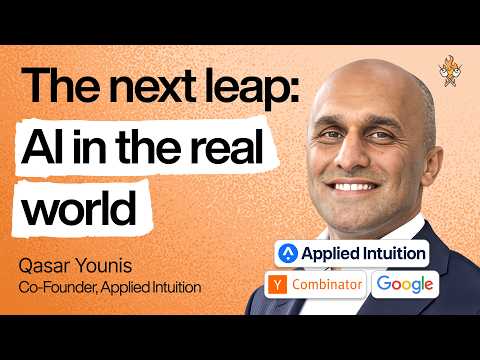
The real AI revolution isn’t software. It’s farms, mines, and trucks. | Qasar Younis
Lenny Rachitsky (host), Qasar Younis (guest)
In this episode of Lenny's Podcast, featuring Lenny Rachitsky and Qasar Younis, The real AI revolution isn’t software. It’s farms, mines, and trucks. | Qasar Younis explores aI’s near-term revolution will transform physical industries, not apps alone Qasar Younis, CEO of Applied Intuition, explains why AI’s biggest near-term impact won’t be chatbots or software products, but autonomy in farms, mines, construction sites, and trucking—domains with labor shortages, safety issues, and massive economic leverage.
AI’s near-term revolution will transform physical industries, not apps alone
Qasar Younis, CEO of Applied Intuition, explains why AI’s biggest near-term impact won’t be chatbots or software products, but autonomy in farms, mines, construction sites, and trucking—domains with labor shortages, safety issues, and massive economic leverage.
He frames the AI era as analogous to the Industrial Revolution: disruptive and imperfect, yet likely to reduce global suffering via expanded access to services, safety, and eventually breakthroughs in areas like disease.
Younis recommends combating AI anxiety through hands-on understanding of the technology’s limitations and actively steering it toward beneficial uses rather than “pumping the brakes.”
He also shares contrarian founder advice: early traction is a strong signal; quiet focus and “maintenance” culture matter; and high-performing organizations institutionalize truth-seeking, decisiveness, and customer obsession.
Key Takeaways
The next AI wave is autonomy in the physical economy.
Younis expects the most meaningful 5–10 year impact in farming, mining, construction, and trucking because these sectors already have expensive machines and clear ROI—adding “a little intelligence” unlocks huge safety and productivity gains.
Get the full analysis with uListen AI
AI fear is often a knowledge gap, not a technical reality.
He argues anxiety is fueled by misunderstanding—people fill in scary assumptions when they don’t know how systems work. ...
Get the full analysis with uListen AI
Safety is the under-discussed moral argument for autonomy.
He emphasizes that tens of thousands die annually in U. ...
Get the full analysis with uListen AI
Labor shortages make autonomy a complement, not a replacement—near term.
In industries like farming and long-haul trucking, fewer people want these roles (aging workforce, lifestyle tradeoffs). ...
Get the full analysis with uListen AI
Expect autonomy to become cheap and ubiquitous like navigation did.
He predicts L2++ driver-assist will spread broadly because it doesn’t require heavy sensor suites and HD maps, while L4 expands in constrained geographies. ...
Get the full analysis with uListen AI
Don’t confuse stock sell-offs with real-world AI impacts.
Younis separates public market fear (hedge funds extrapolating from quick AI-built demos and “vibe coding” narratives) from societal anxiety. ...
Get the full analysis with uListen AI
Quiet focus can be a strategic advantage—if your context allows it.
Applied Intuition stayed under the radar to maximize time on customers/product (“every minute…for public consumption” is time lost). ...
Get the full analysis with uListen AI
Early traction is a powerful signal; lack of market narrowing may require a reset.
From YC experience, strong companies often show traction early and sustain it. ...
Get the full analysis with uListen AI
High-performance culture is built from observed causes of success, not abstract ideals.
He recommends deriving values from what’s already working (e. ...
Get the full analysis with uListen AI
Truth-seeking requires psychological safety plus decisive execution.
He encourages leaders to surface naysayers and ensure juniors speak up, preventing momentum from drowning out reality (his Google vs Facebook example). ...
Get the full analysis with uListen AI
China should be analyzed as state competition, not company competition.
He argues firms like Huawei function as extensions of the state with different incentives than profit-driven Western companies, making comparisons misleading (e. ...
Get the full analysis with uListen AI
Taste and leadership judgment are cultivated through breadth—work, travel, and reading.
He believes many CEOs lack taste due to narrow life paths (school → startup without being an employee). ...
Get the full analysis with uListen AI
Notable Quotes
“Every minute you're writing something for public consumption, you're not focusing your very limited time that you have on your customers and your product.”
— Qasar Younis
“The real impact of AI in the next five to 10 years really is gonna be in farming, mining, construction.”
— Qasar Younis
“The core root of fear is misunderstanding.”
— Qasar Younis
“Over thirty thousand people will die in the next year from these accidents.”
— Qasar Younis
“Our best work is done alone and quietly.”
— Qasar Younis
Questions Answered in This Episode
Applied Intuition is described as “Waymo or Tesla without hardware”—what are the concrete product modules you sell (simulation, validation, tooling, on-vehicle runtime), and which drive most revenue today?
Qasar Younis, CEO of Applied Intuition, explains why AI’s biggest near-term impact won’t be chatbots or software products, but autonomy in farms, mines, construction sites, and trucking—domains with labor shortages, safety issues, and massive economic leverage.
Get the full analysis with uListen AI
You predict autonomy becomes “close to free” like navigation—what has to change (compute cost, regulation, liability, OEM economics) for that pricing collapse to happen?
He frames the AI era as analogous to the Industrial Revolution: disruptive and imperfect, yet likely to reduce global suffering via expanded access to services, safety, and eventually breakthroughs in areas like disease.
Get the full analysis with uListen AI
Where do you see the hardest remaining bottlenecks for physical AI: long-tail edge cases, sensor cost, data collection, verification/safety certification, or deployment/operations?
Younis recommends combating AI anxiety through hands-on understanding of the technology’s limitations and actively steering it toward beneficial uses rather than “pumping the brakes.”
Get the full analysis with uListen AI
You argue learning AI reduces fear because of its limitations—what are the most important limitations in real-world autonomy that the public misunderstands today?
He also shares contrarian founder advice: early traction is a strong signal; quiet focus and “maintenance” culture matter; and high-performing organizations institutionalize truth-seeking, decisiveness, and customer obsession.
Get the full analysis with uListen AI
How should policymakers balance ‘don’t pump the brakes’ with legitimate safety and labor transition concerns—what specific regulations would you support or oppose for autonomous trucks/mining?
Get the full analysis with uListen AI
Transcript Preview
You decided to join Twitter recently. You put out your first tweet. Marc Andreessen quote tweeted it and said, "This is the best AI CEO nobody knows."
Our best work is done alone and quietly. Every minute you're writing something for public consumption, you're not focusing your very limited time that you have on your customers and your product.
You're building a lot of the future that we're gonna be living in. What does the next couple years look like?
Us solving some of these impossible problems like cancer are directly gonna be related to this AI boom. Net suffering in humanity overall should go down significantly.
A thread that has emerged on this podcast is that AI is coming just in time to save us.
The real impact of AI in the next five to 10 years really is gonna be in farming, mining, construction. These industries, they need autonomy, and it couldn't come soon enough. If you look at farmers, the average age of a farmer is in their late fifties. What does that mean in 10 years from now?
There's a lot of anxiety about what AI is gonna do to the world.
The core root of fear is misunderstanding. If you at home are very anxious about AI, the best thing that you can do is spend time to understand, and you will quickly see the limitations. Get to know it, then actively make the technology be used for good.
[instrumental music playing] Today my guest is Qasar Younis, co-founder and CEO of Applied Intuition. You've probably never heard of Qasar or Applied Intuition. This is the most important under-the-radar AI company and CEO that I've ever come across. It's a fifteen-billion-dollar company that has been growing quietly over the last decade. What they do is they add AI to vehicles like cars, tractors, planes, submarines, mining rigs, and a lot more. Eighteen out of the top twenty automakers are customers as well as the biggest global construction, mining, and trucking companies, also the Department of Defense. They're basically Waymo or Tesla, but without the hardware. Qasar himself was born on a farm in Pakistan, grew up in Detroit, started his career as an engineer at GM and then at Bosch. He then went on to start a couple companies before starting Applied Intuition. I love everything about this episode, and I am so excited to bring it to you. Don't forget to check out lennysproductpass.com for an incredible set of deals available exclusively to Lenny's Newsletter subscribers. Let's get into it after a short word from our wonderful sponsors. This episode is brought to you by Omni. Many product teams today are in the process of debating how to ship AI analytics. The hard part is obvious. Having an LLM guess at SQL in production is a huge mess and just a bad idea. Omni takes a different approach. They have a semantic layer built in so that when you embed their analytics, the AI actually knows your business definitions, not just your raw tables. You can test queries, validate the reasoning, and lock down permissions before anything hits production. If you want AI analytics in your product without building the whole stack from scratch, check out omni.co/lenny for a free three-week trial. Companies like Perplexity, DBT, and BuzzFeed use Omni to ship analytics their customers can trust. That's O-M-N-I dot C-O slash lenny. My podcast guests and I love talking about craft and taste and agency and product market fit. You know what we don't love talking about? SOC two. That's where Vanta comes in. Vanta helps companies of all sizes get compliant fast and stay that way with industry-leading AI, automation, and continuous monitoring. Whether you're a startup tackling your first SOC two or ISO twenty-seven oh-oh-one or an enterprise managing vendor risk, Vanta's trust management platform makes it quicker, easier, and more scalable. Vanta also helps you complete security questionnaires up to five times faster so that you can win bigger deals sooner. The result, according to a recent IDC study, Vanta customers slashed over five hundred thousand dollars a year and are three times more productive. Establishing trust isn't optional. Vanta makes it automatic. Get one thousand dollars off at vanta.com/lenny. [instrumental music playing] Qasar, thank you so much for being here. Welcome to the podcast.
Install uListen to search the full transcript and get AI-powered insights
Get Full TranscriptGet more from every podcast
AI summaries, searchable transcripts, and fact-checking. Free forever.
Add to Chrome