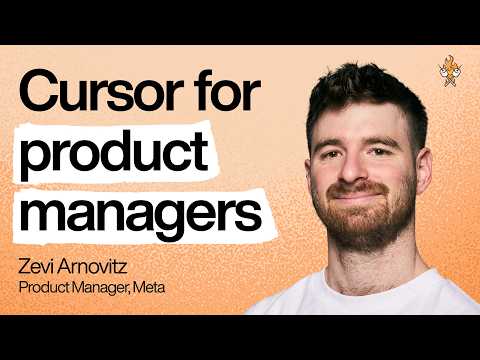
How a Meta PM ships products without ever writing code | Zevi Arnovitz
Lenny Rachitsky (host), Zevi Arnovitz (guest)
In this episode of Lenny's Podcast, featuring Lenny Rachitsky and Zevi Arnovitz, How a Meta PM ships products without ever writing code | Zevi Arnovitz explores a non-technical Meta PM builds and ships using AI workflows Zevi Arnovitz, a Meta PM with no technical background, demonstrates how he builds and ships real product features without writing code by relying on a structured AI workflow in Cursor.
A non-technical Meta PM builds and ships using AI workflows
Zevi Arnovitz, a Meta PM with no technical background, demonstrates how he builds and ships real product features without writing code by relying on a structured AI workflow in Cursor.
His system centers on reusable “slash commands” that turn product ideas into Linear issues, guide an exploration phase, generate an implementation plan, execute it with AI coding agents, and then run multi-model code review.
To mitigate risks (especially code review), he pits different models (Claude, Codex, Gemini) against each other via “peer review,” and continuously improves prompts/documentation through postmortems.
He argues AI doesn’t replace thinking—if used intentionally, it accelerates learning and enables juniors to build faster, gain reps, and even prepare effectively for high-stakes interviews like Meta’s.
Key Takeaways
Use a staged workflow to prevent “AI jumps straight to code” failures.
Zevi found tools like Bolt/Lovable overly eager to code without sufficient planning. ...
Get the full analysis with uListen AI
Start with “compartmentalized” AI contexts to avoid polluted memory and bad advice.
He recommends Projects (ChatGPT/Claude) to separate domains (running vs. ...
Get the full analysis with uListen AI
Slash commands turn good prompting into a scalable operating system.
He saves reusable prompts inside the repo (e. ...
Get the full analysis with uListen AI
Automate fast idea capture into Linear to protect flow.
When a bug/idea appears mid-build, his “create issue” command asks minimal clarifying questions and generates a structured Linear ticket via MCP tooling—good enough to resume later, not “final spec” perfection.
Get the full analysis with uListen AI
Treat exploration as an engineering-style discovery phase, not ideation fluff.
In exploration, Claude reads the codebase, identifies affected files, and asks sophisticated scope/data/UX/grading/prompt questions. ...
Get the full analysis with uListen AI
Multi-model review is a practical substitute for missing technical judgment.
Since Zevi can’t reliably catch code issues, he runs reviews across Claude and Codex (and sometimes others), then uses a “peer review” prompt to force the primary agent to rebut or fix issues rather than blindly accept them.
Get the full analysis with uListen AI
Continuous postmortems + docs are the highest leverage productivity hack.
After mistakes, he asks the model what in the prompt/tooling caused the error, then updates documentation/commands so the same failure doesn’t recur. ...
Get the full analysis with uListen AI
AI can accelerate PM craft—if you still own the output.
He rejects the idea that AI ‘outsources thinking’; the risk is only when you ship unowned “AI slop. ...
Get the full analysis with uListen AI
For larger companies, make the codebase AI-native first and keep scope contained.
He suggests technical teams add markdown guides and structure so agents can navigate safely. ...
Get the full analysis with uListen AI
AI-first interviewing works best as a coach + feedback loop, not a crutch.
Zevi built a Claude Project “interview coach,” used question banks and analysis to prioritize practice, and got blunt feedback. ...
Get the full analysis with uListen AI
Notable Quotes
“It basically felt like someone came up to me and said, ‘You have superpowers now.’”
— Zevi Arnovitz
“If people walk away thinking how amazing you are, you’ve failed… if people walk away and open their computer and start building, you’ve succeeded.”
— Zevi Arnovitz
“Code is terrifying… I look at it as kind of like exposure therapy.”
— Zevi Arnovitz
“It’s very difficult for me to catch mistakes… I will have each of them review the code.”
— Zevi Arnovitz
“I think titles are gonna collapse, and responsibilities are gonna collapse, and everyone’s just gonna be building.”
— Zevi Arnovitz
Questions Answered in This Episode
Can you share the exact structure of your Claude.md “system prompt” (the CTO behaviors, challenge mode, and workflow rules) and what changed most over time?
Zevi Arnovitz, a Meta PM with no technical background, demonstrates how he builds and ships real product features without writing code by relying on a structured AI workflow in Cursor.
Get the full analysis with uListen AI
In your “exploration phase,” what are the top 5 clarifying questions you’ve learned to always answer before letting an agent plan or code?
His system centers on reusable “slash commands” that turn product ideas into Linear issues, guide an exploration phase, generate an implementation plan, execute it with AI coding agents, and then run multi-model code review.
Get the full analysis with uListen AI
How do you decide when to use Composer vs. Claude Code vs. Gemini for UI—do you have heuristics or a decision tree?
To mitigate risks (especially code review), he pits different models (Claude, Codex, Gemini) against each other via “peer review,” and continuously improves prompts/documentation through postmortems.
Get the full analysis with uListen AI
What does your “peer review” slash command look like verbatim, and how do you format/merge conflicting feedback from Claude vs. Codex?
He argues AI doesn’t replace thinking—if used intentionally, it accelerates learning and enables juniors to build faster, gain reps, and even prepare effectively for high-stakes interviews like Meta’s.
Get the full analysis with uListen AI
What are the most common failure modes you see when AI edits prompts that generate quiz questions (e.g., hallucinations, wrong difficulty, leakage from source text)?
Get the full analysis with uListen AI
Transcript Preview
You are a product manager shipping product without knowing how to write code, barely knowing how to review code.
I have zero technical background. Did music in high school when Sonnet 3.5 came out. I remember watching a YouTube video building apps using Bolt or Lovable. It basically felt like someone came up to me and said, "You have superpowers now."
These days, you're using Cursor with Claude Code.
If you're non-technical like me, code is terrifying, but AI just makes so much possible. In the next coming years, I think everyone's gonna become a builder. Titles are gonna collapse, and responsibilities are gonna collapse.
The main challenge people have is reviewing the code that AI has written.
It's very difficult for me to catch mistakes. What I'll do is basically slash review. This tells Claude to start reviewing its own code, but what's even cooler is I have Codex as well as Cursor open. I will have each of them review the code.
This comes back to this quote I think everyone's always hearing: "It's not that you will be replaced by AI. You'll be replaced by someone who's better at using AI than you."
It's the best time to be a junior, contrary to what a lot of people are saying, how there's no more junior roles out there. Yeah, that's true, but also, when else in history could you get out of school and just build a startup on your own?
[upbeat music] Today, my guest is Zevi Arnovitz. Zevi's a PM at Meta. Prior to that, he was a PM at Wix, and this is a truly remarkable conversation that every non-technical product person needs to hear. Zevi is super young and has no technical background, but as a smart, young, ambitious person, has learned how to use Cursor and Claude Code to build significant and real products completely on his own, and he's created his own very clever and effective workflow that everyone listening can copy. To make that copying even easier, at the top of the show notes of this episode, you can download all of the prompts and slash commands and start doing all of this yourself. Zevi shows you how to work with Cursor to quickly add your ideas to Linear, to explore your idea with AI, how to develop your plan, how to then build the thing, and then have different LLMs review your code and update your documentation, and then use all of this as a learning opportunity to develop your own sense of how things work. I haven't stopped thinking about this conversation since we had it, and everyone needs to pay attention to what AI is unlocking for non-technical people. A huge thank you to Tal Raviv for encouraging me to meet Zevi. If you enjoy this podcast, don't forget to subscribe and follow it in your favorite podcasting app or YouTube. It helps tremendously. And if you become an annual subscriber of my newsletter, you get 19 premium products for free for an entire year, including Lovable, Replit, Bolt, Gamma, n8n, Linear, Devon, PostHog, Superhuman, Descript, Wispr Flow, Perplexity, Warp, Granola, Magic Pattern, Drake House, ChatPR, dmobbin, and Stripe Atlas. Head on over to lennysnewsletter.com and click Product Pass. With that, I bring you Zevi Arnovitz after a short word from our sponsors. This episode is brought to you by 10Web, the company that pioneered AI website building before ChatGPT. In the last three years, over two million websites have been generated with 10Web's vibe coding platform. 10Web's vibe coding platform is a powerful way to build websites. Think of it as Lovable for WordPress, front-end and back-end. Users can build any website at any complexity: e-commerce, portfolios, information websites, blogs, and it comes with a WordPress admin panel and thousands of ready-to-use plugins. 10Web also offers website generation as an API as a service for SaaS companies, marketplaces, hosting providers, MSPs, and agencies. SaaS companies can embed it via API, so that users can launch AI-generated sites directly inside of their platform, connected to their own data. Agencies and MSPs can get a white label dashboard to manage clients and resell under their brand. Hosting providers can self-host the API builder on their own infrastructure. Check it out at 10web.io/lenny, and use code LENNY for exclusive free credits and 30% off API or white label solutions. That's the number 10W-E-B.io/lenny. Vibe coding platform as an API. Today's episode is brought to you by DX, the developer intelligence platform designed by leading researchers. To thrive in the AI era, organizations need to adapt quickly, but many organization leaders struggle to answer pressing questions like: Which tools are working? How are they being used? What's actually driving value? DX provides the data and insights that leaders need to navigate this shift. With DX, companies like Dropbox, Booking.com, Adyen, and Intercom get a deep understanding of how AI is providing value to their developers and what impact AI is having on engineering productivity. To learn more, visit DX's website at getdx.com/lenny. That's getdx.com/lenny. [upbeat music] Zevi, thank you so much for being here, and welcome to the podcast.
Install uListen to search the full transcript and get AI-powered insights
Get Full TranscriptGet more from every podcast
AI summaries, searchable transcripts, and fact-checking. Free forever.
Add to Chrome