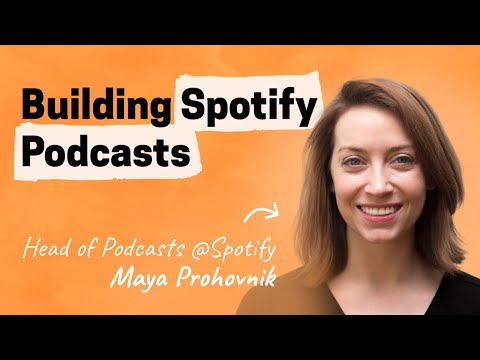
Building Anchor, selling to Spotify, and lessons learned | Maya Prohovnik (Head of Podcast Product)
Maya Prohovnik (guest), Lenny Rachitsky (host), Guest PM (colleague of Maya, possibly Wilma Chu) (guest)
In this episode of Lenny's Podcast, featuring Maya Prohovnik and Lenny Rachitsky, Building Anchor, selling to Spotify, and lessons learned | Maya Prohovnik (Head of Podcast Product) explores from Anchor Hackery To Spotify Powerhouse: Maya Prohovnik’s Playbook Maya Prohovnik, Head of Podcast Product at Spotify and first employee at Anchor, shares how Anchor evolved from a scrappy startup into the backbone of Spotify’s podcast ecosystem, now hosting over 75% of new shows on the platform.
From Anchor Hackery To Spotify Powerhouse: Maya Prohovnik’s Playbook
Maya Prohovnik, Head of Podcast Product at Spotify and first employee at Anchor, shares how Anchor evolved from a scrappy startup into the backbone of Spotify’s podcast ecosystem, now hosting over 75% of new shows on the platform.
She explains why deep dogfooding (running four of her own podcasts) is central to her product philosophy, and how that informs onboarding, community features, and creator tools.
Maya dives into balancing gut and data in product decisions, including two major strategic ‘evolutions’ of Anchor and a famously unscalable distribution hack powered by college interns.
She also covers integrating a startup into a big company, maintaining a fast-moving culture, leadership frameworks like Radical Candor, productivity habits, public speaking tactics, and even backyard chicken therapy.
Key Takeaways
Dogfooding deeply improves product judgment and empathy.
By running four of her own podcasts—including highly produced, fully mobile, niche, and parenting shows—Maya experiences the same pain points as creators, which sharpens her sense of what to build, how to onboard, and which features actually matter.
Get the full analysis with uListen AI
Be willing to “kill your darlings” even when something is working.
Anchor twice rebuilt its core product despite strong user love and retention, because the team believed the existing direction couldn’t achieve their mission of democratizing audio at massive scale; each bold shift led to materially better growth and fit.
Get the full analysis with uListen AI
Treat gut instinct as a valid data source, not the opposite of data.
Maya frames intuition as one type of data among many, then backs it with past experience, user anecdotes, and research; this makes subjective calls easier to align around and avoids the trap of hiding behind numbers or pure opinion.
Get the full analysis with uListen AI
Unscalable hacks can unlock differentiated value and market share.
Anchor’s “one-click” distribution to Apple Podcasts was secretly powered by college interns manually creating Apple IDs and submitting hundreds of thousands of feeds—an experience so magical for creators that it rapidly accelerated hosting market share.
Get the full analysis with uListen AI
Clarity of mission makes strategic pivots and acquisitions survivable.
Because Anchor’s founders were unwavering about democratizing audio rather than about any specific product instantiation, they could repeatedly pivot features, and later flex within Spotify’s evolving strategy, without losing their core purpose.
Get the full analysis with uListen AI
Radical Candor and fit-based thinking make feedback more effective.
Maya relies heavily on Kim Scott’s ‘care personally, challenge directly’ model, approaching underperformance as a role–fit problem rather than a character flaw, which makes tough conversations more constructive and relationships stronger.
Get the full analysis with uListen AI
Externalizing tasks and applying simple triage keeps leaders productive.
She writes everything down in a digital to-do app (Todoist), then runs a daily ‘do, defer, delegate, delete’ pass so her mind is free for deep thinking rather than holding lists—an application of the Eisenhower Matrix and “mind like water” principles.
Get the full analysis with uListen AI
Notable Quotes
“We were obsessed with reducing friction. This was our constant battle.”
— Maya Prohovnik
“We just had college students making Apple Podcast accounts and then submitting hundreds of thousands of podcasts through these accounts.”
— Maya Prohovnik
“You never know which tiny product changes are going to end up being this existential moment for your business.”
— Maya Prohovnik
“I would think of your gut actually as a type of data, and I think it's a totally valid one.”
— Maya Prohovnik
“Only a fool wishes time away.”
— Maya Prohovnik
Questions Answered in This Episode
How do you decide when a ‘working’ product is not good enough to achieve your long-term mission and merits a major pivot?
Maya Prohovnik, Head of Podcast Product at Spotify and first employee at Anchor, shares how Anchor evolved from a scrappy startup into the backbone of Spotify’s podcast ecosystem, now hosting over 75% of new shows on the platform.
Get the full analysis with uListen AI
What concrete steps can a non-creator product team take in the next month to dogfood more effectively?
She explains why deep dogfooding (running four of her own podcasts) is central to her product philosophy, and how that informs onboarding, community features, and creator tools.
Get the full analysis with uListen AI
Where is the line between a smart unscalable hack (like Anchor’s interns) and something that creates long-term technical or ethical debt?
Maya dives into balancing gut and data in product decisions, including two major strategic ‘evolutions’ of Anchor and a famously unscalable distribution hack powered by college interns.
Get the full analysis with uListen AI
How can founders better prepare emotionally and structurally for the post-acquisition identity crisis you described?
She also covers integrating a startup into a big company, maintaining a fast-moving culture, leadership frameworks like Radical Candor, productivity habits, public speaking tactics, and even backyard chicken therapy.
Get the full analysis with uListen AI
What specific product changes or experiments does Spotify plan to try next to finally crack podcast discovery and creator monetization at scale?
Get the full analysis with uListen AI
Transcript Preview
... we were obsessed with reducing friction. This was, like, our constant battle. And so we hired a couple of college interns and we, (laughs) brought them in and we were like, "People are gonna push, push this magical one button in the Anchor app and they're gonna say, 'I want to distribute my podcast,' and your job is gonna be to do all that same manual stuff manually. But to them, it's gonna feel magical and like it happened automatically." I, I still don't know how many people know this. I think people think that we had some secret door, like, backdoor deal with, with Apple for distribution, but we, uh, we just had college students (laughs) making Apple Podcast accounts and then submitting, like, hundreds of thousands of podcasts through these accounts. And I think that was a really big part of why we got so much hosting market share so quickly, because it was such an insane benefit over the other platforms, which otherwise had been, sort of, commoditized at that point.
(instrumental music) Welcome to Lenny's Podcast, where I interview world class product leaders and growth experts to learn from their hard won experiences building and growing today's most successful products. Today my guest is Maya Prohovnik. Maya is Spotify's head of product for podcasting, where she oversees product design and engineering teams responsible for building the tools and experiences for podcasters and their listeners. Maya was also employee number one at Anchor, which Spotify acquired about five years ago, which became the core of Spotify's podcasting hosting platform, which now powers over 75% of all new podcasts created in the world. In our conversation, we dig into why Maya is obsessed with dogfooding and why she encourages everyone on her team to create their own podcast. She's got four podcasts of her own, which are all very highly rated and people love. We dig into how she stays productive and organized in a very hectic senior leadership role, what she's done to allow for Anchor to continue to operate like a startup within a larger organization, also a bunch of really fun early Anchor stories, including how interns uploaded podcasts to Apple and Spotify manually before they could automate that, plus how to find a balance between using your gut and using data to make decisions. Also, public speaking tips, so much more. Maya's amazing and I'm really excited for you to hear this episode. With that, I bring you Maya Prohovnik after a short word from our sponsors. This episode is brought to you by Sidebar. Are you looking to land your next big career move or start your own thing? One of the most effective ways to create a big leap in your career, and something that worked really well for me a few years ago, is to create a personal board of directors, a trusted peer group where you can discuss challenges you're having, get career advice, and just kind of gut check how you're thinking about your work, your career, and your life. This has been a big trajectory changer for me, but it's hard to build this trusted group. With Sidebar, senior leaders are matched with highly vetted, private, supportive peer groups to lean on for unbiased opinions, diverse perspectives, and raw feedback. Everyone has their own zone of genius, so together we're better prepared to navigate professional pitfalls, leading to more responsibility, faster promotions, and bigger impact. Guided by world class programming and facilitation, Sidebar enables you to get focused, tactical feedback at every step of your journey. If you're a listener of this podcast, you're likely already driven and committed to growth. A Sidebar personal board of directors is the missing piece to catalyze that journey. Why spend a decade finding your people when you can meet them at Sidebar today? Jump the growing wait list of thousands of leaders from top tech companies by visiting sidebar.com/lenny to learn more. That's sidebar.com/lenny. This episode is brought to you by Wix Studio. Your agency has just landed a dream client, and you already have big ideas for the website, but do you have the tools to bring your ambitious vision to life? Let me tell you about Wix Studio, the new platform that lets agencies deliver exceptional client sites with maximum efficiency. How? First, let's talk about advanced design capabilities. With Wix Studio, you can build unique layouts with a revolutionary grid experience and watch as elements scale proportionally by default. No code animations add sparks of delight while adding custom CSS gives total design control. Bring ambitious client projects to life with any industry with a fully integrated suite of business solutions, from e-commerce to events, bookings, and more. And extend the capabilities even further with hundreds of APIs and integrations. You know what else? Their workflows just make sense. There's the built-in AI tools, the on-canvas collaborating, a centralized workspace, the reuse of assets across sites, a seamless client handover, and that's not all. Find out more at wix.com/studio. Maya, thank you so much for being here and welcome to the podcast.
Install uListen to search the full transcript and get AI-powered insights
Get Full TranscriptGet more from every podcast
AI summaries, searchable transcripts, and fact-checking. Free forever.
Add to Chrome