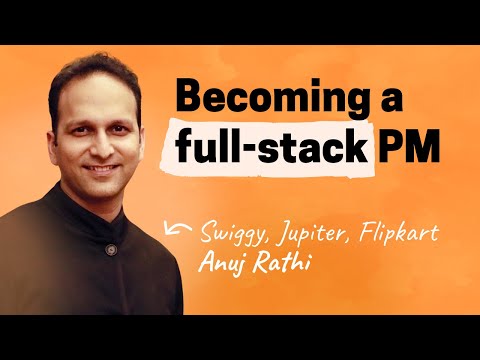
The full-stack PM | Anuj Rathi (Swiggy, Jupiter Money, Flipkart)
Anuj Rathi (guest), Lenny Rachitsky (host), Narrator
In this episode of Lenny's Podcast, featuring Anuj Rathi and Lenny Rachitsky, The full-stack PM | Anuj Rathi (Swiggy, Jupiter Money, Flipkart) explores building Full-Stack Product Managers for India’s Complex Digital Marketplaces Lenny interviews Anuj Rathi, veteran India-based product leader (Flipkart, Swiggy, Jupiter Money), about how product management has evolved in India’s unique, highly diverse, and price-sensitive market.
Building Full-Stack Product Managers for India’s Complex Digital Marketplaces
Lenny interviews Anuj Rathi, veteran India-based product leader (Flipkart, Swiggy, Jupiter Money), about how product management has evolved in India’s unique, highly diverse, and price-sensitive market.
Anuj shares detailed frameworks for onboarding and activating new users, implementing Amazon-style working backwards and PR/FAQs, and driving alignment through ‘show, don’t tell’ storytelling and strategy-on-a-page.
He argues PMs and companies must become far more ‘full stack’—owning outcomes across product, marketing, growth, operations, and org design—rather than just shipping features.
The conversation is packed with contrarian takes on experimentation, PM career fit, marketplace strategy, and how to think about excellence vs. speed, influence, and organizational setup.
Key Takeaways
Treat new users as lazy, vain, and selfish to design effective onboarding.
Assume users have little time (lazy), strong existing habits (vain), and care only about clear benefit (selfish). ...
Get the full analysis with uListen AI
Use working backwards with three divergent PR/FAQs to explore strategy space.
Don’t just write one PR/FAQ; craft three fully thought-through, divergent press releases and FAQs, then recommend one. ...
Get the full analysis with uListen AI
Be a full-stack PM who owns outcomes across product, business, and GTM.
Success isn’t shipping features; it’s changing user behavior, hitting business goals, and building capabilities. ...
Get the full analysis with uListen AI
Prioritize work using the 4BB framework, not just an undifferentiated backlog.
Allocate focus across four buckets—Brilliant Basics (foundational/“tech debt”), Bread & Butter (incremental improvements), Big Bets (cross-team initiatives), and Breaking Bad (company-changing moves). ...
Get the full analysis with uListen AI
Show, don’t tell: visualize concrete user journeys and company strategy.
Create detailed, wall-worthy flows of specific individuals (“person, not persona”) moving through the product, and strategy-on-a-page diagrams for the whole growth/retention loop. ...
Get the full analysis with uListen AI
Most failed execution is a setup problem, not a people problem.
When things don’t happen, classify the cause as: can’t do (capability), won’t do (motivation/alignment), or not set up to do (org design, goals, process). ...
Get the full analysis with uListen AI
In marketplaces, conventional tools like OKRs and A/B tests often break.
Three-sided marketplaces (consumer, supplier, delivery) have tightly coupled levers and network effects, so goals frequently conflict and experiments bleed across variants. ...
Get the full analysis with uListen AI
Notable Quotes
“Users today are lazy, vain, and selfish. Your onboarding has to win over that person, not the idealized power user in your head.”
— Anuj Rathi
“Product managers are in the business of influence. You’re a full-stack influencer—of engineers, of leadership, and of your users.”
— Anuj Rathi
“Most experiments should be thought experiments. If you think harder, many tests are obviously going to fail and never need to be run.”
— Anuj Rathi
“There are only three reasons things don’t happen: they can’t do, they won’t do, or they were not set up to do.”
— Anuj Rathi
“Work backwards from an amazing future and be paranoid about everything that can go wrong on the way there.”
— Anuj Rathi
Questions Answered in This Episode
How would Anuj’s ‘lazy, vain, selfish’ framework change the onboarding or marketing of a product I currently work on?
Lenny interviews Anuj Rathi, veteran India-based product leader (Flipkart, Swiggy, Jupiter Money), about how product management has evolved in India’s unique, highly diverse, and price-sensitive market.
Get the full analysis with uListen AI
What would my own 4BB allocation look like today, and does it truly match my company’s stated strategy and risk appetite?
Anuj shares detailed frameworks for onboarding and activating new users, implementing Amazon-style working backwards and PR/FAQs, and driving alignment through ‘show, don’t tell’ storytelling and strategy-on-a-page.
Get the full analysis with uListen AI
If I wrote three divergent PR/FAQs for my next big initiative, what surprising trade-offs or misalignments might I uncover?
He argues PMs and companies must become far more ‘full stack’—owning outcomes across product, marketing, growth, operations, and org design—rather than just shipping features.
Get the full analysis with uListen AI
Which of my team’s current failures are actually ‘not set up to do’ problems rather than capability or motivation issues?
The conversation is packed with contrarian takes on experimentation, PM career fit, marketplace strategy, and how to think about excellence vs. ...
Get the full analysis with uListen AI
As a PM, where am I currently ‘partial stack’—and what concrete steps can I take to become more full stack in the next 6–12 months?
Get the full analysis with uListen AI
Transcript Preview
There are only three reasons why things do not happen the way you want them to happen as a leader, and you could look at a person, and you'd say that either that person can't do, which is a capability issue, or they won't do, which is a motivation or an alignment issue, or they were not set up to do, which is really your problem that you didn't set up the ways of working or design properly. So as a leader, do you have the right people in terms of capability? And if not, is the right answer for us to coach them or to, like, really put them... or mentor them and so on? Or move them to some other place because maybe their capability is suited elsewhere? If they won't do, why won't they? Are they not aligned to you? Do they not agree with your vision? Do they not have enough time? And so on, so forth. So you need to really go deeper there. Why won't they do?
(Instrumental music) Today my guest is Anuj Rathi. I've been looking to get more India-based product leaders on the podcast because this podcast has a large audience in India, and when I put out a call on Twitter and LinkedIn asking people who I should have on, Anuj was the single most requested person. Anuj is Chief Product and Marketing Officer at Jupiter Money. Previously, he was Senior Vice President of Revenue and Growth at Swiggy where he spent seven years. He was also VP of Product at Snapdeal, a Senior PM at Walmart Labs, and the very first product manager at Flipkart where he led the buyer experience team. In our conversation, we dig into how product management is different in India, Anuj's lessons about building product experiences for new users, how he operationalized the working backwards process at the companies he's worked at, why he pushes his teams to explore three divergent directions before settling on a plan, why he thinks product managers and companies should be much more full stack than they are, also a bunch of frameworks and contrarian takes about building product and your career in product. A big thank you to Sayant Mighty and Nikhil Kulkarni for helping me navigate the product scene in India. Look for more amazing India-based product leaders to come. With that, I bring you Anuj Rathi after a short word from our sponsors. This episode is brought to you by Sanity. Your website is the heart of your growth engine. For that engine to drive big results, you need to be able to move super fast, ship new content, experiment, learn, and iterate. But most content management systems just aren't built for this. Your content teams wrestle with rigid interfaces as they build new pages. You spend endless time copying and pasting across pages and recreating content for other channels and applications. And their ideas for new experiments are squashed when developers can't build them within the constraints of outdated tech. Forward-thinking companies like Figma, Amplitude, Loom, Riot Games, Linear, and more use Sanity to build content growth engines that scale, drive innovation, and accelerate customer acquisition. With Sanity, your team can dream bigger and move faster. As the most powerful headless CMS on the market, you can tailor editorial workflows to match your business, reuse content seamlessly across any page or channel, and bring your ideas to market without developer friction. Sanity makes life better for your whole team. It's fast for developers to build with, intuitive for content managers, and it integrates seamlessly with the rest of your tech stack. Get started with Sanity's generous free plan, and as a Lenny's Podcast listener, you can get a boosted plan with double the monthly usage. Head over to sanity.io/lenny to get started for free. That's sanity.io/lenny. This episode is brought to you by Vanta, helping you streamline your security compliance to accelerate your growth. Thousands of fast-growing companies like Gusto, Calm, Quora, and Modern Treasury trust Vanta to help build, scale, manage, and demonstrate their security and compliance programs and get ready for audits in weeks, not months. By offering the most in-demand security and privacy frameworks such as SOC 2, ISO 27001, GDPR, HIPAA, and many more, Vanta helps companies obtain the reports they need to accelerate growth, build efficient compliance processes, mitigate risks to their businesses, and build trust with external stakeholders. Over 5,000 fast-growing companies use Vanta to automate up to 90% of the work involved with SOC 2 and these other frameworks. For a limited time, Lenny's Podcast listeners get $1,000 off Vanta. Go to vanta.com/lenny. That's V-A-N-T-A dot-com slash Lenny to learn more and to claim your discounts. Get started today. Anuj, thank you so much for being here, and welcome to the podcast.
Install uListen to search the full transcript and get AI-powered insights
Get Full TranscriptGet more from every podcast
AI summaries, searchable transcripts, and fact-checking. Free forever.
Add to Chrome