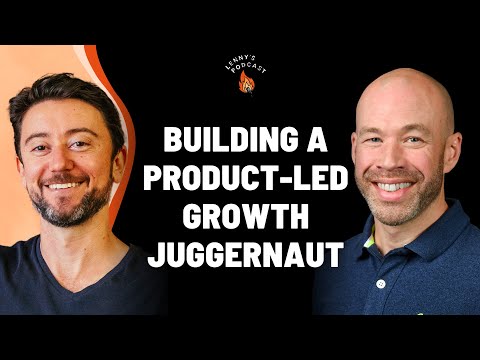
How Snyk built a product-led growth juggernaut | Ben Williams (VP of Product at Snyk)
Ben Williams (guest), Lenny Rachitsky (host)
In this episode of Lenny's Podcast, featuring Ben Williams and Lenny Rachitsky, How Snyk built a product-led growth juggernaut | Ben Williams (VP of Product at Snyk) explores inside Snyk’s rise: developer-first security and product-led sales engine VP of Product Ben Williams explains how Snyk built a massive developer-first security business through product-led growth that later evolved into product-led sales. Starting with a laser-focused niche—Node.js developers securing open source dependencies—the founders leaned on community engagement, freemium access, and cleverly designed growth loops (e.g., GitHub PRs, SEO sidecar products) to drive adoption.
Inside Snyk’s rise: developer-first security and product-led sales engine
VP of Product Ben Williams explains how Snyk built a massive developer-first security business through product-led growth that later evolved into product-led sales. Starting with a laser-focused niche—Node.js developers securing open source dependencies—the founders leaned on community engagement, freemium access, and cleverly designed growth loops (e.g., GitHub PRs, SEO sidecar products) to drive adoption.
Early monetization attempts via self-serve struggled with larger companies, revealing missing enterprise requirements like governance features and broader language support; this pushed Snyk to add sales, expand product breadth, and better serve security leaders while keeping developers at the core. Ben details how they structure their growth and product orgs, define activation, and think about freemium vs. paid, trials, and PLG-to-sales handoffs.
Throughout, he emphasizes intentional growth strategy via acquisition/activation/monetization loops, strong data foundations, cross-functional growth teams (including embedded growth marketers and “decision scientists”), and a culture of continuous experimentation and shared learnings.
Key Takeaways
Start with a narrow, high-need developer niche and go deep before expanding.
Snyk began with a single persona, ecosystem, and use case—Node. ...
Get the full analysis with uListen AI
Design explicit growth loops into the product experience from the start.
Snyk’s GitHub integration creates Snyk-branded auto-fix pull requests that both deliver value and act as acquisition and engagement loops, while programmatic SEO products like Snyk Advisor and free security education content continuously attract and convert developers without heavy manual marketing.
Get the full analysis with uListen AI
PLG alone isn’t enough in enterprise security; you must serve governance and buyers too.
Early self-serve monetization failed to land larger customers because Snyk lacked governance, reporting, and breadth across tech stacks that AppSec leaders and CISOs required—forcing them to add sales, enterprise capabilities, and a product-led sales motion while keeping developer love intact.
Get the full analysis with uListen AI
Structure growth teams around outcomes and make them truly cross-functional.
Snyk’s growth group is organized by acquisition, activation, monetization, and platform, with each team including engineering, PM, design, growth marketing, and decision science; this alignment on shared KPIs and skills reduces friction, accelerates experimentation, and avoids marketing–R&D misalignment.
Get the full analysis with uListen AI
Invest early in trustworthy behavioral data and a disciplined experimentation process.
Snyk had plenty of data but lacked clean, intentional behavioral tracking, so they built schema-validated event plans, a growth data platform, and regular impact-and-learning rituals, enabling reliable activation definitions, predictive models, and company-wide use of experiment insights.
Get the full analysis with uListen AI
Define activation around real value and habits at the team level, not just logins.
Because security is a ‘team sport,’ Snyk defines activation as a team fixing a vulnerability within 30 days of team creation—a behavior strongly correlated with 3‑month retention—then works backward to design set‑up, aha, and habit moments that increase the likelihood of reaching that milestone.
Get the full analysis with uListen AI
Continuously revisit freemium, trials, and packaging as your market and motion evolve.
Rather than freezing their free/paid split, Snyk regularly re-evaluates what’s in free vs. ...
Get the full analysis with uListen AI
Notable Quotes
“Security programs were historically more about audit and policing and enforcement versus developer enablement or empowerment.”
— Ben Williams
“While the answer to how does your product monetize users was much less clear-cut in the early days, the answer to how does your product acquire and retain users has always been product-led.”
— Ben Williams
“The GitHub pull requests were a first-of-a-kind integration… not only fixing code, but educating users and bringing new ones in at the same time.”
— Ben Williams
“You’re never gonna have a shortage of ideas in a high performing growth team. Knowing where to focus amidst that sea of ideas is a really important role of the strategy.”
— Ben Williams
“If you focus on the user’s path to value, monetization will follow. Learnings are the path to impact, not the opposite of it.”
— Ben Williams
Questions Answered in This Episode
How would Snyk’s early growth strategy differ if they were starting today, given the much more crowded developer tooling and security landscapes?
VP of Product Ben Williams explains how Snyk built a massive developer-first security business through product-led growth that later evolved into product-led sales. ...
Get the full analysis with uListen AI
What concrete steps can a non-security B2B company take to replicate Snyk’s GitHub-style growth loops in their own product domain?
Early monetization attempts via self-serve struggled with larger companies, revealing missing enterprise requirements like governance features and broader language support; this pushed Snyk to add sales, expand product breadth, and better serve security leaders while keeping developers at the core. ...
Get the full analysis with uListen AI
How do you decide when it’s time to shift focus from deep specialization in one niche to broader product coverage without diluting quality?
Throughout, he emphasizes intentional growth strategy via acquisition/activation/monetization loops, strong data foundations, cross-functional growth teams (including embedded growth marketers and “decision scientists”), and a culture of continuous experimentation and shared learnings.
Get the full analysis with uListen AI
What are the leading indicators Snyk uses to decide when a self-serve user or team is ready for a sales touch, and how does product-led sales work day to day?
Get the full analysis with uListen AI
How might Snyk’s freemium and trial strategy need to change as regulations, cloud environments, and software supply chain risks continue to evolve?
Get the full analysis with uListen AI
Transcript Preview
... being able to identify the various micro and macro loops, how they're all connected, being able to document them in a qualitative model to communicate a shared understanding of how you grow, it's really powerful. Augmenting that then with, you know, the quantitative side of things that help sh- guide quarter-to-quarter focus and ensure you can be intentional about where you're investing, that becomes a big enabler. You know, you're never gonna have a shortage of ideas in a high performing growth team. So, knowing where to focus amidst that kind of sea of ideas is a really important, um, role of the strategy.
(instrumental music) Welcome to Lenny's Podcast. I'm Lenny, and my goal here is to help you get better at the craft of building and growing products. I interview world class product leaders and growth experts to learn from their hard won experiences building and scaling today's most successful companies. Today my guest is Ben Williams. Ben is a VP of product at Snyk, which is likely one of the biggest and most interesting companies that you've never heard of. Snyk makes it easy for developers to catch security issues in their code, and there's a lot to learn from how Snyk got started. It started through product-led growth, evolved into product-led sales, was very community driven, was also laser focused on developers, which has become one of the most lucrative markets to go after. In our conversation, we cover how the founders of Snyk got their first 100 users, what they got wrong when they tried to monetize early on, when they hired their first marketing and sales people, how they structured and grew their growth and product teams, what they figured out about what should go into freemium and what shouldn't, and so much more. As you'll soon hear, Ben is British, and so the episode is automatically gonna sound more sophisticated, and I can't wait for you to hear it. With that, I bring you Ben Williams. This episode is brought to you by Coda. Coda's an all-in-one doc that combines the best of documents, spreadsheets and apps in one place. I actually use Coda every single day. It's my home base for organizing my newsletter writing. It's where I plan my content calendar, capture my research, and write the first drafts of each and every post. It's also where I curate my private knowledge repository for paid newsletter subscribers. And it's also how I manage the workload for this very podcast. Over the years, I've seen Coda evolve from being a tool that makes teams more productive to one that also helps bring the best practices across the tech industry to life with an incredibly rich collection of templates and guides in the Coda doc gallery, including resources from many guests on this podcast, including Shreyas, Gokul, and Shishir, the CEO of Coda. Some of the best teams out there like Pinterest, Spotify, Square, and Uber use Coda to run effectively and have published their templates for anyone to use. If you're ping-ponging between lots of documents and spreadsheets, make your life better and start using Coda. You can take advantage of a special limited time offer just for startups. Head over to coda.io/lenny to sign up and get $1,000 credit on your first statement. That's coda.io/lenny to sign up and get $1,000 in credit on your account. This episode is brought to you by Athletic Greens. I've been hearing about AG1 on basically every podcast that I listen to like Tim Ferriss and Lex Fridman. And so I finally gave it a shot earlier this year, and it has quickly become a core part of my morning routine, especially on days that I need to go deep on writing or record a podcast like this. Here's three things that I love about AG1. One, with a small scoop that dissolves in water, you are absorbing 75 vitamins, minerals, probiotics, and adaptogens. I kind of like to think of it as a little safety net for my nutrition in case I've missed something in my diet. Two, they treat AG1 like a software product. Apparently, they're on their 52nd iteration and they're constantly evolving it based on the latest science, research studies, and internal testing that they do. And three, it's just one easy thing that I can do every single day to take care of myself. Right now, it's time to reclaim your health and arm your immune system with convenient daily nutrition. It's just one scoop in a cup of water every day, and that's it. There's no need for a million different pills and supplements to look out for your health. To make it easy, Athletic Greens is gonna give you a free one-year supply of immune-supporting vitamin D and five free travel packs with your first purchase. All you have to do is visit athleticgreens.com/lenny. Again, that's athleticgreens.com/lenny to take ownership over your health and pick up the ultimate daily nutritional insurance. Ben, welcome to the podcast.
Install uListen to search the full transcript and get AI-powered insights
Get Full TranscriptGet more from every podcast
AI summaries, searchable transcripts, and fact-checking. Free forever.
Add to Chrome