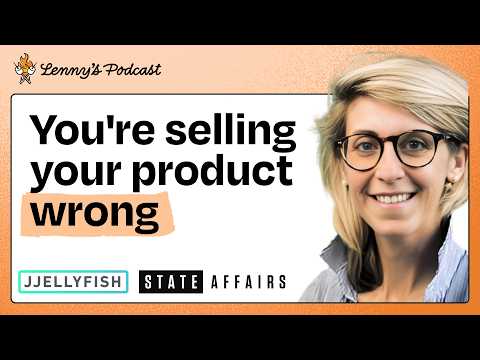
$1M to $10M: The enterprise sales playbook with Jen Abel
Jen Abel (guest), Lenny Rachitsky (host), Narrator, Narrator
In this episode of Lenny's Podcast, featuring Jen Abel and Lenny Rachitsky, $1M to $10M: The enterprise sales playbook with Jen Abel explores from $1M To $10M: Jen Abel’s Counterintuitive Enterprise Sales Playbook Jen Abel lays out a highly tactical, contrarian roadmap for going from roughly $1M to $10M ARR by leaning hard into true enterprise sales instead of hovering in a vague 'mid-market' space.
From $1M To $10M: Jen Abel’s Counterintuitive Enterprise Sales Playbook
Jen Abel lays out a highly tactical, contrarian roadmap for going from roughly $1M to $10M ARR by leaning hard into true enterprise sales instead of hovering in a vague 'mid-market' space.
She argues founders should target tier-one logos early, price for six-figure ACVs, and focus on vision casting and opportunity selling rather than narrow problem-solving.
Design partners, creative deal-crafting, and relationship-driven selling (often over text, not email) are presented as the real levers for landing and expanding large accounts.
Throughout, she emphasizes founder-led learning, ruthless qualification, and hiring enterprise reps who can 'cosplay the founder' rather than generic playbook-driven salespeople.
Key Takeaways
Pick a side: true SMB or true enterprise—stop aiming for 'mid-market'.
Selling to a 100-person company is fundamentally different from selling to a 1,000+ person enterprise; blurring those motions under a 'mid-market' label leads to mis-hiring, mis-pricing, and misaligned GTM strategy.
Get the full analysis with uListen AI
Go after tier-one logos much earlier than you think you should.
Category leaders (e. ...
Get the full analysis with uListen AI
Price for six-figure ACVs and protect your future expansion.
Aim to land deals in the ~$75K–$150K range and avoid anchoring large enterprises at $10K–$20K, because jumping from 10K to 100K is almost impossible to defend and will cripple both expansion revenue and your ability to justify serious executive attention.
Get the full analysis with uListen AI
Sell the opportunity (the 'gap') and alpha, not just today’s problem.
Executives respond to vision casting—'Here’s where we can take you and the edge you’ll gain'—not rote problem-checklist selling; in the AI era especially, you win by promising differentiated speed, insight, or talent, not just incremental efficiency.
Get the full analysis with uListen AI
Use design partners for learning, not as your future revenue base.
Great design partners (often tech-forward large companies) should guide product direction and provide hard feedback, but founders must filter out 80% 'old way' requests, clearly frame future pricing/roadmap, and not expect them to become easy million-dollar rollouts.
Get the full analysis with uListen AI
Enterprise sales is creative, bespoke, and relationship-driven.
Every big deal is 'deal-crafted': co-authored pricing, tailored scope, non-obvious extras (e. ...
Get the full analysis with uListen AI
Hire reps who can 'cosplay the founder', not generic big-company VPs.
From $1M–$10M ARR you need people (often ex-founders or product/technical profiles) who can sell the vision, navigate executives, and learn from rejection—comped with meaningful upside—not senior brand-name VPs whose success depended on an established logo.
Get the full analysis with uListen AI
Notable Quotes
“Most founders would rather get ten 10K deals than lose nine and get one 100K deal.”
— Jen Abel
“You need to vision cast. You need to sell to a gap, don’t sell to a problem.”
— Jen Abel
“The market doesn’t wanna be sold to, they want to buy.”
— Jen Abel
“As soon as you become a comparison, as soon as you become one of three that they’re testing out, you’ve already sorta lost.”
— Jen Abel
“I wanna take a backdoor in, not the front door where everyone else is trick-or-treating.”
— Jen Abel
Questions Answered in This Episode
How can a founder practically transition from problem-based selling to true vision casting without sounding vague or hand-wavy?
Jen Abel lays out a highly tactical, contrarian roadmap for going from roughly $1M to $10M ARR by leaning hard into true enterprise sales instead of hovering in a vague 'mid-market' space.
Get the full analysis with uListen AI
What specific signals tell you that a prospective design partner will push you in the right direction versus dragging you into bespoke one-off work?
She argues founders should target tier-one logos early, price for six-figure ACVs, and focus on vision casting and opportunity selling rather than narrow problem-solving.
Get the full analysis with uListen AI
How do you decide when a low-ACV land-and-expand path is still worth it, versus when you must walk away to protect your pricing and positioning?
Design partners, creative deal-crafting, and relationship-driven selling (often over text, not email) are presented as the real levers for landing and expanding large accounts.
Get the full analysis with uListen AI
What are concrete ways to develop the 'deal crafting' and reframing skills Jen describes if you don’t naturally enjoy sales?
Throughout, she emphasizes founder-led learning, ruthless qualification, and hiring enterprise reps who can 'cosplay the founder' rather than generic playbook-driven salespeople.
Get the full analysis with uListen AI
Given the rise of AI-driven outbound tools, how should teams balance scalable automation with the kind of high-touch, deeply personalized outreach Jen advocates?
Get the full analysis with uListen AI
Transcript Preview
You need to vision cast. You need to sell to a gap, don't sell to a problem. When you're selling to a leader, you need to be selling an opportunity. The market doesn't wanna be sold to, they want to buy.
Most founders would rather get 10 10K deals than lose nine and get one 100K deal.
In the very early days, people will discount 'til the cows come home 'cause they think that's the way to get a deal done. The best clients are not going to do that to you. If they're sitting there nickel-and-diming you, they're not fully bought in on what you're selling them.
It might be giving you a false sense of success and product market fit.
As soon as you become a comparison, as soon as you become one of three that they're testing out, you've already sorta lost. It's all about differentiation. Here's what you will be able to do tomorrow because of how we're gonna serve you today.
Something else that you talk about is that enterprise sales is very creative.
It's more of an art. It's all about deal crafting. It is a relationship you're building with someone. If they know they can call on you, people will turn over rocks for you. I have a client at a Fortune 10 company where I was like, "It's so important we get the deal done this year. Is that possible?" And she's like, "It's a tall order, but, like, if it's gonna help you, let's do it." These are how enterprise deals gets done. It's relationships.
What's kind of, like, the state-of-the-art on go-to-market outbound tooling?
I don't use a tool. The thing about AI tools is they're all pulling from the same databases. I wanna email someone not in the database that's getting hit by a million folks. I wanna take a backdoor in, not the front door where everyone else is trick-or-treating.
Today my guest is Jen Abel, co-founder of Jellyfish, where she and her team help early stage founders learn how to sell, and now GM of Enterprise at State Affairs. If you want to become better at selling your product, this episode is going to blow your mind and make you so much better in every way. This is the second time Jen's been on the podcast. Our first conversation was focused around getting from zero to one million ARR, essentially founder-led sales. This conversation is part two, going from around one million in ARR to around 10 million. This is the most tactical and in-the-weeds discussion you will find anywhere for free on how to actually become more effective at selling to enterprises. I am so excited for you to listen to this conversation. If you enjoy this podcast, don't forget to subscribe and follow it in your favorite podcasting app or YouTube. It helps tremendously. And if you become an annual subscriber of my newsletter, you get 17 incredible products for free for an entire year, including Devin, Lovable, Repl.it, Bolt, n8n, Linear, Superhuman, Descript, Whisperflow, Gamma, Perplexity, Warp, Granola, Magic Patterns, Raycast, ChatBRD, and Mobben. Head on over to lennysnewsletter.com and click Product Pass. With that, I bring you Jen Abel after a short word from our sponsors. Here's a puzzle for you. What do OpenAI, Cursor, Perplexity, Vercel, Plat, and hundreds of other winning companies have in common? The answer is they're all powered by today's sponsor, WorkOS. If you're building software for enterprises, you've probably felt the pain of integrating single sign-on, SKIM, RBAC, audit logs, and other features required by big customers. WorkOS turns those deal blockers into drop-in APIs with a modern developer platform built specifically for B2B SaaS. Whether you're a seed stage startup trying to land your first enterprise customer or a unicorn expanding globally, WorkOS is the fastest path to becoming enterprise ready and unlocking growth. They're essentially Stripe for enterprise features. Visit workos.com to get started or just hit up their Slack support where they have real engineers in there who answer your questions super fast. WorkOS allows you to build like the best with delightful APIs, comprehensive docs, and a smooth developer experience. Go to workos.com to make your app enterprise ready today. This episode is brought to you by Lovable. Not only are they the fastest growing company in history, I use it regularly and I could not recommend it more highly. If you've ever had an idea for an app but didn't know where to start, Lovable is for you. Lovable lets you build working apps and websites by simply chatting with AI. Then you can customize it, add automations, and deploy it to a live domain. It's perfect for marketers spinning up tools, product managers prototyping new ideas, and founders launching their next business. Unlike no-code tools, Lovable isn't about static pages. It builds full apps with real functionality and it's fast. What used to take weeks, months, or years, you can now do over a weekend. So if you've been sitting on an idea, now is the time to bring it to life. Get started for free at lovable.dev. That's lovable.dev. Jen, thank you so much for being here and welcome to the podcast.
Install uListen to search the full transcript and get AI-powered insights
Get Full TranscriptGet more from every podcast
AI summaries, searchable transcripts, and fact-checking. Free forever.
Add to Chrome