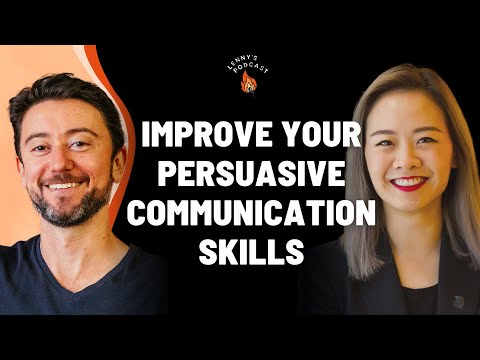
Persuasive communication and managing up | Wes Kao (Maven, altMBA, Section4)
Wes Kao (guest), Lenny Rachitsky (host), Narrator
In this episode of Lenny's Podcast, featuring Wes Kao and Lenny Rachitsky, Persuasive communication and managing up | Wes Kao (Maven, altMBA, Section4) explores mastering persuasion, teaching, and managing up with Wes Kao Lenny Rachitsky interviews Wes Kao, co-founder of Maven and co-creator of Seth Godin’s altMBA, about practical frameworks for communication, teaching, and career growth.
Mastering persuasion, teaching, and managing up with Wes Kao
Lenny Rachitsky interviews Wes Kao, co-founder of Maven and co-creator of Seth Godin’s altMBA, about practical frameworks for communication, teaching, and career growth.
They unpack concepts like the “Super Specific How,” the “content hierarchy of BS,” and the “state change method” for making talks and meetings far more engaging.
Wes shares concrete tactics for managing up, over-communicating with managers, and structuring writing so it’s clearer, more persuasive, and less confusing.
They also dive into saying no through framing trade-offs, spotting “eyes light up” moments as feedback on your messaging, and why cohort-based courses force a higher standard of rigor than most content formats.
Key Takeaways
Focus less on ‘what and why’ and more on the ‘Super Specific How.’
Most readers already agree with your premise; they’re hungry for concrete, step-by-step guidance, nuanced examples, and applications they can actually use.
Get the full analysis with uListen AI
Cut long intros and “start right before you get eaten by the bear.”
Trim backstory and context-setting; jump in at the most interesting, high-stakes moment so you hook attention and respect your audience’s time.
Get the full analysis with uListen AI
Design talks and meetings around frequent state changes, not monologues.
Every 3–5 minutes, shift the audience’s state—use chat prompts, polls, screen-sharing, breakouts, or other voices—to keep people alert and engaged on Zoom.
Get the full analysis with uListen AI
Watch for ‘eyes light up’ moments to refine your pitch and content.
Facial expressions and body language are better signals than polite words; double down on the angles, phrases, and topics that visibly energize people.
Get the full analysis with uListen AI
Managing up is a core career skill, not an optional extra.
Proactively keep your manager in the loop, share your reasoning, and avoid surprises; this builds trust, unlocks opportunities, and is a major reason senior people get promoted.
Get the full analysis with uListen AI
Overcommunicate, but structure your communication for skimmability.
Lead with the bottom line or TL;DR, then provide optional context; this lets busy stakeholders quickly align while still having access to your deeper thinking.
Get the full analysis with uListen AI
Say no by clearly framing trade-offs instead of flat rejection.
When asked to take on work, explain what will be delayed or deprioritized if you say yes and invite the requester to help re-prioritize—protecting your bandwidth while staying collaborative.
Get the full analysis with uListen AI
Notable Quotes
“Don’t take yourself out of the running before you get rejected.”
— Wes Kao
“Most writers spend too much time on the what and the why, and not enough time on how.”
— Wes Kao
“In a cohort-based course where your students are right there with you, there’s very little room for BS.”
— Wes Kao
“Avoid surprises. In a work context, surprises are generally not great.”
— Wes Kao
“By talking about trade-offs, you protect your bandwidth without actually even having to say the word no.”
— Wes Kao
Questions Answered in This Episode
How can I audit my current writing or content to remove ‘why’ fluff and add more ‘Super Specific How’?
Lenny Rachitsky interviews Wes Kao, co-founder of Maven and co-creator of Seth Godin’s altMBA, about practical frameworks for communication, teaching, and career growth.
Get the full analysis with uListen AI
What concrete state changes could I build into my recurring team meetings to reduce Zoom fatigue and increase engagement?
They unpack concepts like the “Super Specific How,” the “content hierarchy of BS,” and the “state change method” for making talks and meetings far more engaging.
Get the full analysis with uListen AI
Where in my day-to-day interactions do I see people’s eyes light up, and how can I deliberately use those moments to refine my messaging or product positioning?
Wes shares concrete tactics for managing up, over-communicating with managers, and structuring writing so it’s clearer, more persuasive, and less confusing.
Get the full analysis with uListen AI
If I started rigorously managing up this month, what specific updates and formats (e.g., weekly emails, TL;DRs) would most increase my manager’s trust in me?
They also dive into saying no through framing trade-offs, spotting “eyes light up” moments as feedback on your messaging, and why cohort-based courses force a higher standard of rigor than most content formats.
Get the full analysis with uListen AI
What trade-offs can I surface the next time I’m asked to take on work, so I can say no—or ‘not now’—without damaging the relationship?
Get the full analysis with uListen AI
Transcript Preview
I think that most people assume that their boss has to manage them and they feel a little bit resentful that, you know, "Why should I manage my boss? Like, they're getting paid more. They are my manager. They have more responsibility." And you can continue to think that way and your career, you know, might be fine, but if you embrace that if you manage your boss, they're going to appreciate you much more, you're gonna get more opportunities, you're gonna have more trust with them. There's all these great things that happen when you decide to manage up.
(instrumental music) Wes Kao is the co-founder of Maven, a cohort-based learning platform that I used to create my own course on product management. But even more interestingly, she's helped folks like Seth Godin start his AltMBA course, which is legendary. She's also helped people like David Perell, Tiago Forte, Scott Galloway, and even Morning Brew build their cohort-based courses. She's one of the smartest people I've ever met on the art of teaching and I've learned a ton from her. And in our chat, we cover a concept I love called the super specific who. We talk about the state change method and how using this idea, you'll run better meetings. We look at a bunch of advice for why you should spend time managing up and how to manage up effectively. We talk about a bunch of ways to write better, tips for saying no, and a bunch of other really interesting topics. I always have such a good time chatting with Wes and I hope that you learn as much from this chat as I did. And with that, I bring you Wes Kao. This episode is brought to you by Modern Treasury. Modern Treasury is a next generation operating system for moving and tracking money. They're modernizing the developer tools and financial processes for companies managing complex payment flows. Think digital wallets, via crypto on-ramps, ride sharing marketplaces, instant lending, and more. They work with high growth companies like Gusto, Hype, ClassPass, and Marqeta. Modern Treasury's robust APIs allow engineering to build payment flows right into your product while finance can monitor and approve everything through a sleek and modern web dashboard, enabling real-time payments, automatic reconciliation, continuous accounting, and compliance solutions. Modern Treasury's platform is used to reconcile over three billion dollars per month. They're one of the hottest young fintech startups on the market today, having raised funding from top firms like Benchmark, Altimeter, SVB Capital, Salesforce Ventures, and Y Combinator. Check them out at moderntreasury.com. This episode is brought to you by Berbix. Whether you're in the business of crypto or renting out vehicles or selling age-restricted goods, it's important to have the confidence that who you're selling to is who they say they are. With Berbix, businesses can quickly and easily verify someone's identity through their government-issued ID and real-time selfie. Unlike other identity verification software solutions, Berbix takes only seconds to verify an identity, helping you maximize conversion and mitigate fraud. With Berbix, you can grow revenue by instantly verifying a customer's driver's license, passport, or ID card. You can also deter fraud by customizing which transactions you want to accept or reject based on triggers like duplicate IDs, expiration dates, or a user session location. Get started quickly by setting up Berbix with no code, low code, or complete integration in as little as one afternoon. Visit berbix.com/start to get started. That's B-E-R-B-I-X dot-com slash start. Wes, I've learned so much from you over the years in so many different ways while building my course, through your writing, through your tweets, and generally, you're just a super fascinating human that I love this excuse to get to learn more about you and for listeners to learn more about you. And so with that, Wes, welcome to the podcast.
Install uListen to search the full transcript and get AI-powered insights
Get Full TranscriptGet more from every podcast
AI summaries, searchable transcripts, and fact-checking. Free forever.
Add to Chrome