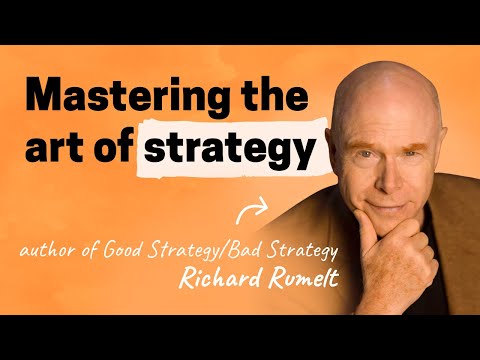
Good Strategy, Bad Strategy | Richard Rumelt
Richard Rumelt (guest), Lenny Rachitsky (host)
In this episode of Lenny's Podcast, featuring Richard Rumelt and Lenny Rachitsky, Good Strategy, Bad Strategy | Richard Rumelt explores richard Rumelt Redefines Strategy As Focused, Actionable Problem-Solving Agenda Richard Rumelt argues that strategy is not slogans, goals, or vision statements, but a concrete design for overcoming a high‑stakes challenge through focused, coherent action.
Richard Rumelt Redefines Strategy As Focused, Actionable Problem-Solving Agenda
Richard Rumelt argues that strategy is not slogans, goals, or vision statements, but a concrete design for overcoming a high‑stakes challenge through focused, coherent action.
He breaks good strategy into three elements—diagnosis, guiding policy, and coherent actions—and emphasizes starting from a clear definition of the core problem, or “crux,” you can realistically address.
Rumelt contrasts good and bad strategy, calling out common failures such as mistaking goals for strategy, producing fluffy “word salad,” and creating laundry lists of priorities that diffuse focus.
He also explains the role of power and asymmetry, the organizational and political barriers to real strategy, and offers a practical reframing: stop calling it a “strategy,” and instead build an “action agenda” around an important, achievable challenge.
Key Takeaways
Define strategy as a focused solution to a specific high‑stakes challenge.
Strategy is not a vision, mission, or goal list; it is a design—a mix of policy and action—aimed at overcoming a clearly defined challenge or problem.
Get the full analysis with uListen AI
Use the three-part ‘kernel’: diagnosis, guiding policy, coherent actions.
A good strategy starts with understanding what’s really going on (diagnosis), choosing how you’ll deal with it (guiding policy), and then committing to a small set of mutually reinforcing, concrete actions.
Get the full analysis with uListen AI
Start from the ‘crux’: the most important problem you can actually solve.
You must identify a challenge that is both significant to your ambitions and realistically addressable with your resources; focus there rather than trying to tackle everything at once.
Get the full analysis with uListen AI
Build an ‘action agenda’ instead of a grand “strategy” document.
To avoid abstraction and jargon, Rumelt suggests explicitly framing the work as an action agenda: “Here’s the challenge, and here’s what we’re going to do about it,” with clear steps, not just desired outcomes.
Get the full analysis with uListen AI
Exploit power and asymmetry—don’t rely on even bets.
An effective strategy leans on some form of power (e. ...
Get the full analysis with uListen AI
Avoid common traps of bad strategy: goals, fluff, and incoherence.
Calling profit targets a “strategy,” writing vague word salad, or assembling long, conflicting lists of priorities (e. ...
Get the full analysis with uListen AI
Recognize that organizational politics and fear of focus are often the real blockers.
Leaders hesitate to choose and to reallocate power or resources, so strategies get watered down; someone must ultimately decide, concentrate effort, and accept that some interests will lose out.
Get the full analysis with uListen AI
Notable Quotes
“A strategy is a design for overcoming a high-stakes challenge.”
— Richard Rumelt
“All strategy is problem-solving.”
— Richard Rumelt
“Don’t call it a strategy. Call it an action agenda.”
— Richard Rumelt
“Ambitions are not a strategy.”
— Richard Rumelt
“Focus is a fundamental source of power in strategy.”
— Richard Rumelt
Questions Answered in This Episode
How do I rigorously distinguish between a real diagnosis and just restating my goals or frustrations?
Richard Rumelt argues that strategy is not slogans, goals, or vision statements, but a concrete design for overcoming a high‑stakes challenge through focused, coherent action.
Get the full analysis with uListen AI
What specific asymmetries or sources of power does my team or company actually have that competitors lack?
He breaks good strategy into three elements—diagnosis, guiding policy, and coherent actions—and emphasizes starting from a clear definition of the core problem, or “crux,” you can realistically address.
Get the full analysis with uListen AI
If I listed all our current “priorities,” which two or three would truly qualify as the crux we should focus on?
Rumelt contrasts good and bad strategy, calling out common failures such as mistaking goals for strategy, producing fluffy “word salad,” and creating laundry lists of priorities that diffuse focus.
Get the full analysis with uListen AI
How can I navigate the internal politics and misaligned incentives that prevent our organization from committing to a focused action agenda?
He also explains the role of power and asymmetry, the organizational and political barriers to real strategy, and offers a practical reframing: stop calling it a “strategy,” and instead build an “action agenda” around an important, achievable challenge.
Get the full analysis with uListen AI
For an early‑stage startup with high uncertainty, what practical signs should I watch to know when to persist with my bet versus pivot to a new problem or customer?
Get the full analysis with uListen AI
Transcript Preview
Don't call it a strategy. (laughs) Call it an action agenda. There's huge numbers of people out there willing to sell you advice on, well, uh, your mission and your vision and your values, all these things that have to be in place before you can have a strategy. That's not true. We begin to try to identify, you know, the one or two key challenges that could actually be addressed, and what are we gonna do about it? What are the coherent actions we're gonna have to do to, to take these on. Okay, we're gonna, we're gonna go after this, and here's the action steps we're gonna take to do that. That's the essence of what you're doing when you're thinking strategically.
(instrumental music) Today my guest is Richard Rumelt. Richard is an absolute legend in the world of strategy. It was such an honor to have him come on the podcast. He's the author of Good Strategy/Bad Strategy, which I've gifted to countless people who wanted to become more strategic. He's been mentioned so many times on this podcast. He's also the author of The Crux, his most recent book, which some consider his best book, which delves even further into his advice on how to craft a winning strategy. Richard was a longtime professor at UCLA Anderson School of Management, was on the faculty of Harvard Business School, and he's consulted on strategy with companies like Microsoft, Apple, and Intel, and also with government organizations like the US Army Special Ops Command, and folks like Donald Rumsfeld. In our conversation, Richard shares the concrete elements that make a good strategy, why we'd be better off calling them action agendas rather than strategies, why every great strategy starts with a clear diagnosis of the biggest challenge that you face, also how to actually lay out a strategy, why organizational dynamics are often the biggest hindrance to winning strategies, and so much more. I could keep going, but let me just say we cover a lot of ground in this episode, and Richard shares incredibly thoughtful and deep answers to each question. I am excited to bring you Richard Rumelt after a short word from our sponsors. Let me tell you about Commandbar. If you're like me and most users I build product for, you probably find those little in-product pop-ups really annoying. "Want to take a tour?" "Check out this new feature." And these pop-ups are becoming less and less effective, since most users don't read what they say. They just want to close them as soon as possible. But every product builder knows that users need help to learn the ins and outs of your product. We use so many products every day, and we can't possibly know the ins and outs of every one. Commandbar is an AI-powered toolkit for product, growth, marketing, and customer teams to help users get the most out of your product without annoying them. They use AI to get closer to user intent, so they have search and chat products that let users describe what they're trying to do in their own words, and then see personalized results, like customer walkthroughs or actions. And they do pop-ups too, but their nudges are based on in-product behaviors, like confusion or intent classification, which makes them much less annoying and much more impactful. This works for web apps, mobile apps, and websites. And they work with industry-leading companies like Gusto, Freshworks, HashiCorp, and LaunchDarkly. Over 15 million end users have interacted with Commandbar. To try out Commandbar, you can sign up at commandbar.com/lenny, and you can unlock an extra 1,000 AI responses per month for any plan. That's commandbar.com/lenny. This episode is brought to you by Miro. Do you ever feel like your projects aren't as organized as you'd like them to be? Or it's way too hard for people on your team to find all of the documents and files and context that they need for their project? Miro helps you streamline your workflows, organize information, and get your whole team on the same page. If you want to see what Miro can do for you, check out my Miro board that the Miro team helped me create, which includes all of my favorite plug-and-play templates, like a user journey map, my favorite one-pager template, plus a brainstorming guide. My board also has a place for you to share suggestions for this podcast, and also answer a question that I have for you. You can then take my Miro board and easily create your own to see how it feels. Make sure to check out some of my favorite features, like the sticky notes, the inline comments and charts, and also their really cool diagramming tools. Check it out at miro.com/lenny. Your first three Miro boards are free when you sign up today at miro.com/lenny. Find simplicity in your most complex projects with Miro. That's M-I-R-o.com/lenny. (instrumental music) Richard, thank you so much for being here, and welcome to the podcast.
Install uListen to search the full transcript and get AI-powered insights
Get Full TranscriptGet more from every podcast
AI summaries, searchable transcripts, and fact-checking. Free forever.
Add to Chrome