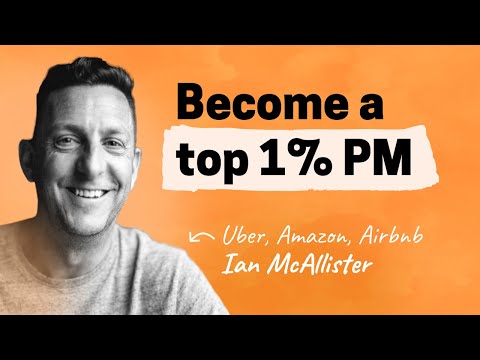
What it takes to become a top 1% PM | Ian McAllister (Uber, Amazon, Airbnb)
Ian McAllister (guest), Lenny Rachitsky (host)
In this episode of Lenny's Podcast, featuring Ian McAllister and Lenny Rachitsky, What it takes to become a top 1% PM | Ian McAllister (Uber, Amazon, Airbnb) explores inside the Mindset of a Top 1% Product Manager, Amazon-Style Product leader Ian McAllister (Amazon, Airbnb, Uber) breaks down what separates top 1% product managers from everyone else, emphasizing communication, ruthless prioritization, and relentless execution as the foundational skills. He expands his classic framework with newer, underrated skills like earning trust, digging for data, pushing back effectively, adapting to change, and optimizing for impact rather than promotion.
Inside the Mindset of a Top 1% Product Manager, Amazon-Style
Product leader Ian McAllister (Amazon, Airbnb, Uber) breaks down what separates top 1% product managers from everyone else, emphasizing communication, ruthless prioritization, and relentless execution as the foundational skills. He expands his classic framework with newer, underrated skills like earning trust, digging for data, pushing back effectively, adapting to change, and optimizing for impact rather than promotion.
Ian also demystifies Amazon’s famed “working backwards” process, explaining that its essence is obsessing over the customer problem first, not the solution or available tech, with the internal press release and FAQ serving as mechanisms to enforce that mindset. He shares concrete stories from Amazon, Airbnb, and his own career that illustrate how misapplying the process (starting from technology or “what we could build”) leads to weak products.
Throughout the conversation, Ian stresses that no PM is perfect across all dimensions; instead, PMs should develop a core set of strengths appropriate to their career stage and continuously self-assess and improve after every communication, project, and leadership moment.
Key Takeaways
For new PMs, communication, prioritization, and execution matter most.
Early-career PMs often stress about being strategic or visionary, but Ian argues their leverage comes from clearly answering questions (e. ...
Get the full analysis with uListen AI
For senior PMs, thinking big, earning trust, and driving impact are the differentiators.
As scope grows, leaders are judged less on feature delivery and more on whether they can articulate big opportunities, be trusted stewards of resources, and consistently move key business metrics up and to the right.
Get the full analysis with uListen AI
Working backwards is about the problem, not the press release template.
The core of Amazon’s process is starting with a real, painful customer problem and only then designing solutions; the internal PR/FAQ is just a mechanism to force that discipline, not the essence of the method.
Get the full analysis with uListen AI
Most teams misapply “working backwards” by starting from technology or assets.
A telltale sign is language like “we could combine these two systems” or “we already have these ingredients,” which signals solution-first thinking and retrofitted problem statements rather than truly customer-back reasoning.
Get the full analysis with uListen AI
Trust is the primary currency of product leadership.
Trust is built by repeatedly setting and meeting expectations, telling the truth, owning mistakes, and shipping what you said you would; without it, you won’t get resources or alignment for larger bets, no matter how smart your ideas are.
Get the full analysis with uListen AI
Relentless focus on impact beats optimizing for promotion or politics.
Ian credits his own career progression to obsessing over growing his “fitness function” metrics, not lobbying for promotions; consistently delivering outsized business impact tends to pull promotions and scope along with it.
Get the full analysis with uListen AI
Continuous self-review is a powerful habit for PM growth.
After meetings, docs, or exec Q&A, Ian recommends mentally grading yourself (or asking your manager) on how you communicated and what you could have done better; over time, this builds sharper thinking and communication instincts.
Get the full analysis with uListen AI
Notable Quotes
“If you simply wake up every day trying to have the biggest impact you can on the company, how you do every part of your day, that's a really good guiding light.”
— Ian McAllister
“You’ve got to be a clear thinker to be a clear communicator.”
— Ian McAllister
“Given the same amount of skill, intelligence, and resources, a product manager with a great innate ability to prioritize is going to generate five times the impact as someone without that skill.”
— Ian McAllister
“Trust is the currency of a product manager and a product leader.”
— Ian McAllister
“Working backwards is all about the problem… If you have the solution first and then retrofit the problem, you’re not really working backwards.”
— Ian McAllister
Questions Answered in This Episode
How can a PM objectively assess whether they are truly working backwards from a customer problem versus retrofitting a problem to a desired solution?
Product leader Ian McAllister (Amazon, Airbnb, Uber) breaks down what separates top 1% product managers from everyone else, emphasizing communication, ruthless prioritization, and relentless execution as the foundational skills. ...
Get the full analysis with uListen AI
What specific behaviors most quickly erode trust as a PM, and how can someone recover once that trust has been damaged?
Ian also demystifies Amazon’s famed “working backwards” process, explaining that its essence is obsessing over the customer problem first, not the solution or available tech, with the internal press release and FAQ serving as mechanisms to enforce that mindset. ...
Get the full analysis with uListen AI
How should a junior PM balance learning the craft on smaller features with seeking opportunities to work on high-impact, “offense” areas of the business?
Throughout the conversation, Ian stresses that no PM is perfect across all dimensions; instead, PMs should develop a core set of strengths appropriate to their career stage and continuously self-assess and improve after every communication, project, and leadership moment.
Get the full analysis with uListen AI
In organizations that are deeply slide- or meeting-driven, what are practical first steps to introduce Amazon-style written docs and working-backwards thinking without triggering cultural rejection?
Get the full analysis with uListen AI
How can product leaders systematically teach and scale the habits of prioritization and impact-focus across an entire PM org, rather than relying on individual talent or intuition?
Get the full analysis with uListen AI
Transcript Preview
If you forget about everything else, forget about politics, forget about promotion or- or having more- a bigger org, or whatever. If you simply wake up every day trying to have the biggest impact you can, or if you're a leader trying to use your team to have the biggest impact you can on the company, how you do every part of your day, that's a really good guiding light.
(instrumental music) Welcome to Lenny's Podcast. I'm Lenny, and my goal here is to help you get better at the craft of building and growing products. Today, my guest is Ian McCalister. Ian is the author of one of the most classic posts on product management, What Separates a Top 1% PM from a Top 10% PM, amongst many other pieces of writing that he shared online. Ian has managed over 100 product managers in his career. He spent 12 years at Amazon, where he built Amazon Smile and led the team responsible for growing Alexa internationally. He also worked at Airbnb with me, and now he's at Uber leading global product for the vehicles platform, which includes making Uber's fleet increasingly electric and autonomous. In our conversation, we focus primarily on two topics: what separates a top 1% PM from everyone else, specifically for new PMs and also for senior PMs, and we also dig deep into the working backwards process. We get into how you can implement the process on your team and how you might be doing it wrong. There's also a bunch of links to templates and guides in the show notes, so if you want to follow along, definitely check those out. With that, I bring you Ian McCalister. This episode is brought to you by Mixpanel, offering powerful self-serve product analytics. If you listen to this podcast, you know that it's really hard to build great product without making compromises. And when it comes to using data, a lot of teams think that they only have two choices: make quick decisions based on gut feelings, or make data-driven decisions at a snail's pace. But that's a false choice. You shouldn't have to compromise on speed to get product answers that you can trust. With Mixpanel, there are no trade-offs. Get deep insights at the speed of thought at a fair price that scales as you grow. Mixpanel builds powerful and intuitive product analytics that everyone can trust, use, and afford. Explore plans for teams of every size and see what Mixpanel can do for you at mixpanel.com. And while you're at it, they're hiring. Check out mixpanel.com to learn more. This episode is brought to you by Athletic Greens. I've been hearing about AG1 on basically every podcast that I listen to, like Tim Ferriss and Lex Fridman, and so I finally gave it a shot earlier this year, and it has quickly become a core part of my morning routine, especially on days that I need to go deep on writing or record a podcast like this. Here's three things that I love about AG1. One, with a small scoop that dissolves in water, you're absorbing 75 vitamins, minerals, probiotics, and adaptogens. I kind of like to think of it as a little safety net for my nutrition in case I've missed something in my diet. Two, they treat AG1 like a software product. Apparently, they're on their 52nd iteration, and they're constantly evolving it based on the latest science, research studies, and internal testing that they do. And three, it's just one easy thing that I can do every single day to take care of myself. Right now, it's time to reclaim your health and arm your immune system with convenient daily nutrition. It's just one scoop in a cup of water every day, and that's it. There's no need for a million different pills and supplements to look out for your health. Make it easy. Athletic Greens is gonna give you a free one-year supply of immune-supporting vitamin D and five free travel packs with your first purchase. All you have to do is visit athleticgreens.com/lenny. Again, that's athleticgreens.com/lenny to take ownership over your health and pick up the ultimate daily nutritional insurance. (instrumental music) Ian, welcome to the podcast.
Install uListen to search the full transcript and get AI-powered insights
Get Full TranscriptGet more from every podcast
AI summaries, searchable transcripts, and fact-checking. Free forever.
Add to Chrome