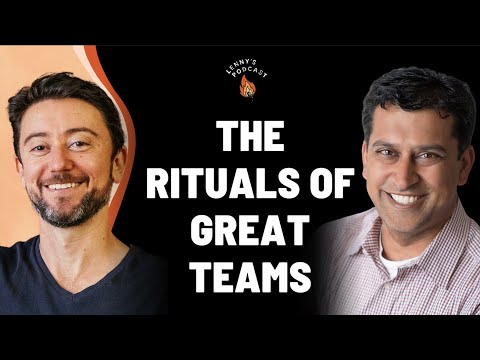
The rituals of great teams | Shishir Mehrotra, Coda, YouTube, Microsoft
Lenny Rachitsky (host), Narrator, Narrator, Shishir Mehrotra (guest), Narrator, Narrator, Narrator, Narrator, Narrator
In this episode of Lenny's Podcast, featuring Lenny Rachitsky and Narrator, The rituals of great teams | Shishir Mehrotra, Coda, YouTube, Microsoft explores shishir Mehrotra reveals growth loops, rituals, and hiring superpowers Shishir Mehrotra, co‑founder and CEO of Coda and former YouTube/Microsoft product leader, unpacks how great products grow, how great teams work, and how to identify great talent.
Shishir Mehrotra reveals growth loops, rituals, and hiring superpowers
Shishir Mehrotra, co‑founder and CEO of Coda and former YouTube/Microsoft product leader, unpacks how great products grow, how great teams work, and how to identify great talent.
He explains Coda’s “black loop” and “blue loop” growth framework, inspired by Microsoft- and YouTube-style flywheels, and how those loops shaped Coda’s pricing, product, and go‑to‑market.
Shishir dives into his upcoming book, *Rituals of Great Teams*, sharing powerful examples of cultural rituals from companies like Coda, Thrive, Gusto, Coinbase, and Airbnb, and why rituals are the most concrete expression of culture.
He also introduces the concepts of Eigenquestions and the PSHE talent framework, showing how to ask leverage-rich questions, evaluate product talent, and run reference checks that are far more predictive than interviews.
Key Takeaways
Map your business as loops, not funnels.
Every successful product grows through reinforcing loops (e. ...
Get the full analysis with uListen AI
Align pricing with your core growth loop to remove friction.
Coda’s “maker billing” only charges document creators, keeping collaboration and sharing free. ...
Get the full analysis with uListen AI
Use rituals as the practical surface area of culture.
Rituals like Coda’s Dory + Pulse, Thrive’s Resets, or Gusto’s offer-call ceremony make abstract cultural values concrete in day‑to‑day behavior. ...
Get the full analysis with uListen AI
Practice Eigenquestions: answer the question that answers many others.
An Eigenquestion is the single question which, once answered, makes many downstream decisions trivial (e. ...
Get the full analysis with uListen AI
Evaluate people on PSHE, not just scope or title.
Shishir’s PSHE framework (Problem, Solution, How, Execution) describes a progression from executing a given plan to defining the right problems. ...
Get the full analysis with uListen AI
Treat reference checks as your most important hiring signal.
Shishir ranks reference checks above interviews and work samples, because former colleagues have far more data than a structured loop ever will. ...
Get the full analysis with uListen AI
Teach and test high-leverage thinking in low-stakes environments.
Skills like Eigenquestioning are hard to develop only in high-stakes situations. ...
Get the full analysis with uListen AI
Notable Quotes
“You probably do have a loop, not a funnel. It might just be hiding in plain sight.”
— Shishir Mehrotra
“Great companies have a very small list of golden rituals…they’re named, every employee knows them by their first Friday, and they’re templated.”
— Bing Gordon (quoted by Shishir Mehrotra)
“Rituals are a mirror of culture. When you ask people about culture, they answer with rituals.”
— Shishir Mehrotra
“An Eigenquestion is the question that, when answered, also answers the most subsequent questions.”
— Shishir Mehrotra
“I generally value the reference check over interview signals…what you’re going to get out of 30 minutes of artificial scenarios is never going to compare with what a good reference check will give you.”
— Shishir Mehrotra
Questions Answered in This Episode
How would my product’s black and blue loops look if I actually drew them, and what would that reveal about where we’re stuck or under-invested?
Shishir Mehrotra, co‑founder and CEO of Coda and former YouTube/Microsoft product leader, unpacks how great products grow, how great teams work, and how to identify great talent.
Get the full analysis with uListen AI
Which existing team behaviors could I elevate into named, templated rituals that better reflect the culture I want to build?
He explains Coda’s “black loop” and “blue loop” growth framework, inspired by Microsoft- and YouTube-style flywheels, and how those loops shaped Coda’s pricing, product, and go‑to‑market.
Get the full analysis with uListen AI
What are the Eigenquestions in the biggest strategic decisions I’m wrestling with right now, and have I explicitly tried to identify them?
Shishir dives into his upcoming book, *Rituals of Great Teams*, sharing powerful examples of cultural rituals from companies like Coda, Thrive, Gusto, Coinbase, and Airbnb, and why rituals are the most concrete expression of culture.
Get the full analysis with uListen AI
If I re-leveled my team using PSHE instead of title and scope, who would suddenly look more (or less) senior than our current org chart suggests?
He also introduces the concepts of Eigenquestions and the PSHE talent framework, showing how to ask leverage-rich questions, evaluate product talent, and run reference checks that are far more predictive than interviews.
Get the full analysis with uListen AI
How can I redesign my reference checks to surface real PSHE behavior—rather than polite, generic praise—without putting refs in a defensive position?
Get the full analysis with uListen AI
Transcript Preview
I generally value the reference check over interview signals. You know, if I had to stack rank in interviews what is the best signal, the, uh, reference check is the top of the list. Tho- those people, you know, they work with this person for, you know, sometimes for years. Like, their knowledge ... What you're gonna get out of 30 minutes of artificial scenarios is just, like, never gonna compare with what a good reference check will give you. (instrumental music) Shishir Mehrotra is the co-founder and CEO of Coda. Before starting Coda, Shishir led the YouTube product engineering and design teams at Google, where he spent over six years. Before that, he spent six years at Microsoft. He's also on the board of Spotify. As you'll hear in this episode, Shishir is an incredibly deep and very first principles thinker on all kinds of topics. And in this episode, we cover growth strategy, specifically a framework that he calls blue loops and black loops. We talk about the rituals of great teams, something that Shishir's been passionate about and has been collecting from all of the best leaders in tech for the past two years, and which he'll soon turn into a book. We talk about Eigenquestions, which is not a German game show. He shares how he evaluates product talent and s- gives some really great advice on doing reference checks. We go into so many other topics. This is the longest episode that I've recorded yet, and you'll see why. Shishir is so full of wisdom, and we could have kept going for at least another hour. And so with that, I bring you Shishir Mehrotra. Hey, Kasey Winters, what do you love about Coda?
Coda's a company that's actually near and dear to my heart, because I got to work on their launch when I was at Greylock. But in terms of what I love about it, you know I love loops, and Coda has some of the coolest and most useful content loops I've seen. How the loop works is someone can create a Coda and share it publicly for the world. This can be how you create OKRs, run annual planning, build your own map, whatever. Every one of those Codas can then be easily copied and adapted to your organization without knowing who originally wrote it. So they're embedding the sharing of best practices of scaling companies into their core product and growth loops, which is something I'm personally passionate about.
I actually use Coda myself every day. It's kind of the center of my writing and podcasting operation. I use it for first drafts, to organize my content calendar, to plan each podcast episode, and so many more things. Coda is giving listeners of this podcast $1,000 in free credit off their first statement. Just go to coda.io/lenny. That's coda.io/lenny. Hey, Ashley, head of marketing at Flatfile. How many B2B SaaS companies would you estimate need to import CSV files from their customers?
Install uListen to search the full transcript and get AI-powered insights
Get Full TranscriptGet more from every podcast
AI summaries, searchable transcripts, and fact-checking. Free forever.
Add to Chrome