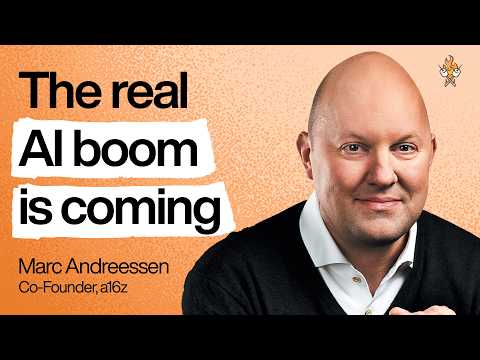
Marc Andreessen: The real AI boom hasn’t even started yet
Marc Andreessen (guest), Lenny Rachitsky (host)
In this episode of Lenny's Podcast, featuring Marc Andreessen and Lenny Rachitsky, Marc Andreessen: The real AI boom hasn’t even started yet explores marc Andreessen on AI’s economic impact, careers, and founder playbook Andreessen frames the current era as historically significant due to three collisions: weakening trust in institutions, broader public discourse, and massive geopolitical shifts—all alongside rapidly improving AI.
Marc Andreessen on AI’s economic impact, careers, and founder playbook
Andreessen frames the current era as historically significant due to three collisions: weakening trust in institutions, broader public discourse, and massive geopolitical shifts—all alongside rapidly improving AI.
He argues AI’s biggest underpriced impact is macroeconomic: after 50 years of low productivity growth and with looming population decline, AI and robotics may be necessary to prevent economic stagnation or contraction.
At the individual level, he emphasizes “agency” and using AI as a personal tutor to become a “super-empowered” multi-skill builder, especially across product, engineering, and design.
For founders and investors, he expects AI to redefine products, change how teams operate, and potentially enable ultra-lean or even “AI-run” companies, while warning that moats and industry structure are still highly uncertain.
Key Takeaways
AI’s macro value may be bigger than the hype narratives suggest.
Andreessen claims the West has experienced decades of low measured productivity growth; AI’s key role could be restoring productivity and economic expansion rather than simply “displacing jobs.”
Get the full analysis with uListen AI
Demographics change the job-loss story—humans may become scarcer, not cheaper.
With declining birth rates and potentially reduced immigration, he expects human labor to be at a premium in many countries, making AI/robots a complement to labor shortages rather than a pure substitute.
Get the full analysis with uListen AI
Focus on “task loss,” not “job loss.”
He argues jobs are bundles of tasks that evolve; AI will replace/transform tasks first (like executives adopting email) long before entire roles vanish, reshaping what PMs, designers, and engineers actually do.
Get the full analysis with uListen AI
The winning career move is becoming a multi-domain builder.
In a PM–engineering–design “Mexican standoff,” each role can use AI to encroach on the other two; the most valuable people will be deep in one domain while credibly operating across the others (a T/E/F-shaped skill stack).
Get the full analysis with uListen AI
Use AI as a tutor, not just a tool.
Andreessen repeatedly stresses asking AI to “train me up,” generate exercises, quiz you, and critique your work—making elite-style one-on-one tutoring broadly accessible.
Get the full analysis with uListen AI
Coding shifts from writing to orchestration—but depth still matters.
He likens AI coding to prior abstractions (machine code → C → scripting): programmers increasingly “argue with” and coordinate many code bots, yet must still understand fundamentals to evaluate and correct outputs.
Get the full analysis with uListen AI
AI-native founders rethink products, teams, and even what a ‘company’ is.
He sees three layers: AI changes product categories, changes internal job structures (10× coders), and could enable founder-led companies run by “armies of bots,” approaching the one-person-billion-dollar company ideal.
Get the full analysis with uListen AI
Moats in AI are unknowable early; avoid premature certainty.
Drawing on internet-era forecasting errors, he argues models might become oligopolistic or quickly commoditized (as open source and fast followers catch up), and value may accrue either to foundation models or app layers depending on domain and regulation.
Get the full analysis with uListen AI
Notable Quotes
“AI is the philosopher's stone… a technology that transfers… sand… into… thought.”
— Marc Andreessen
“Everybody wants to talk about job loss, but really what you wanna look at is task loss.”
— Marc Andreessen
“The remaining human workers are gonna be at a premium, not at a discount.”
— Marc Andreessen
“People who really want to improve themselves… should be spending every spare hour… talking to an AI… 'All right, train me up.'”
— Marc Andreessen
“There’s like a Mexican standoff happening between… product manager, designer, and coder… They’re actually all kind of correct.”
— Marc Andreessen
Questions Answered in This Episode
You argue productivity growth has been low for ~50 years—what specific metrics or datasets best support that, and what would “AI-driven productivity” look like in the official numbers?
Andreessen frames the current era as historically significant due to three collisions: weakening trust in institutions, broader public discourse, and massive geopolitical shifts—all alongside rapidly improving AI.
Get the full analysis with uListen AI
If declining population is the hidden driver, which countries (US, EU, China, LATAM) do you think will feel the ‘labor premium’ first, and in what sectors?
He argues AI’s biggest underpriced impact is macroeconomic: after 50 years of low productivity growth and with looming population decline, AI and robotics may be necessary to prevent economic stagnation or contraction.
Get the full analysis with uListen AI
On “jobs vs. tasks”: what are 5–10 concrete tasks PMs should expect to lose first, and what new tasks replace them?
At the individual level, he emphasizes “agency” and using AI as a personal tutor to become a “super-empowered” multi-skill builder, especially across product, engineering, and design.
Get the full analysis with uListen AI
In the PM–design–engineering “Mexican standoff,” what does the org chart look like in 3 years at a high-performing product company—fewer specialists, or different specialist boundaries?
For founders and investors, he expects AI to redefine products, change how teams operate, and potentially enable ultra-lean or even “AI-run” companies, while warning that moats and industry structure are still highly uncertain.
Get the full analysis with uListen AI
You say ‘still learn to code’—how deep is deep enough in an AI-coding world (CS fundamentals, systems, assembly), and what’s the best learning path for non-engineers?
Get the full analysis with uListen AI
Transcript Preview
If we didn't have AI, we'd be in a panic right now about what's gonna happen to the economy. We've actually been in a regime for fifty years of very slow technological change in the face of declining population growth. The timing has worked out miraculously well. We're gonna have AI and robots precisely when we actually need them. The remaining human workers are gonna be at a premium, not at a discount.
How big of a deal is the moment in time that we're living through right now?
This is a very, very historic time. AI is the philosopher's stone. Now we have a technology that transfers the most common thing in the world, which is sand, converted into the most rare thing in the world, which is thought.
I spent a lot of time with the most cutting-edge AI-forward founders.
The most leading-edge founders are thinking of, can you have entire companies where the founder does everything?
There's all this concern that young people, jobs are not gonna be there for them, AI is replacing them.
Everybody wants to talk about job loss, but really what you wanna look at is task loss. The job persists longer than the individual tasks.
What's your sense of just the future of three very specific roles: product manager, engineer, designer?
There's like a Mexican standoff happening between those three roles. Every coder now believes they can also be a product manager and a designer because they have AI. Every product manager thinks they can be a coder and a designer, and then every designer knows they can be a product manager and a coder. They're actually all kind of correct. What happens is, the additive effect of being good at two things is more than double. The additive effect of being good at three things is more than triple. You become a super relevant specialist in the combination of the domains.
People aren't fully grasping how much is changing.
People who really want to improve themselves and develop their career should be spending every spare hour, in my view, at this point, talking to an AI, being like: "All right, train me up."
[upbeat music] Today, my guest is Marc Andreessen, one of the most seminal figures in tech and in business. He invented the web browser, built the world's largest venture firm. He's also a multi-time founder and an investor in essentially every generational tech company, and is also one of the most clear-minded, lateral, and insightful thinkers about both the past and the future of technology. In this very special conversation, we chat about how unique and significant the moment that we are all living through right now is, what skills he's teaching his kids to thrive in the AI future, what happens to product managers, designers, and engineers in the coming years, where moats exist in AI, what the most AI-native founders are doing differently, and so much more. That is just scratching the surface of this very deep and important conversation. You are gonna walk away from this chat being smarter about what is going on in the world right now and where things are heading. A huge thank you to my newsletter community and folks on X for suggesting topics and questions for this conversation. If you enjoy this podcast, don't forget to subscribe and follow it in your favorite podcasting app or YouTube. It helps tremendously. And if you become an insider subscriber of my newsletter, you get a year free of over twenty incredible products, including a year free of Lovable, Replit, Bold, Gamma, n8n, Linear, Superhuman, Devon, PostHog, Descript, Whisperflow, Perplexity, Warp, Granola, Magic Pattern, Raycast, ChatPRD, Mobbin, and Stripe Atlas. Head on over to lennysnewsletter.com and click Product Pass. With that, I bring you Marc Andreessen after a short word from our sponsors. Today's episode is brought to you by DX, the developer intelligence platform designed by leading researchers. To thrive in the AI era, organizations need to adapt quickly. But many organization leaders struggle to answer pressing questions like: Which tools are working? How are they being used? What's actually driving value? DX provides the data and insights that leaders need to navigate this shift. With DX, companies like Dropbox, Booking.com, Adyen, and Intercom get a deep understanding of how AI is providing value to their developers and what impact AI is having on engineering productivity. To learn more, visit DX's website at getdx.com/lenny. That's getdx.com/lenny. If you're a founder, the hardest part of starting a company isn't having the idea, it's scaling the business without getting buried in back-office work. That's where Brex comes in. Brex is the intelligent finance platform for founders. With Brex, you get high-limit corporate cards, easy banking, high-yield treasury, plus a team of AI agents that handle manual finance tasks for you. They'll do all the stuff that you don't wanna do, like file your expenses, scour transactions for waste, and run reports, all according to your rules. With Brex's AI agents, you can move faster while staying in full control. One in three startups in the United States already runs on Brex. You can, too, at brex.com. [upbeat music] Marc Andreessen, thank you so much for being here, and welcome to the podcast.
Install uListen to search the full transcript and get AI-powered insights
Get Full TranscriptGet more from every podcast
AI summaries, searchable transcripts, and fact-checking. Free forever.
Add to Chrome