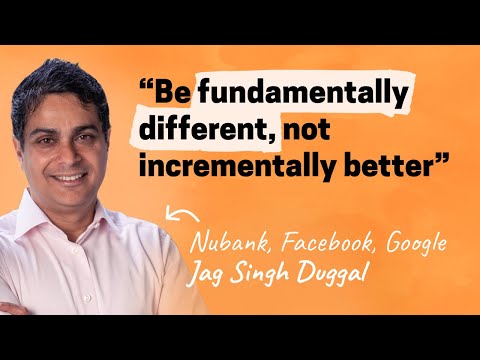
Be fundamentally different, not incrementally better | Jag Duggal (Nubank, Facebook, Google)
Lenny Rachitsky (host), Jag Duggal (guest)
In this episode of Lenny's Podcast, featuring Lenny Rachitsky and Jag Duggal, Be fundamentally different, not incrementally better | Jag Duggal (Nubank, Facebook, Google) explores nubank’s Fanatical Customers: Building Fundamentally Different Financial Products Worldwide Jag Duggal, CPO of Nubank, explains how Nubank became a massive, word-of-mouth-driven fintech by obsessively building products customers love “fanatically,” anchored in deep pain points and a clear, focused strategy. He details how Nubank operationalizes product love through cultural values, rigorous product‑market‑fit gates like the Sean Ellis score, and extremely high NPS expectations before scaling new lines. The conversation dives into strategy craft, category design, and how to be fundamentally different rather than incrementally better, while also unpacking Nubank’s expansion into dozens of product lines and new geographies. Jag closes by outlining a future where banking becomes AI-native, social, and “self-driving,” effectively putting a personal banker in everyone’s pocket.
Nubank’s Fanatical Customers: Building Fundamentally Different Financial Products Worldwide
Jag Duggal, CPO of Nubank, explains how Nubank became a massive, word-of-mouth-driven fintech by obsessively building products customers love “fanatically,” anchored in deep pain points and a clear, focused strategy. He details how Nubank operationalizes product love through cultural values, rigorous product‑market‑fit gates like the Sean Ellis score, and extremely high NPS expectations before scaling new lines. The conversation dives into strategy craft, category design, and how to be fundamentally different rather than incrementally better, while also unpacking Nubank’s expansion into dozens of product lines and new geographies. Jag closes by outlining a future where banking becomes AI-native, social, and “self-driving,” effectively putting a personal banker in everyone’s pocket.
Key Takeaways
Anchor products in deep, emotionally charged pain points.
Nubank succeeded by attacking the intense frustration with Brazil’s fee-heavy, widely hated incumbent banks, offering a no-fee, digital, branchless credit card that felt fundamentally different, not just cheaper.
Get the full analysis with uListen AI
Build culture that demands customers ‘love you fanatically.’
Nubank’s first core value is that customers should love them fanatically; this value is pervasive, used in reviews and decisions, and creates a bias toward long-term customer delight over short-term convenience or revenue.
Get the full analysis with uListen AI
Use high product-market-fit thresholds before scaling anything.
They rarely scale a product until it passes an elevated Sean Ellis score (50% “very disappointed” in Brazil) plus strong NPS and low churn, preventing them from “scaling small problems into big messes.”
Get the full analysis with uListen AI
Combine quant data with direct, scrappy customer contact.
Teams don’t just survey thousands of users; PMs and designers personally call ~10 customers, use anecdotes to interpret data, analyze bullseye segments with high love scores, and then iterate specifically for those use cases.
Get the full analysis with uListen AI
Strategy must be specific, coherent, and focused—not vague ambition.
Following thinkers like Richard Rumelt and Roger Martin, Jag defines strategy as a clear, concentrated plan to apply unique strengths to a well-defined problem; clarity matters more than being perfectly right because it reveals when you’re off course.
Get the full analysis with uListen AI
Aim to be fundamentally different, not incrementally better.
Whether in category creation or entering an existing market, Nubank looks for ways to redefine experiences (e. ...
Get the full analysis with uListen AI
Envision AI-native, ‘self-driving’ banking that optimizes lives.
Nubank is betting on an AI-powered, social, and automated financial system that behaves like a personal banker for billions of people—proactively handling bills, savings, and goals—rather than just putting a traditional bank branch into a phone.
Get the full analysis with uListen AI
Notable Quotes
“We’re not trying to be incrementally better. We are trying to be fundamentally different.”
— Jag Duggal
“We want our customers to love us fanatically.”
— Jag Duggal
“Good enough isn’t good enough. Is it great enough?”
— Jag Duggal (quoting Nubank’s lead designer)
“We are not going to take a small problem and scale it, because if we do that, we end up with a big mess.”
— Jag Duggal
“We may not be right, but at least we are clear.”
— Kevin Systrom (quoted by Jag Duggal)
Questions Answered in This Episode
How can smaller or earlier-stage companies realistically adopt Nubank’s high product‑market‑fit thresholds without stalling growth?
Jag Duggal, CPO of Nubank, explains how Nubank became a massive, word-of-mouth-driven fintech by obsessively building products customers love “fanatically,” anchored in deep pain points and a clear, focused strategy. ...
Get the full analysis with uListen AI
What are concrete examples of being ‘fundamentally different’ in less obviously broken, less emotional categories than banking?
Get the full analysis with uListen AI
How should a PM decide when to push back on leadership’s pressure to scale versus when to accept the risk and move forward?
Get the full analysis with uListen AI
What does an AI-native, ‘self-driving’ bank experience actually look like in a customer’s day-to-day life, beyond today’s features?
Get the full analysis with uListen AI
How transferable is Nubank’s Latin American playbook (culture, word-of-mouth, credit-first strategy) to other regions with different regulations and customer behaviors?
Get the full analysis with uListen AI
Transcript Preview
NewBank is bigger than Coinbase, Robinhood, Affirm, SoFi, and Lemonade combined. 80 to 90% of NewBank's growth is through word of mouth.
We're not trying to be incrementally better. We are trying to be fundamentally different. We want our customers to love us fanatically.
It feels like NewBank is one of the historically most successful companies at launching new business lines.
We built a lending product. We built an investments product. We built an insurance product. We built a series of small business products. We rarely scale a project until we know the Sean Ellis Score hit the threshold that we find really compelling.
I want to talk about strategy.
Kevin Systrom, in the early days of Instagram, I heard him say it at a conference, "We may not be right, but at least we are clear." Even if your strategy isn't right, you have a very clear idea of what was supposed to be happening.
Where do you think all this goes in the future?
Why not have the company that reinvents banking come out of Sao Paolo, Mexico City, Bogota?
(instrumental music) Today, my guest is Jag Duggal. Jag is chief product officer at NewBank, which is one of the most under-the-radar monster businesses that you'll ever come across, with a fanatical user base and a really unique approach to building product. Before NewBank, Jag was director of product Management at Facebook, leading monetization of video and third-party content, including news, gaming, and influencer content. Prior to Facebook, he was senior vice president of product and strategy at Quantcast and group product manager and head of strategy for display ads at Google, which was Google's second-largest business at the time. In our conversation, we cover how to build products that people become fanatical about, how to develop a strategy, category design, product line expansion, the future of fintech, and tons more. With that, I bring you Jag Duggal after a short word from our sponsors. And if you enjoy this podcast, don't forget to subscribe and follow it in your favorite podcasting app or YouTube. It's the best way to avoid missing future episodes, and it helps the podcast tremendously. This episode is brought to you by WorkOS. If you're building a SaaS app, at some point, your customers will start asking for enterprise features like SAML authentication and SCIM provisioning. That's where WorkOS comes in, making it fast and painless to add enterprise features to your app. Their APIs are easy to understand so that you can ship quickly and get back to building other features. Today, hundreds of companies are already powered by WorkOS, including ones you probably know, like Vercel, Webflow, and Loom. WorkOS also recently acquired Warrant, the fine-grained authorization service. Warrant's product is based on a groundbreaking authorization system called Zanzibar, which was originally designed for Google to power Google Docs and YouTube. This enables fast authorization checks at enormous scale while maintaining a flexible model that can be adapted to even the most complex use cases. If you're currently looking to build role-based access control or other enterprise features like single sign-on, SCIM, or user management, you should consider WorkOS. It's a drop-in replacement for Auth0 and supports up to one million monthly active users for free. Check it out at workos.com to learn more. That's workos.com. This episode is brought to you by Mercury. Mercury knows your financial operations are complex. It doesn't have to be this way. I've been a super happy customer of Mercury for over a year now, and it's honestly hard to imagine a better online banking experience can exist. Most founders and finance teams have to cobble together a patchwork of tools to reconcile transactions from different sources, work extra hard just to get a holistic view of cashflow and how it maps to company priorities, and struggle to get answers from platforms that all speak different languages. Mercury knows that there's an art to simplifying this complex patchwork. With new bill pay and accounting capabilities, you can pay bills faster, stay in control of company spend, and speed up reconciliation. The end result is the precision, control, and focus that startups need to transform how they operate. Apply in minutes at mercury.com and join over 200,000 ambitious startups like mine that trust Mercury to get them to perform at their best. Mercury, the art of simplified finances. Mercury is a financial technology company, not a bank. Banking services provided by Choice Financial Group and Evolve Bank & Trust, Members FDIC. Jag, thank you so much for being here. Welcome to the podcast.
Install uListen to search the full transcript and get AI-powered insights
Get Full TranscriptGet more from every podcast
AI summaries, searchable transcripts, and fact-checking. Free forever.
Add to Chrome