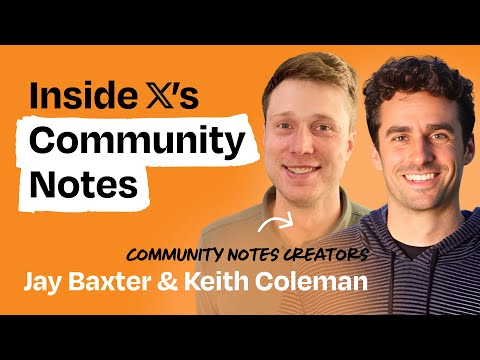
An inside look at X’s Community Notes | Keith Coleman & Jay Baxter
Lenny Rachitsky (host), Keith Coleman (guest), Jay Baxter (guest), Narrator
In this episode of Lenny's Podcast, featuring Lenny Rachitsky and Keith Coleman, An inside look at X’s Community Notes | Keith Coleman & Jay Baxter explores inside X’s Community Notes: Crowdsourcing Neutral Truth At Internet Scale The episode explores how X’s Community Notes crowdsources context on potentially misleading posts and uses a novel "bridging" algorithm to surface notes agreed upon by people who usually disagree.
Inside X’s Community Notes: Crowdsourcing Neutral Truth At Internet Scale
The episode explores how X’s Community Notes crowdsources context on potentially misleading posts and uses a novel "bridging" algorithm to surface notes agreed upon by people who usually disagree.
Keith Coleman and Jay Baxter walk through the product’s origin, design principles, and the small, highly autonomous “thermal” team structure that allowed it to survive multiple leadership changes and become an industry model.
They explain why transparency, open participation, and strict quality thresholds are essential for trust, how external research validates its impact on reducing misinformation spread, and how Meta and independent researchers are now adopting and extending the system.
The conversation also highlights broader lessons about lean teams, low‑ego leadership, and why Community Notes reveals there is far more cross‑partisan agreement on facts than the public narrative suggests.
Key Takeaways
Crowdsourced context can rival professional fact-checkers when carefully structured.
Community Notes doesn’t rely on majority votes or experts; instead it surfaces notes rated helpful by people who historically disagree, which produces neutral, verifiable, and widely accepted context.
Get the full analysis with uListen AI
Quality and trust depend on strict thresholds and visible constraints on power.
Only ~7–10% of proposed notes ever show, and no one at X has a "force override" button; if a bad note shows, they treat it as a system-design failure, not something to hand-fix, which reinforces user trust.
Get the full analysis with uListen AI
Radical transparency and open participation are core to legitimacy.
The scoring code and full rating data are open-sourced so outsiders can reproduce results, audit for bias, and even propose better algorithms—turning Community Notes into a genuinely community-built system.
Get the full analysis with uListen AI
Pseudonymity increases honest cross-partisan agreement.
Testing showed contributors were more willing to endorse notes that challenge their own “side” when not tied to their main identity, and harassment risk dropped—contrary to the usual assumption that real names improve discourse.
Get the full analysis with uListen AI
Lean, fully focused teams move faster and build more impactful products.
A tiny cross-functional "thermal" team (one backend, one frontend, one ML, one designer, one researcher, one PM) with a single senior decision-maker (Elon) iterated rapidly without OKRs, Jira, or heavy process and shipped what an org of hundreds might not have.
Get the full analysis with uListen AI
Community Notes measurably reduces misinformation spread and belief.
A/B tests and external studies show posts with notes see 30–40% lower engagement rates, 50–60% fewer reposts overall, and significant reductions in user agreement with false claims; authors become ~80% more likely to delete noted posts.
Get the full analysis with uListen AI
There is more factual agreement across divides than it appears.
Even on hyper-polarized topics like the Israel–Hamas war, Community Notes finds substantial cross-faction agreement on specific facts, suggesting large majorities could similarly converge on practical policies if surfaced correctly.
Get the full analysis with uListen AI
Notable Quotes
“We actually look for agreement from people who have disagreed in the past. That surprising agreement is what makes the notes so neutral and accurate.”
— Jay Baxter
“This thing is going to be the voice of the people. It’s not going to represent the company’s voice.”
— Keith Coleman
“If there’s a problem with a note that’s so bad you want to do something about it, it’s a problem with the system.”
— Keith Coleman
“People a few years ago were pretty pessimistic that fact-checking ever changes people’s understandings. External studies now show Community Notes does.”
— Jay Baxter
“Society often feels really polarized, but Community Notes shows people really can agree on quite a lot—even on super controversial topics.”
— Keith Coleman
Questions Answered in This Episode
How could the bridging-based agreement model used in Community Notes be adapted to help draft legislation or public policy that majorities across the spectrum endorse?
The episode explores how X’s Community Notes crowdsources context on potentially misleading posts and uses a novel "bridging" algorithm to surface notes agreed upon by people who usually disagree.
Get the full analysis with uListen AI
What are the biggest risks if AI-generated notes become more common—both in terms of hallucinations and subtle bias—and how will users be able to detect or override them?
Keith Coleman and Jay Baxter walk through the product’s origin, design principles, and the small, highly autonomous “thermal” team structure that allowed it to survive multiple leadership changes and become an industry model.
Get the full analysis with uListen AI
Should other large platforms (YouTube, TikTok, news sites) adopt a similar community-driven context system, and what challenges would differ from X’s environment?
They explain why transparency, open participation, and strict quality thresholds are essential for trust, how external research validates its impact on reducing misinformation spread, and how Meta and independent researchers are now adopting and extending the system.
Get the full analysis with uListen AI
Where is the line between adding context and de facto fact-checking or moderation, and how should Community Notes handle deeply contested normative or value-laden claims?
The conversation also highlights broader lessons about lean teams, low‑ego leadership, and why Community Notes reveals there is far more cross‑partisan agreement on facts than the public narrative suggests.
Get the full analysis with uListen AI
What organizational lessons from the "thermal" team model—tiny, fully focused, low-process, high-autonomy—can be safely applied inside more conventional large companies without causing chaos?
Get the full analysis with uListen AI
Transcript Preview
(instrumental music plays) The work that you guys do has had such a tremendous impact on the way the world works. I want to start with just giving people a brief understanding of what is Community Notes.
Someone on X can see a post. If they think it's misleading, they can propose a note that they think other people might find informative. Other people can then rate that note.
We actually look for agreement from people who have disagreed in the past. And, and what we see is when people actually have that sort of surprising agreement, that's what makes the notes so neutral and, and accurate and well-written really overall.
There's many people that are very polarized. How do you deal with people that are like super anti-vax, super Jan 6th?
One philosophical thing that's important is that we want all of humanity to participate. And sometimes people are surprised by that. We have all of humanity. We then have the data to understand what notes will be helpful to actual humanity. Every post is eligible for notes. We shouldn't exempt Elon, we shouldn't exempt government figures, we should... Like, everyone, even advertisers can get notes.
There have been external studies, you know, run by people totally independent of us who have found that if you take a post with or without a Community Note, that actually people's agreement with the core claims in the post does change if they see it with the note versus without.
Is there anything else along the lines of just working for Elon within an org Elon runs that might surprise people?
If I were to start a company, that company, it would be even leaner than I would have made it before. I've been amazed with just how much the team is able to accomplish with a small group, and I think because of a small group.
(instrumental music plays) Today my guests are Keith Coleman, product lead for Community Notes, and Jay Baxter, founding ML engineer and researcher for Community Notes. This conversation may be my newest favorite podcast episode so far. Community Notes is one of the most impactful and clever and also underappreciated products in the world right now. If you ever use X/Twitter and you see a note underneath a tweet correcting the misinformation in that tweet, that is Community Notes. I've never heard a deep dive into the story behind the product and the team that built it, and I'm excited to bring you just that. We get into the surprising origin story of the product, how the algorithm actually works, how the algorithm emerged out of an internal contest within Twitter, the principles behind Community Notes and why staying true to them has been so key to its success, also how it survived four different leaders including Elon and Jack, and why it's now a big part of the solution to solving misinformation on the internet, including recently being adopted by Meta as their main fact-checking tool. This is an incredibly special episode, and I'm so excited to bring it to you. If you enjoy this podcast, don't forget to subscribe and follow it in your favorite podcasting app or YouTube. Also, if you become a subscriber of my newsletter, you now get a year free of Notion and Superhuman and Granola and Linear and Perplexity Pro. Check that out at lennysnewsletter.com. With that, I bring you Keith Coleman and Jay Baxter. This episode is brought to you by WorkOS. If you're building a SaaS app, at some point your customers will start asking for enterprise features like SAML authentication and SCIM provisioning. That's where WorkOS comes in, making it fast and painless to add enterprise features to your app. Their APIs are easy to understand so that you can ship quickly and get back to building other features. Today, hundreds of companies are already powered by WorkOS, including ones you probably know, like Vercel, Webflow, and Loom. WorkOS also recently acquired Warrant, the fine-grain authorization service. Warrant's product is based on a groundbreaking authorization system called Zanzibar, which was originally designed for Google to power Google Docs and YouTube. This enables fast authorization checks at enormous scale while maintaining a flexible model that can be adapted to even the most complex use cases. If you're currently looking to build role-based access control or other enterprise features like single sign-on, SCIM, or user management, you should consider WorkOS. It's a drop-in replacement for Auth0 and supports up to one million monthly active users for free. Check it out at workos.com to learn more. That's workos.com. This episode is brought to you by Productboard, the leading product management platform for the enterprise. For over 10 years, Productboard has helped customer-centric organizations like Zoom, Salesforce, and Autodesk build the right products faster. And as an end-to-end platform, Productboard seamlessly supports all stages of the product development life cycle, from gathering customer insights, to planning a roadmap, to aligning stakeholders, to earning customer buy-in, all with a single source of truth. And now, product leaders can get even more visibility into customer needs with Productboard Pulse, a new voice of customer solution. Built-in intelligence helps you analyze trends across all of your feedback, and then dive deeper by asking AI your follow-up questions. See how Productboard can help your team deliver higher impact products that solve real customer needs and advance your business goals. For a special offer and free 15-day trial, visit productboard.com/lenny. That's productboard.com/L-E-N-N-Y. Keith and Jay, thank you so much for being here, and welcome to the podcast.
Install uListen to search the full transcript and get AI-powered insights
Get Full TranscriptGet more from every podcast
AI summaries, searchable transcripts, and fact-checking. Free forever.
Add to Chrome