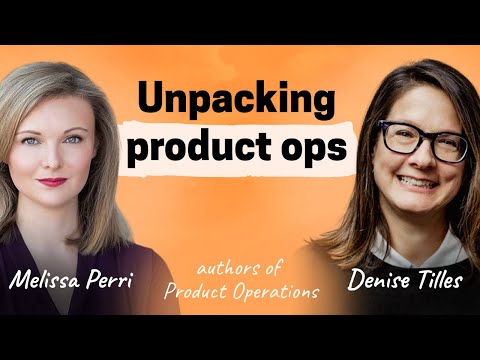
The ultimate guide to product operations | Melissa Perri and Denise Tilles
Melissa Perri (guest), Lenny Rachitsky (host), Denise Tilles (guest), Guest (guest), Guest (guest)
In this episode of Lenny's Podcast, featuring Melissa Perri and Lenny Rachitsky, The ultimate guide to product operations | Melissa Perri and Denise Tilles explores why Product Operations Is Transforming How Companies Build Products At Scale Melissa Perri and Denise Tilles break down the fast‑emerging discipline of product operations and why it has exploded across modern product-led companies. They argue that product ops exists to free product managers and leaders from operational drag—data wrangling, process chaos, and ad-hoc research—so they can focus on strategy and outcomes. The role is organized around three pillars: business & data insights, customer & market insights, and product processes & practices, with emphasis shifting by company stage. They share how to know when you need product ops, how to hire and structure it, how it differs from product and project management, and case studies from companies like Uber, Amplitude, and Athenahealth.
Why Product Operations Is Transforming How Companies Build Products At Scale
Melissa Perri and Denise Tilles break down the fast‑emerging discipline of product operations and why it has exploded across modern product-led companies. They argue that product ops exists to free product managers and leaders from operational drag—data wrangling, process chaos, and ad-hoc research—so they can focus on strategy and outcomes. The role is organized around three pillars: business & data insights, customer & market insights, and product processes & practices, with emphasis shifting by company stage. They share how to know when you need product ops, how to hire and structure it, how it differs from product and project management, and case studies from companies like Uber, Amplitude, and Athenahealth.
Key Takeaways
Product ops exists to maximize the time PMs spend on strategic work.
Instead of PMs burning 20–30% of their time chasing data, scheduling research, and reinventing processes, product ops builds shared systems and infrastructure so PMs can focus on customer problems, strategy, and outcomes.
Get the full analysis with uListen AI
The three pillars of product ops should be tailored to company stage.
High-growth startups usually need help first with business & data insights, while large or transforming enterprises often benefit most initially from process, governance, and operating model support; customer & market insights is a major underused opportunity across both.
Get the full analysis with uListen AI
Product ops informs decisions but should never make product decisions.
Product managers must keep ownership of vision, strategy, prioritization, trade-offs, and stakeholder negotiations; product ops supplies clean data, efficient research systems, and consistent processes to support those decisions—not replace them.
Get the full analysis with uListen AI
Start small: one sharp hire focused on the biggest pain point.
Most successful product ops functions begin with a single person focused on a clearly defined, high-impact problem (e. ...
Get the full analysis with uListen AI
Hiring for product ops depends heavily on the pillar you’re addressing.
For business & data insights, look for analyst/BI or consulting profiles strong in data storytelling and BI tools; for process & practices, look for an ex-PM with high EQ and systems thinking; for customer & market insights, seek research-ops or UX research profiles with a process-orientation.
Get the full analysis with uListen AI
Product ops should be lean and leverage tools, not become a bloated org.
A 1:1 ratio of product ops to PMs is a red flag; instead, a small team should design shared services, automate repeatable work, and sit atop existing tools (e. ...
Get the full analysis with uListen AI
Reporting lines matter: product ops should sit under the head of product.
To stay tightly aligned with product strategy, priorities, and operating decisions, product ops should report to the CPO/head of product and function as a right-hand partner, not as a generic ops or PMO function elsewhere in the org.
Get the full analysis with uListen AI
Notable Quotes
“Do you want to hire 10,000 product managers and let them all do these things off the side of their desk, or do you want them concentrating on strategic work the majority of the time?”
— Melissa Perri
“Product operations does not take away decision-making rights from the product manager. It's there to inform them.”
— Melissa Perri
“If you try to serve everybody, you serve no one.”
— Denise Tilles
“We don't usually need another agile coach telling us how to run a standup. We need people to come in and help us figure out who's invited to cross-functional roadmap reviews and how to communicate at the right level to executives.”
— Melissa Perri
“My current chief product officer said he will never go anywhere else that doesn’t have product ops.”
— Melissa Perri (relaying a CPO’s view on Athenahealth)
Questions Answered in This Episode
How do we identify which of the three product ops pillars would create the most immediate leverage in our organization?
Melissa Perri and Denise Tilles break down the fast‑emerging discipline of product operations and why it has exploded across modern product-led companies. ...
Get the full analysis with uListen AI
Where are PMs in our company currently spending time on low-leverage operational work that could be centralized or automated by product ops?
Get the full analysis with uListen AI
What metrics and dashboards would truly help us understand product health (not just business health) at the executive level?
Get the full analysis with uListen AI
How can we structure product ops so it partners effectively with design, user research, data, sales, and support—without stepping on their mandates?
Get the full analysis with uListen AI
If we piloted a single product ops hire, what clear success criteria and quick wins would we define for their first 90 days?
Get the full analysis with uListen AI
Transcript Preview
Do you want to hire 10,000 product managers and let them all do these things off the side of their desk (laughs) and then concentrate on strategic work, like, 30% of the time? Or do you want them concentrating on strategic work majority of the time and then help build a product operations team around them that can create these shared systems and this infrastructure to allow them to work better?
(instrumental music) Today my guests are Melissa Perri and Denise Tillis. This is a rare two-guest episode. Melissa and Denise are authors of an awesome new book called Product Operations: How Successful Companies Build Better Products at Scale. Melissa is a legend in the product management community. She's the author of the foundational PM book, Escaping the Build Trap. She runs a product management training organization called Productslabs, teaches product management at Harvard, and has worked with hundreds of companies on their product management function. Denise is a product leader, coach, and consultant, helping companies with their product vision, strategy, and execution, and works with Melissa at Productslabs. In our conversation, we get super deep into the emerging role of product ops. As you'll hear in our conversation, over the past few years, this role has gone from almost nonexistent to something like half of scaling tech companies with at least one product ops person. This new role is probably the thing that's most changing in the world of product management, and after this conversation, I'm convinced it's a great thing. We chat about what the role concretely is, how it differs from product management and project management, what to look for in your first product ops hire, how to roll out a product ops function, why product managers shouldn't be afraid of this role, and how your life gets significantly better, plus a case study on how they rolled out product ops function at a large company, and so much more. With that, I bring you Melissa Perri and Denise Tillis after a short word from our sponsor. You fell in love with building products for a reason, but sometimes the day-to-day reality is a little different than you imagined. Instead of dreaming up big ideas, talking to customers, and crafting a strategy, you're drowning in spreadsheets and roadmap updates and you're spending your days basically putting out fires. A better way is possible. Introducing Jira Product Discovery, the new prioritization and road mapping tool built for product teams by Atlassian. With Jira Product Discovery, you can gather all your product ideas and insights in one place and prioritize confidently, finally replacing those endless spreadsheets. Create and share custom product roadmaps with any stakeholder in seconds, and it's all built on Jira, where your engineering teams are already working, so true collaboration is finally possible. Great products are built by great teams, not just engineers. Sales, support, leadership, even Greg from finance. Anyone that you want can contribute ideas, feedback, and insights in Jira Product Discovery for free. No catch. And it's only $10 a month for you. Say goodbye to your spreadsheets and their never-ending alignment efforts. The old way of doing product management is over. Rediscover what's possible with Jira Product Discovery. Try it for free at atlassian.com/lenny. That's atlassian.com/lenny. Melissa and Denise, thank you so much for being here. Welcome to the podcast.
Install uListen to search the full transcript and get AI-powered insights
Get Full TranscriptGet more from every podcast
AI summaries, searchable transcripts, and fact-checking. Free forever.
Add to Chrome