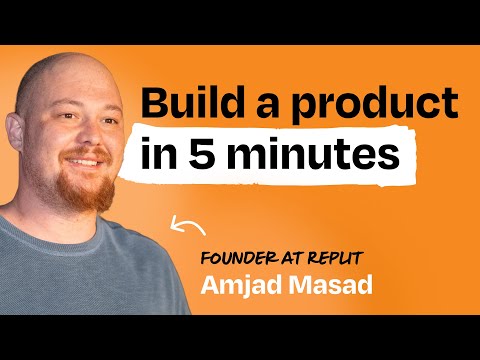
Behind the product: Replit | Amjad Masad (co-founder and CEO)
Amjad Masad (guest), Lenny Rachitsky (host), Narrator
In this episode of Lenny's Podcast, featuring Amjad Masad and Lenny Rachitsky, Behind the product: Replit | Amjad Masad (co-founder and CEO) explores replit’s AI Agents Turn Anyone Into A Full-Stack Product Builder The episode explores how Replit’s AI-powered development environment lets non-engineers describe an app in plain language and have a working, deployable product generated end-to-end. Amjad Masad demos building and deploying a feature-request dashboard in minutes, highlighting how Replit abstracts away setup, hosting, databases, and most coding. He and Lenny then dig into how this changes the roles of engineers, product managers, designers, and founders—shifting constraints from implementation capacity to idea generation and iteration speed. They also discuss Replit’s technical architecture, the rise of AI-native coding, and a future where tiny or even zero-employee software companies become feasible.
Replit’s AI Agents Turn Anyone Into A Full-Stack Product Builder
The episode explores how Replit’s AI-powered development environment lets non-engineers describe an app in plain language and have a working, deployable product generated end-to-end. Amjad Masad demos building and deploying a feature-request dashboard in minutes, highlighting how Replit abstracts away setup, hosting, databases, and most coding. He and Lenny then dig into how this changes the roles of engineers, product managers, designers, and founders—shifting constraints from implementation capacity to idea generation and iteration speed. They also discuss Replit’s technical architecture, the rise of AI-native coding, and a future where tiny or even zero-employee software companies become feasible.
Key Takeaways
AI can now generate real, deployable products from natural-language specs.
Replit’s Agent builds a complete full-stack web app—from database and backend to frontend UI and deployment on Google Cloud—based only on a detailed prompt, in minutes and at very low compute cost.
Get the full analysis with uListen AI
The bottleneck is shifting from engineering capacity to idea generation.
When implementation becomes cheap and fast, your constraint becomes how many good product ideas you can generate, articulate, and test—not how many engineers you can hire or how much time they have.
Get the full analysis with uListen AI
Non-technical roles can directly build and test V1 products.
PMs, marketers, operations staff, and even kids are already using Replit to create dashboards, internal tools, prototypes, and MVPs that they can ship to users before any engineering team gets involved.
Get the full analysis with uListen AI
“AI-native coding” is a distinct skillset from traditional software engineering.
You no longer need deep tooling expertise (Git, complex setup), but you do need to understand basic app structure, prompt effectively, and debug AI-generated code—skills Masad argues are rapidly increasing in ROI.
Get the full analysis with uListen AI
Engineers will increasingly focus on debugging, architecture, and unblocking AI.
As agents handle more of the straightforward coding, human engineers become most valuable at diagnosing failures, handling complex migrations, scaling systems, and wiring together advanced infrastructure the AI can use.
Get the full analysis with uListen AI
Organizations must become more fluid and less siloed to benefit fully.
When designers, PMs, and engineers can all directly create working software, rigid role boundaries and heavy roadmapping slow you down; Masad advocates flexible, hybrid roles and highly adaptive roadmaps.
Get the full analysis with uListen AI
The economics of software and startups will be fundamentally reshaped.
If the cost of building and maintaining software collapses, more people will launch more products, competition will intensify, and long-term advantage will hinge on creativity, speed of iteration, and problem selection rather than raw build capacity.
Get the full analysis with uListen AI
Notable Quotes
“The idea behind Replit is that making software today is very difficult. We want to make it easier.”
— Amjad Masad
“What if you made everyone a developer? What does that look like?”
— Amjad Masad
“Actually making things is a lot easier. You become limited by how fast you can generate ideas.”
— Amjad Masad
“The return on investment for learning to code is doubling every six months.”
— Amjad Masad
“I could imagine, five years from now, someone running a billion-dollar company with zero employees.”
— Amjad Masad
Questions Answered in This Episode
If implementation becomes almost free, how should product teams redefine what a ‘PM’ or ‘engineer’ actually does day to day?
The episode explores how Replit’s AI-powered development environment lets non-engineers describe an app in plain language and have a working, deployable product generated end-to-end. ...
Get the full analysis with uListen AI
What specific ‘AI-native coding’ skills should non-engineers prioritize learning in the next 12 months to stay relevant?
Get the full analysis with uListen AI
How will pricing and business models for SaaS change when anyone can spin up a Salesforce-like tool on demand?
Get the full analysis with uListen AI
Where are the hard limits of current AI agents in terms of scale, reliability, and complex architecture—and what work will always require humans?
Get the full analysis with uListen AI
How should founders and leaders adapt their roadmapping and org design to stay agile in a world where core capabilities can change every six months?
Get the full analysis with uListen AI
Transcript Preview
(instrumental music plays) The idea behind Replit is that making software today is very difficult. We want to make it easier. People view this as a developer in their pocket, essentially. We have 34 million, uh, users globally. There's people everywhere learning to code on Replit, building startups, building personal software, personal tools.
For people building products, say product managers, founders, like, what skills do you see will matter more, matter less?
Typically, your bottlenecked where your ideas are not fitting in (laughs) because, like, they need to be made and they need to be made quickly, now you open up that bottleneck. So now, like, actually making things is, is a lot easier. Actually, you become limited by how fast you can generate ideas.
I think people are unaware of just how far things have gone.
I could imagine, whatever, five years from now, someone running a billion-dollar company with zero employees, where it's like the support is handled by AI, the development is handled by AI, and you're just building and creating this thing.
Man, the future is wild. (instrumental music plays) Today, my guest is Amjad Masad. Amjad is the co-founder of Replit, an AI-powered software development and deployment platform for building and shipping software. It's one of the fastest-growing developer communities and AI products in the world. There's a lot of talk these days about how AI is changing how products will be built, how product teams are gonna operate, which functions will be more and less valuable over time. But I feel like very few people have actually seen what modern AI tools can do and have fully grasped how much you can get done with very little technical skill now and in the future. And so, I'm gonna do an experiment with this podcast where I'm gonna do a series of Behind the Product episodes, where we go deep on important products that product builders should be aware of and should probably start playing with. In our conversation, Amjad does a demo of what you can do with Replit today, which is gonna blow your mind. And then we spend most of the conversation talking about the implications of this on the future of product development, on the future of product management, and on the future of startups and founders. It's a very exciting time. It's also a very scary and destabilizing time for a lot of people. And my thinking is, the more you are aware of what's possible today and where things are going, the better position you'll be in to thrive in this very wild and crazy future that is coming very fast. If you enjoy this podcast, don't forget to subscribe and follow it in your favorite podcasting app or YouTube. It's the best way to avoid missing future episodes and helps the podcast tremendously. With that, I bring you Amjad Masad. (instrumental music plays) Amjad, thank you so much for being here. Welcome to the podcast.
Install uListen to search the full transcript and get AI-powered insights
Get Full TranscriptGet more from every podcast
AI summaries, searchable transcripts, and fact-checking. Free forever.
Add to Chrome