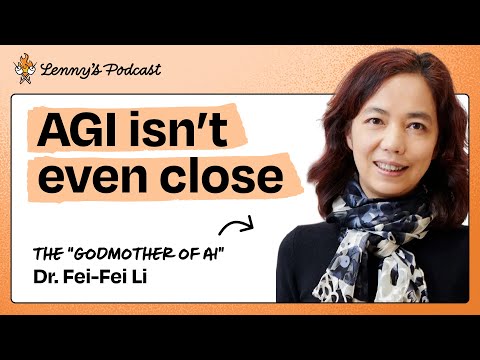
The Godmother of AI on jobs, robots & why world models are next | Dr. Fei-Fei Li
Lenny Rachitsky (host), Dr. Fei-Fei Li (guest), Narrator
In this episode of Lenny's Podcast, featuring Lenny Rachitsky and Dr. Fei-Fei Li, The Godmother of AI on jobs, robots & why world models are next | Dr. Fei-Fei Li explores godmother of AI Fei-Fei Li bets big on world models Dr. Fei-Fei Li traces the evolution of AI from early machine learning and the "AI winter" through ImageNet and deep learning to today's large language models, emphasizing how data, neural networks, and GPUs enabled the current boom.
Godmother of AI Fei-Fei Li bets big on world models
Dr. Fei-Fei Li traces the evolution of AI from early machine learning and the "AI winter" through ImageNet and deep learning to today's large language models, emphasizing how data, neural networks, and GPUs enabled the current boom.
She argues that AI is a civilizational technology and a double‑edged sword whose impact on jobs, dignity, and society is ultimately determined by human choices, not technological inevitability.
Li explains why current systems are still far from human‑level intelligence, why AGI is mostly a marketing term, and why new breakthroughs in spatial understanding and "world models" are needed—especially for robotics and embodied intelligence.
She introduces Marble, the first large world model from her company World Labs, which can generate fully explorable 3D worlds from prompts, unlocking applications in film, games, robotics simulation, design, science, and even psychology research.
Key Takeaways
AI’s trajectory is shaped by people, not inevitability.
Li stresses that AI is designed, deployed, and governed by humans; whether it augments dignity and work or harms society depends on individual, corporate, and policy choices at every stage.
Get the full analysis with uListen AI
Big data, neural networks, and GPUs formed the ‘golden recipe’ of modern AI.
ImageNet’s millions of labeled images enabled deep learning breakthroughs like AlexNet, which, combined with GPUs, established the basic paradigm that still underpins systems like ChatGPT.
Get the full analysis with uListen AI
Current models are powerful but still far from general human intelligence.
Despite impressive language and coding abilities, today’s AI cannot perform basic spatial reasoning (like robustly counting chairs in videos) or creative scientific leaps (like deriving Newton’s laws), highlighting clear ceilings of the current approach.
Get the full analysis with uListen AI
AGI is more a marketing label than a scientific concept.
Li sees no clear scientific boundary between ‘AI’ and ‘AGI’ and prefers to focus on the long‑standing north star—building systems that can think and act in human‑like ways—rather than on hype terms.
Get the full analysis with uListen AI
World models and spatial intelligence are essential to move beyond chatbots.
To power robotics, immersive environments, and many real‑world tasks, AI must understand 3D space, objects, dynamics, and interactions, not just sequences of tokens, which is what world models aim to capture.
Get the full analysis with uListen AI
Robotics needs more than just ‘bigger models and more data.’
Unlike language models, robots must act in 3D physical space with incomplete, hard‑to‑collect data and demanding safety constraints, making the simple ‘bitter lesson’ of scaling less straightforward to apply.
Get the full analysis with uListen AI
Everyone—from artists to farmers—has an active role in shaping AI.
Li urges people in all professions to see AI as a tool to augment their work and to participate in civic and policy discussions, insisting no technology should strip away human agency or dignity.
Get the full analysis with uListen AI
Notable Quotes
“There’s nothing artificial about AI. It’s inspired by people, it’s created by people, and most importantly, it impacts people.”
— Fei-Fei Li
“I’m a humanist. I believe that whatever AI does, currently or in the future, is up to us.”
— Fei-Fei Li
“AGI, I feel, is more a marketing term than a scientific term.”
— Fei-Fei Li
“We operate on about 20 watts… and yet we can do so much. The more I work in AI, the more I respect humans.”
— Fei-Fei Li
“No technology should take away human dignity.”
— Fei-Fei Li
Questions Answered in This Episode
If world models become as ubiquitous as language models, how might that change the way we design products, cities, and digital experiences?
Dr. ...
Get the full analysis with uListen AI
What governance structures or norms are most urgently needed to ensure AI enhances, rather than erodes, human dignity and agency?
She argues that AI is a civilizational technology and a double‑edged sword whose impact on jobs, dignity, and society is ultimately determined by human choices, not technological inevitability.
Get the full analysis with uListen AI
How could education and workforce training realistically adapt so non‑technical professionals—like nurses, teachers, and artists—can confidently use and shape AI tools?
Li explains why current systems are still far from human‑level intelligence, why AGI is mostly a marketing term, and why new breakthroughs in spatial understanding and "world models" are needed—especially for robotics and embodied intelligence.
Get the full analysis with uListen AI
What breakthroughs, beyond scaling data and compute, does Li believe are most critical for AI to achieve robust spatial reasoning and creativity?
She introduces Marble, the first large world model from her company World Labs, which can generate fully explorable 3D worlds from prompts, unlocking applications in film, games, robotics simulation, design, science, and even psychology research.
Get the full analysis with uListen AI
How should startups and researchers decide where to focus in an AI landscape that is both hyper‑competitive and still scientifically immature in many areas (like robotics)?
Get the full analysis with uListen AI
Transcript Preview
A lot of people call you the godmother of AI. The work you did actually was the spark that brought us out of AI winter.
In the middle of 2015, middle of 2016, some tech companies avoids using the word AI because they were not sure if AI was a dirty word. (laughs) 2017-ish was the beginning of companies calling themselves AI companies.
There's this line, I think this was when you were presenting to Congress, "There's nothing artificial about AI. It's inspired by people, it's created by people, and most importantly, it impacts people."
It's not like I think AI will have no impact on jobs or people. In fact, I believe that whatever AI does, currently or in the future, is up to us. It's up to the people. I do believe technology is a net positive for humanity, but I think every technology is a double-edged sword. If we're not doing the right thing, as a society, as individuals, we can screw this up as well.
You had this breakthrough insight of just, okay, we can train machines to think like humans, but it's just missing the data that humans have to learn as a child.
I chose to look at artificial intelligence through the lens of visual intelligence because humans are deeply visual animals. We need to train machines with as much information as possible on images of objects, but objects are very, very difficult to learn. A single object can have infinite possibilities that is shown on an image. In order to train computers with tens and thousands of object concepts, you really need to show it millions of examples.
Today my guest is Dr. Fei-Fei Li, who's known as the godmother of AI. Fei-Fei has been responsible for and at the center of many of the biggest breakthroughs that sparked the AI revolution that we are currently living through. She spearheaded the creation of ImageNet, which was basically her realizing that AI needed a ton of clean label data to get smarter, and that dataset became the breakthrough that led to the current approach to building and scaling AI models. She was chief AI scientist at Google Cloud, which is where some of the biggest early technology breakthroughs emerged from. She was director at SAIL, Stanford's Artificial Intelligence Lab, where many of the biggest AI minds came out of. She's also co-creator of Stanford's Human-Centered AI Institute, which is playing a vital role in a direction that AI is taking. She's also been on the board of Twitter. She was named one of Time's 100 most influential people in AI. She's also on the United Nations advisory board. I could go on. In our conversation, Fei-Fei shares a brief history of how we got to today in the world of AI, including this mind-blowing reminder that nine to 10 years ago, calling yourself an AI company was basically a death knell for your brand because no one believed that AI was actually gonna work. Today, it's completely different. Every company is an AI company. We also chat about her take on how she sees AI impacting humanity in the future, how far current technologies will take us, why she's so passionate about building a world model and what exactly world models are, and most exciting of all, the launch of the world's first large world model, Marble, which just came out as this podcast comes out. Anyone can go play with this at marble.worldlabs.ai. It's insane. Definitely check it out. Fei-Fei is incredible and way too under the radar for the impact that she's had on the world, so I am really excited to have her on and to spread her wisdom with more people. A huge thank you to Ben Horowitz and Condoleezza Rice for suggesting topics for this conversation. If you enjoy this podcast, don't forget to subscribe and follow it in your favorite podcasting app or YouTube. With that, I bring you Dr. Fei-Fei Li after a short word from our sponsors. This episode is brought to you by Figma, makers of Figma Make. When I was a PM at Airbnb, I still remember when Figma came out and how much it improved how we operated as a team. Suddenly, I could involve my whole team in the design process, give feedback on design concepts really quickly, and it just made the whole product development process so much more fun. But Figma never felt like it was for me. It was great for giving feedback and designs, but as a builder, I wanted to make stuff. That's why Figma built Figma Make. With just a few prompts, you can make any idea or design into a fully functional prototype or app that anyone can iterate on and validate with customers. Figma Make is a different kind of vibe coding tool. Because it's all in Figma, you can use your team's existing design building blocks, making it easy to create outputs that look good and feel real and are connected to how your team builds. Stop spending so much time telling people about your product vision, and instead show it to them. Make code-backed prototypes and apps fast with Figma Make. Check it out at figma.com/lenny. Did you know that I have a whole team that helps me with my podcast and with my newsletter? I want everyone on that team to be super happy and thrive in their roles. Justworks knows that your employees are more than just your employees. They're your people. My team is spread out across Colorado, Australia, and Nepal, West Africa, and San Francisco. My life would be so incredibly complicated to hire people internationally, to pay people on time and in their local currencies, and to answer their HR questions 24/7, but with Justworks, it's super easy. Whether you're setting up your own automated payroll, offering premium benefits, or hiring internationally, Justworks offers simple software and 24/7 human support from small business experts for you and your people. They do your human resources right so that you can do right by your people. Justworks, for your people. Fei-Fei, thank you so much for being here and welcome to the podcast.
Install uListen to search the full transcript and get AI-powered insights
Get Full TranscriptGet more from every podcast
AI summaries, searchable transcripts, and fact-checking. Free forever.
Add to Chrome