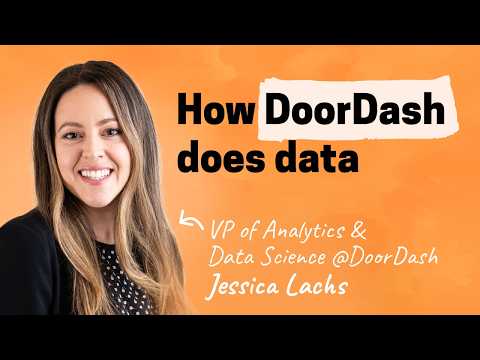
Building a world-class data org | Jessica Lachs (VP of Analytics and Data Science at DoorDash)
Lenny Rachitsky (host), Jessica Lachs (guest)
In this episode of Lenny's Podcast, featuring Lenny Rachitsky and Jessica Lachs, Building a world-class data org | Jessica Lachs (VP of Analytics and Data Science at DoorDash) explores how DoorDash Built a Centralized, Impact-Driven World-Class Data Organization Jessica Lachs, VP of Analytics and Data Science at DoorDash, explains how she built one of tech’s most respected data orgs by positioning analytics as a strategic, impact-driving partner rather than a service function.
How DoorDash Built a Centralized, Impact-Driven World-Class Data Organization
Jessica Lachs, VP of Analytics and Data Science at DoorDash, explains how she built one of tech’s most respected data orgs by positioning analytics as a strategic, impact-driving partner rather than a service function.
She strongly favors a centralized “center of excellence” data model with embedded pods and shared goals, enabling higher talent bars, consistent metrics, cross-functional mobility, and a strong team culture.
Lachs dives into how to hire great data people, design effective and simple metrics that truly drive behavior, and create space for proactive, exploratory work that uncovers high-leverage opportunities.
She also shares stories from DoorDash’s early scrappy days, the company’s culture of extreme ownership and customer obsession, and how her own non-traditional background shaped her approach to building a global analytics organization.
Key Takeaways
Centralize the data org, but embed pods and share goals with the business.
DoorDash runs a centralized analytics org with pods aligned to product, ops, and marketing; analysts report centrally to maintain standards and community, but share the same goals and roadmaps as their partner teams to ensure tight alignment and impact.
Get the full analysis with uListen AI
Treat analytics as a seat-at-the-table partner, not a service bureau.
Lachs rejects a Jira-ticket, dashboard-only mentality; her team is expected to proactively find opportunities, bring opinions, and answer “so what/what now? ...
Get the full analysis with uListen AI
Hire for deep curiosity and structured problem-solving, not just raw technical skills.
Technical competence is table stakes; the differentiator is people who pull on odd threads unprompted, handle ambiguity, accept being wrong, and can still make a call without perfect information—tested via real-world case interviews with intentional imperfections.
Get the full analysis with uListen AI
Use simple, understandable metrics and short-term proxies for long-term outcomes.
Instead of goaling teams on slow-moving metrics like retention or opaque composite scores, DoorDash identifies measurable input metrics that predict long-term value and keeps them simple enough that everyone can reason about and act on them.
Get the full analysis with uListen AI
Explicitly quantify trade-offs via a common business currency.
By expressing different levers (price cuts, faster delivery, new merchants, better login flows) in a shared unit like orders or GOV, DoorDash can compare investments across functions and choose the highest-ROI actions more quickly and objectively.
Get the full analysis with uListen AI
Make edge cases and fail states first-class metrics, not hidden averages.
Rare but severe failures like “never delivered” orders can drive churn and high cost while disappearing in averages; DoorDash sets explicit goals and dedicated teams to eliminate these fail states, quantifying their true downstream impact.
Get the full analysis with uListen AI
Create structural room for proactive work and learn to negotiate trade-offs.
Deep dives and hackathons (e. ...
Get the full analysis with uListen AI
Notable Quotes
“For me, analytics is a business impact driving function, and not purely a service function.”
— Jessica Lachs
“I strongly disagree [with embedding]; I believe a central model, a center of excellence, is superior.”
— Jessica Lachs
“Ultimately, you want to find a short-term metric you can measure that drives a long-term output.”
— Jessica Lachs
“Retention is a terrible thing to goal on. It's almost impossible to drive in a meaningful way in the short term.”
— Jessica Lachs
“Yes, you are a data scientist, but your goal is to figure out what's happening, and if that means that you're gonna pick up the phone and call customers, then that is what you're going to do.”
— Jessica Lachs
Questions Answered in This Episode
How can a smaller or earlier-stage company practically adopt a centralized data model without slowing down individual teams?
Jessica Lachs, VP of Analytics and Data Science at DoorDash, explains how she built one of tech’s most respected data orgs by positioning analytics as a strategic, impact-driving partner rather than a service function.
Get the full analysis with uListen AI
What are concrete examples of short-term proxy metrics that have proven to be strong predictors of long-term retention or LTV in your business?
She strongly favors a centralized “center of excellence” data model with embedded pods and shared goals, enabling higher talent bars, consistent metrics, cross-functional mobility, and a strong team culture.
Get the full analysis with uListen AI
How do you prevent a centralized data org from drifting back into a reactive, ticket-driven service posture over time?
Lachs dives into how to hire great data people, design effective and simple metrics that truly drive behavior, and create space for proactive, exploratory work that uncovers high-leverage opportunities.
Get the full analysis with uListen AI
What processes or tools do you use to systematically identify and prioritize fail states like “never delivered,” and measure their true lifetime impact?
She also shares stories from DoorDash’s early scrappy days, the company’s culture of extreme ownership and customer obsession, and how her own non-traditional background shaped her approach to building a global analytics organization.
Get the full analysis with uListen AI
For leaders with non-traditional backgrounds who want to move into analytics, what specific steps and skills should they focus on to credibly make that transition?
Get the full analysis with uListen AI
Transcript Preview
So you built one of the largest and most respected data teams in all of tech.
For me, analytics is a business impact driving function, and not purely a service function. Not just answering the why, but answering the what do we do now that we know this.
One of your colleagues told me that you're incredibly good at defining metrics.
Retention is a terrible thing to goal on. It's almost impossible to drive in a meaningful way in a short term. Ultimately, you want to find a short-term metric you can measure that drives a long-term output.
You mentioned the early team had felt extreme ownership.
Yes, you are a data scientist, but your goal is to figure out what's happening, and if that means that you're gonna pick up the phone and call customers, then that is what you're going to do to. So roll up your sleeves.
(instrumental music) Today my guest is Jessica Lacks. Jessica is vice president of analytics and data science at DoorDash, which has built one of the biggest and most impactful data teams in tech. She's been at DoorDash for over 10 years, and was the first GM at DoorDash responsible for launching new markets. Previously, Jessica founded Get Simple, a social gifting startup, and began her career in investment banking at Lehman Brothers. In our conversation, we go deep on how to build and scale your data org, including why a centralized org model is so effective, what to look for when hiring data people, how to pick the right metrics for teams to align incentives and drive the right sorts of outcomes, examples of how the data team at DoorDash has helped the business make better decisions, a bunch of great stories about the early days of DoorDash, and a ton more. If you enjoy this podcast, don't forget to subscribe and follow it in your favorite podcasting app or YouTube. It's the best way to avoid missing future episodes and helps the podcast tremendously. With that, I bring you Jessica Lacks. Jessica, thank you so much for being here, and welcome to the podcast.
Thank you so much for having me. I'm very excited to be here.
So you've built one of the largest and most respected data teams in all of tech. I've heard from a number of people that look to you for advice when they're trying to build and scale their data teams. And then DoorDash, in particular, is an incredibly complex business. There's, uh, three or maybe even four sites to the marketplace. There's this operational element. From the outside, it just feels extremely complicated and wild. I imagine from the inside it's even more wild. Let's talk about some of the things you've learned about building and scaling the team. You have a fairly contrarian perspective on how to structure data teams. This is referent- this was referenced when we had Elizabeth Stone on the podcast too. She approaches data the same way. So I'd love to hear just your take on how to structure data teams within companies. This episode is brought to you by Webflow. We're all friends here, so let's be real for a second. We all know that your website shouldn't be a static asset. It should be a dynamic part of your strategy that drives conversions. That's business 101. But here's a number for you. 54% of leaders say web updates take too long. That's over half of you listening right now. That's where Webflow comes in. Their visual first platform allows you to build, launch, and optimize web pages fast. That means you can set ambitious business goals and your site can rise to the challenge. Learn how teams like Dropbox, IDEO, and Orangetheory trust Webflow to achieve their most ambitious goals today at webflow.com. This episode is brought to you by Anvil. Their document SDK helps product teams build and launch software for documents fast. Companies like Carta and Vouch Insurance use Anvil to accelerate the development of their document workflows. Getting to market fast is a top priority for product teams. And the last thing that you or your developers want is to build document workflows from scratch. It's time-consuming, expensive, and distracts from core work. You could stitch together multiple tools and manage those integrations, or you can use an all-in-one document SDK. Most product managers will tell you paperwork sucks. Anvil's document SDK helps teams get to market fast, incorporate your brand style, and give you back time to focus on your company's core differentiated features. For your users, paperwork often starts with an AI-powered web form styled and embedded in your application. From there, you can route data to your backend systems and to the correct fields in your PDFs via API. Complete the process with a white labeled e-signature. The best part about Anvil is the level of customization their SDK provides. Non-technical folks love Anvil's drag-and-drop builder, and developers love their flexible APIs and easy to understand documentation. Build document software fast with Anvil. That's useanvil.com/lenny to learn more or start a free trial. That's useanvil.com/lenny.
Install uListen to search the full transcript and get AI-powered insights
Get Full TranscriptGet more from every podcast
AI summaries, searchable transcripts, and fact-checking. Free forever.
Add to Chrome