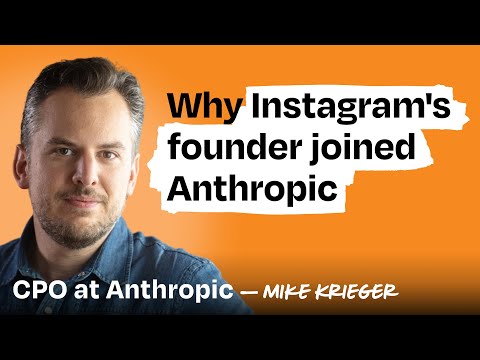
Anthropic's CPO on what comes next | Mike Krieger (co-founder of Instagram)
Lenny Rachitsky (host), Mike Krieger (guest), Narrator
In this episode of Lenny's Podcast, featuring Lenny Rachitsky and Mike Krieger, Anthropic's CPO on what comes next | Mike Krieger (co-founder of Instagram) explores anthropic’s CPO reveals AI’s future, product shifts, and bottlenecks ahead Mike Krieger, Anthropic’s Chief Product Officer and Instagram co-founder, reflects on how rapidly AI capabilities and timelines have outpaced his expectations, including Claude becoming a true strategic thought partner and 70–90% of Anthropic’s code now being AI-generated.
Anthropic’s CPO reveals AI’s future, product shifts, and bottlenecks ahead
Mike Krieger, Anthropic’s Chief Product Officer and Instagram co-founder, reflects on how rapidly AI capabilities and timelines have outpaced his expectations, including Claude becoming a true strategic thought partner and 70–90% of Anthropic’s code now being AI-generated.
He explains how this changes product development: engineering is no longer the main bottleneck; alignment, strategy, review, and deployment pipelines are. Anthropic is effectively “patient zero” for an AI-built codebase, with Claude Code largely written and reviewed by Claude itself.
Krieger discusses Anthropic’s positioning versus OpenAI—leaning into builders, developers, and deep integrations (e.g., MCP) rather than chasing mass consumer mindshare—and what remains uniquely valuable for product teams in an AI-first world.
He also shares why he shut down Artifact, the skills he wants his children to develop in an AI-saturated future, how startups can safely build on top of foundation models, and how Anthropic thinks about metrics, agency, and the human stakes of AI products.
Key Takeaways
AI is moving from assistant to genuine strategic thought partner faster than expected.
Krieger describes Claude Opus 4 surfacing novel, creative angles on Anthropic’s product strategy that he hadn’t considered, shifting his view of when models would show independent, non-obvious thinking rather than just safe, generic feedback.
Get the full analysis with uListen AI
When 70–90% of code is AI-written, bottlenecks shift away from engineering.
Anthropic had to re-architect its merge queues and rethink code review because AI massively increased pull request volume; the new constraints are alignment, decision-making, deployment pipelines, and ensuring coherence and launch strategy, not raw implementation speed.
Get the full analysis with uListen AI
Product teams must embed deeply with model and research work, not just sit on top of APIs.
The highest leverage at Anthropic comes from PMs working directly with researchers on post-training and fine-tuning (e. ...
Get the full analysis with uListen AI
Core product value in the AI era: strategy, comprehension, and unlocking overhang.
Krieger argues product’s enduring edge is deciding where to play and win, making powerful capabilities comprehensible and trusted, and closing the gap between what models can do and how people actually use them, rather than merely “drawing UIs around a giga-brain.”
Get the full analysis with uListen AI
Curiosity, inquiry, and independent thinking matter more than specific skills for kids.
Instead of defaulting to “ask Claude,” Krieger encourages his children to design experiments and reason for themselves, aiming to cultivate the scientific process and confidence in their own judgments so they don’t outsource all cognition to AI.
Get the full analysis with uListen AI
Artifact’s shutdown shows the importance of honest traction assessment and opportunity cost.
Despite a beloved product, mobile web degradation, weak organic growth loops, remote-team constraints, and poor input/output leverage led Krieger and team to conclude they weren’t the right founders for that opportunity—freeing them to work on higher-impact AI problems.
Get the full analysis with uListen AI
For AI startups, durable advantage comes from domain depth and edge-of-capability use.
Krieger advises founders to build in specialized verticals (e. ...
Get the full analysis with uListen AI
Notable Quotes
“I had this notion coming in… but I wasn’t sure how soon AI would be able to come up with something where I look at it and I’m like, ‘Yep, that is a new angle I hadn’t been looking at before.’”
— Mike Krieger
“We really rapidly became bottlenecked on other things, like our merge queue… Over half of our pull requests are Claude Code generated. At this point it’s probably over 70%.”
— Mike Krieger
“If we’re shipping things that could have been built by anybody just using our models off the shelf… that’s not where we should play.”
— Mike Krieger
“I kept having this feeling in these interviews: this is the AI company I would have hoped to have founded if I had founded an AI company.”
— Mike Krieger
“Not everything meaningful shows up in metrics.”
— Claude (as relayed by Lenny Rachitsky)
Questions Answered in This Episode
How should teams redesign their development and review processes once AI code generation becomes the dominant source of code?
Mike Krieger, Anthropic’s Chief Product Officer and Instagram co-founder, reflects on how rapidly AI capabilities and timelines have outpaced his expectations, including Claude becoming a true strategic thought partner and 70–90% of Anthropic’s code now being AI-generated.
Get the full analysis with uListen AI
Where is the line between empowering users with AI and inadvertently diminishing their own skills or agency over time?
He explains how this changes product development: engineering is no longer the main bottleneck; alignment, strategy, review, and deployment pipelines are. ...
Get the full analysis with uListen AI
What metrics or qualitative signals best capture whether an AI assistant is truly improving people’s lives, beyond engagement and time spent?
Krieger discusses Anthropic’s positioning versus OpenAI—leaning into builders, developers, and deep integrations (e. ...
Get the full analysis with uListen AI
How can startups systematically push models to their limits without building on capabilities that may not yet be stable or reliable enough for production?
He also shares why he shut down Artifact, the skills he wants his children to develop in an AI-saturated future, how startups can safely build on top of foundation models, and how Anthropic thinks about metrics, agency, and the human stakes of AI products.
Get the full analysis with uListen AI
If MCP-style integrations become ubiquitous, what new kinds of products and workflows become possible that don’t resemble any existing software category today?
Get the full analysis with uListen AI
Transcript Preview
... 90% of your code roughly is written by AI now.
The team that works in the most futuristic way is the Claude code team. They're using Claude code to build Claude code in a very self-improving kind of way. We really rapidly became bottlenecked on other things, like our merge queue. We had to completely re-architect it because so much more code was being written and so many more pull requests were being submitted. Over half of our pull requests are Claude Code generated. Probably at this point it's probably over 70%. And it just completely blew out the expectations of it.
You guys are at the edge of where things are heading.
I had the very bizarre experience of I had two tabs open. It was AI 2027 and my product strategy, and it was this, like, moment where I'm like, "Wait, am I the character in the story?"
It feels like ChatGPT is just winning in consumer mindshare. How does that inform the way you think about product, strategy, and mission?
I think there's room for several generationally important companies to be built in AI right now. How do we figure out what we wanna be when we grow up versus, like, what we currently aren't or wish that we were, or, like, see other players in the space being?
What's something that you've changed your mind about what AI is capable of and where AI is heading?
I had this notion coming in, like, yes, these models are great, but are they able to have an independent opinion? And it's actually really flipped for me only in the last month.
Today my guest is Mike Krieger. Mike is chief product officer at Anthropic, the company behind Claude. He's also the co-founder of Instagram. He's one of my most favorite product builders and thinkers. He's also now leading product at one of the most important companies in the world, and I'm so thrilled to have had a chance to chat with him on the podcast. We chat about what he's changed his mind about most in terms of AI capabilities in the years since he joined Anthropic, how product development changes and where bottlenecks emerge when 90% of your code is written by AI, which is now true at Anthropic. Also his thoughts on OpenAI versus Anthropic, the future of MCP, why he shut down Artifact, his last startup, and how he feels about it, also what skills he's encouraging his kids to develop with the rise of AI, and we close the podcast on a very heartwarming message that Claude wanted me to share with Mike. A big thank you to my newsletter Slack community for suggesting topics for this conversation. If you enjoy this podcast, don't forget to subscribe and follow it in your favorite podcasting app or YouTube. Also, if you become an annual subscriber of my newsletter, you get a year free of a bunch of incredible products, including Linear, Superhuman, Notion, Perplexity, and Granola. Check it out at lennysnewsletter.com and click bundle. With that, I bring you Mike Krieger. This episode is brought to you by Productboard, the leading product management platform for the enterprise. For over 10 years, Productboard has helped customer-centric organizations like Zoom, Salesforce, and Autodesk build the right products faster. And as an end-to-end platform, Productboard seamlessly supports all stages of the product development life cycle, from gathering customer insights, to planning a roadmap, to aligning stakeholders, to earning customer buy-in, all with a single source of truth. And now, product leaders can get even more visibility into customer needs with Productboard Pulse, a new voice of customer solution. Built-in intelligence helps you analyze trends across all of your feedback and then dive deeper by asking AI your follow-up questions. See how Productboard can help your team deliver higher impact products that solve real customer needs and advance your business goals. For a special offer and free 15-day trial, visit productboard.com/lenny. That's productboard.com/L-E-N-N-Y. Last year, 1.3% of the global GDP flowed through Stripe. That's over $1.4 trillion. And driving that huge number are the millions of businesses growing more rapidly with Stripe. For industry leaders like Forbes, Atlassian, OpenAI, and Toyota, Stripe isn't just financial software. It's a powerful partner that simplifies how they move money, making it as seamless and borderless as the internet itself. For example, Hertz boosted its online payment authorization rates by 4% after migrating to Stripe. And imagine seeing a 23% lift in revenue like Forbes did just six months after switching to Stripe for subscription management. Stripe has been leveraging AI for the last decade to make its product better at growing revenue for all businesses, from smarter checkouts, to fraud prevention, and beyond. Join the ranks of over half of the Fortune 100 companies that trust Stripe to drive change. Learn more at stripe.com. Mike, thank you so much for being here and welcome to the podcast.
Install uListen to search the full transcript and get AI-powered insights
Get Full TranscriptGet more from every podcast
AI summaries, searchable transcripts, and fact-checking. Free forever.
Add to Chrome