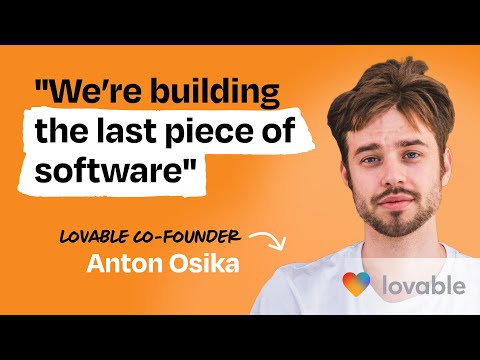
Building Lovable: $10M ARR in 60 days with 15 people | Anton Osika (CEO and co-founder)
Anton Osika (guest), Lenny Rachitsky (host), Narrator
In this episode of Lenny's Podcast, featuring Anton Osika and Lenny Rachitsky, Building Lovable: $10M ARR in 60 days with 15 people | Anton Osika (CEO and co-founder) explores aI engineer Lovable rockets to $10M ARR with 15 people Lenny interviews Anton Osika, CEO and co-founder of Lovable, an AI software engineer that turns natural-language prompts into fully working web products in minutes.
AI engineer Lovable rockets to $10M ARR with 15 people
Lenny interviews Anton Osika, CEO and co-founder of Lovable, an AI software engineer that turns natural-language prompts into fully working web products in minutes.
Lovable has grown explosively since launch, surpassing $10M ARR in two months with just 15–18 people and ~300K MAUs, largely through organic word of mouth and social media demos.
Anton explains how Lovable works (including a live Airbnb-clone demo), their technical breakthroughs to reduce AI “getting stuck,” and why product taste, generalist skills, and AI fluency will matter more than raw coding in the future.
They also dig into how Lovable hires, how to structure future product teams around AI tools, and why being in the top 1% of AI users will be a huge career advantage.
Key Takeaways
AI will handle more of the building; humans must excel at deciding what to build.
As tools like Lovable make it trivial to generate production-ready software, the scarce skills shift toward product discovery, understanding user pain, taste, and knowing when a solution is actually good enough to ship.
Get the full analysis with uListen AI
Clear, specific communication is now a core “AI-era” product skill.
Lovable works best when users describe exactly what they want, what is and isn’t working, and how it should behave—vague prompts like “it doesn’t work” lead to poor outcomes, making precise specification a superpower.
Get the full analysis with uListen AI
To use AI tools well, treat learning them like a serious project.
Anton suggests spending at least a full week taking a real problem from idea to working solution using AI (and asking the AI questions as you go); doing this puts you in roughly the top 1% of AI users globally.
Get the full analysis with uListen AI
Generalists with deep spikes in one area are increasingly valuable.
In future product teams, the most valuable people will understand architecture, design, product, talking to users, and business context, while having an exceptional superpower in at least one dimension (e. ...
Get the full analysis with uListen AI
Hypergrowth came from obsessing over product quality, not marketing tricks.
Lovable’s growth to $10M+ ARR with a tiny team came mostly from people loving the product, sharing demos on social media, and a relentless focus on reliability, not from paid acquisition or elaborate growth hacks.
Get the full analysis with uListen AI
Embedding AI into end-to-end products beats “AI as a bolt-on API.”
Anton learned at a previous startup that simply offering an AI personalization API wasn’t enough; real impact comes when the entire product experience is designed around AI from the ground up, not retrofitted later.
Get the full analysis with uListen AI
Co-located, high-ambition teams still have an edge—even in an AI company.
Despite building cutting-edge AI, Lovable leans on very human advantages—working from the office, frequent informal collaboration (especially over lunch), and extreme ambition—as key to moving incredibly fast.
Get the full analysis with uListen AI
Notable Quotes
“We’re building the last piece of software.”
— Anton Osika
“People love the product. That’s the driver of the growth.”
— Anton Osika
“Being in the top 1% in using AI tools is going to absolutely set you apart in the coming months and years.”
— Anton Osika
“If I’m putting together a product team today, I would really obsess about getting as many skill sets as possible for each person I hire.”
— Anton Osika
“You should see this as fun. The world is changing quickly, and the best thing you can do is get your hands very dirty with these tools.”
— Anton Osika
Questions Answered in This Episode
How should established companies with large, messy codebases practically adopt tools like Lovable without rewriting everything from scratch?
Lenny interviews Anton Osika, CEO and co-founder of Lovable, an AI software engineer that turns natural-language prompts into fully working web products in minutes.
Get the full analysis with uListen AI
As AI agents get more “agentic,” what guardrails or oversight mechanisms will be needed to keep complex systems safe and predictable?
Lovable has grown explosively since launch, surpassing $10M ARR in two months with just 15–18 people and ~300K MAUs, largely through organic word of mouth and social media demos.
Get the full analysis with uListen AI
For an individual contributor today, what’s the most concrete way to transition from being a strong coder to being a strong “AI-powered” product builder?
Anton explains how Lovable works (including a live Airbnb-clone demo), their technical breakthroughs to reduce AI “getting stuck,” and why product taste, generalist skills, and AI fluency will matter more than raw coding in the future.
Get the full analysis with uListen AI
If AI can build and iterate on products so quickly, how will this change competition, defensibility, and moats for software startups?
They also dig into how Lovable hires, how to structure future product teams around AI tools, and why being in the top 1% of AI users will be a huge career advantage.
Get the full analysis with uListen AI
What are the ethical and societal implications of giving non-technical people the ability to spin up powerful software products in minutes?
Get the full analysis with uListen AI
Transcript Preview
(laid-back music) Lovable is your personal AI software engineer. You describe an idea and then you get a fully working product. The reason is to enable those who have had, like, such a hard time finding people who are good at creating software, that's been their absolute bottleneck, and let them take their ideas and their dreams into reality.
You guys hit 4 million ARR in the first four weeks. You hit 10 million ARR in the first two months with just 15 people. You're the fastest growing startup in all of Europe. How did you decide on Lovable as the name? It's so sweet.
The best word for a great product is that it's lovable. A lot of jargon that I like to use to, like, emphasize what we should be striving for is building a minimum lovable product, and then building a lovable product, and then building an absolutely lovable product. So I, I took that jargon with me in the company name.
People wonder just what jobs will be more important, what skills will be less important?
Doing a bit of everything, being a generalist is, I think, much more important than it used to be. If I'm putting together a product team today, I, I would really obsess about getting as many skill sets as possible for each person I hire.
What have you done that has allowed you to grow this fast with so few people?
People love the product. (laughs) That's the driver of, of the growth.
(instrumental music) Today my guest is Anton Ock. Anton is co-founder and CEO of Lovable, which is essentially an AI engineer that takes an English prompt and codes a product for you in minutes. You can then talk to it, iterate on the product, and then launch it to the world. It's one of the fastest growing products in history, the fastest growing startup in Europe ever. And as Anton describes, their goal for Lovable is for it to be the last piece of software that anybody has to write because it'll be able to create all future products for us. They launched just a few months ago. In the first four weeks, hit 4 million ARR. In the first two months, crossed 10 million ARR, all with just 15 people. Absurd. In our conversation, we covered a lot of ground, including a live demo of Lovable, how their team operates, how they hire, what has most enabled their team to scale this quickly with so few people, pro tips for using Lovable, how it all started, how he recommends you build product teams going forward with tools like this existing, what skills will matter more and less going forward, plus how to think about Lovable versus competitors, and so much more. If you're trying to wrap your head around how product building will change with the rise of AI tools, this episode is a must watch. If you enjoy this podcast, don't forget to subscribe and follow it in your favorite podcasting app or YouTube. Also, if you become a yearly subscriber of my newsletter, you now get a year free of Perplexity and Notion and Superhuman and Linear and Granola. Check it out at lennysnewsletter.com. With that, I bring you Anton Ock. This episode is brought to you by Sinch, the customer communications cloud. Here's the thing about digital customer communications. Whether you're sending marketing campaigns, verification codes, or account alerts, you need them to reach users reliably. That's where Sinch comes in. Over 150,000 businesses, including eight of the top 10 largest tech companies globally, use Sinch's API to build messaging, email, and calling into their products. And there's something big happening in messaging that product teams need to know about, rich communication services, or RCS. Think of RCS as SMS 2.0. Instead of getting texts from a random number, your users will see your verified company name and logo without needing to download anything new. It's a more secure and branded experience. Plus you get features like interactive carousels and suggestive replies. And here's why this matters. US carriers are starting to adopt RCS. Sinch is already helping major brands send RCS messages around the world, and they're helping Lenny's podcast listeners get registered first before the rush hits the US market. Learn more and get started at sinch.com/lenny. That's S-I-N-C-H.com/lenny. This episode is brought to you by Persona, the adaptable identity platform that helps businesses fight fraud, meet compliance requirements, and build trust. While you're listening to this right now, how do you know that you're really listening to me, Lenny? These days, it's easier than ever for fraudsters to steal PII, faces, and identities. That's where Persona comes in. Persona helps leading companies like LinkedIn, Etsy, and Twilio securely verify individuals and businesses across the world. What sets Persona apart is its configurability. Every company has different needs depending on its industry, use cases, risk tolerance, and user demographics. That's why Persona offers flexible building blocks that allow you to build tailored collection and verification flows that maximize conversion while minimizing risk. Plus, Persona's orchestration tools automate your identity process so that you can fight rapidly shifting fraud and meet new waves of regulation. Whether you're a startup or an enterprise business, Persona has a plan for you. Learn more at withpersona.com/lenny. Again, that's with P-E-R-S-O-N-a.com/lenny. Anton, thank you so much for being here and welcome to the podcast.
Install uListen to search the full transcript and get AI-powered insights
Get Full TranscriptGet more from every podcast
AI summaries, searchable transcripts, and fact-checking. Free forever.
Add to Chrome