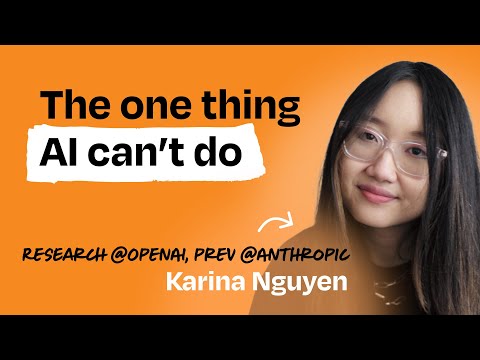
OpenAI researcher on why soft skills are the future of work | Karina Nguyen
Lenny Rachitsky (host), Karina Nguyen (guest), Christina Cacioppo (guest)
In this episode of Lenny's Podcast, featuring Lenny Rachitsky and Karina Nguyen, OpenAI researcher on why soft skills are the future of work | Karina Nguyen explores openAI researcher predicts soft skills will define AI-powered work future OpenAI researcher Karina Nguyen explains how cutting-edge AI models are actually built, stressing that model training is as much art as science and depends heavily on data quality, evals, and synthetic data. She describes how OpenAI teams collaborate across research, engineering, design, and product to ship features like Canvas and Tasks, using synthetic data and careful evaluation to shape model behavior. Karina argues that as AI rapidly improves at coding, writing, and reasoning, the most durable human advantages will be soft skills like creativity, prioritization, people management, and taste. Comparing Anthropic and OpenAI, she highlights differences in culture and product mindset, and sketches a near future of agents that operate computers, automate redundant work, and increasingly assist with strategy and research.
OpenAI researcher predicts soft skills will define AI-powered work future
OpenAI researcher Karina Nguyen explains how cutting-edge AI models are actually built, stressing that model training is as much art as science and depends heavily on data quality, evals, and synthetic data. She describes how OpenAI teams collaborate across research, engineering, design, and product to ship features like Canvas and Tasks, using synthetic data and careful evaluation to shape model behavior. Karina argues that as AI rapidly improves at coding, writing, and reasoning, the most durable human advantages will be soft skills like creativity, prioritization, people management, and taste. Comparing Anthropic and OpenAI, she highlights differences in culture and product mindset, and sketches a near future of agents that operate computers, automate redundant work, and increasingly assist with strategy and research.
Key Takeaways
Model training is an art that hinges on data quality and behavior design.
Nguyen emphasizes that beyond raw scale, the way you curate data, resolve contradictions (e. ...
Get the full analysis with uListen AI
Synthetic data enables near-infinite post-training without hitting a 'data wall'.
By generating synthetic tasks and interactions (often using stronger models like o1), teams can continuously teach specific behaviors—like when to trigger Canvas or how to edit documents—without relying solely on scarce human-labeled data.
Get the full analysis with uListen AI
Evals are becoming a core product skill, not just a research tool.
Product managers and designers are now expected to define success via eval sets—spreadsheets of inputs, desired outputs, and pass/fail criteria—and use win-rate comparisons to guide model and feature iteration.
Get the full analysis with uListen AI
Soft skills will be the strongest moat as AI masters hard skills.
As models get excellent at coding, writing, search, and data synthesis, differentiation will come from creativity, prioritization, communication, people management, empathy, and taste—areas where current models still struggle.
Get the full analysis with uListen AI
Strategy and research will be increasingly AI-augmented, not human-only.
Nguyen agrees that models will be able to ingest huge amounts of data, connect dots across sources, and propose strategies or research directions, effectively acting as high-level planning and analysis partners.
Get the full analysis with uListen AI
Successful AI products pair familiar form factors with 'magical' model capabilities.
Features like Canvas, Tasks, file uploads, and future agents work best when wrapped in interfaces users already understand (docs, notifications, Slack, browsers), then supercharged with model autonomy and reasoning.
Get the full analysis with uListen AI
AI lab culture and processes deeply shape model personality and behavior.
Anthropic’s intense focus and handcrafted behavior give Claude its calm, librarian-like persona, while OpenAI’s more bottoms-up, risk-tolerant environment encourages rapid, creative experimentation with new products and capabilities.
Get the full analysis with uListen AI
Notable Quotes
“Model training is more an art than a science.”
— Karina Nguyen
“The cost of reasoning and intelligence is drastically going down.”
— Karina Nguyen
“You want to build something that the most general model will not replace you.”
— Karina Nguyen
“I still think ChatGPT kind of sucks at writing… it’s bottlenecked by this creative reasoning.”
— Karina Nguyen
“We went from personal computers to personal models.”
— Karina Nguyen
Questions Answered in This Episode
How can product teams practically build the skill of designing high-quality evals and synthetic training sets?
OpenAI researcher Karina Nguyen explains how cutting-edge AI models are actually built, stressing that model training is as much art as science and depends heavily on data quality, evals, and synthetic data. ...
Get the full analysis with uListen AI
What concrete techniques might improve a model’s creativity, aesthetic judgment, and 'taste' in writing and design?
Get the full analysis with uListen AI
Where is the ethical line between helpful autonomous agents and systems that feel uncomfortably powerful or opaque?
Get the full analysis with uListen AI
How should individual contributors and managers in tech re-skill over the next 3–5 years to stay ahead of AI?
Get the full analysis with uListen AI
In what ways might differing lab cultures (Anthropic vs. OpenAI) lead to meaningfully different AI futures and user experiences?
Get the full analysis with uListen AI
Transcript Preview
Not only are you working at the cutting edge of AI and LMS, you're actually building the cutting edge.
When I first came to Andara and I was like, "Oh no, I would have gone from an engineering." And then the reason why I switched to research is because I realized, oh my God, cloud is getting better at front ends. Cloud is getting better at, like, coding. I think cloud can, like, develop new apps.
What skills do you think will be most valuable going forward for product teams, in particular?
Creative, thinking. You kind of want to, like, generate a bunch of ideas and, like, filter through them and just build the best product experience. I think it's actually really, really hard to teach the model how to be aesthetic or really good with visual design, or like how to be extremely creative in the way they write.
What do you think people most misunderstand about how models are created?
When you taught the model some of the self-knowledge of you actually don't have a physical body to operate in the physical world, the model would get like extremely confused.
(Intro music) Today, my guest is Karina Nguyen. Karina is an AI researcher at OpenAI where she helped build Canva, Tasks, the o1-chain-of-thought model and more. Prior to OpenAI, she was at Anthropic, where she led work on post-training and evaluation for the Claude 3 models, built a document upload feature with 100K context windows and so much more. She was also an engineer at New York Times, was a designer at Dropbox and at Square. It's very rare to get a glimpse into how someone working on the bleeding edge of AI and LMS operates, and how they think about where things are heading. In our conversation, we talk about how teams at OpenAI operate and build products, what skills she thinks you should be building as AI gets smarter, how models are created, why synthetic data will allow models to keep getting smarter, and why she moved from engineering to research after realizing how good LMs are gonna be at coding. If you enjoy this podcast, don't forget to subscribe and follow it in your favorite podcasting app or YouTube. It's the best way to avoid missing future episodes, and it helps the podcast tremendously. With that I bring you Karina Nguyen. This episode is brought to you by Interpret. Interpret unifies all your customer interactions from Gong calls to Zendesk tickets to Twitter threads to App Store reviews, and makes it available for analysis. It's trusted by leading product orgs like Canva, Notion, Loom, Linear, monday.com and Strava to bring the voice of the customer into the product development process, helping you build best-in-class products faster. What makes Interpret special is its ability to build and update customer specific AI models that provide the most granular and accurate insights into your business, connect customer insights to revenue and operational data in your CRM or data warehouse to map the business impact of each customer need and prioritize confidently, and empower your entire team to easily take action on use cases like win-loss analysis, critical bug detection, and identifying drivers of churn with Interpret's AI assistant, Wisdom. Looking to automate your feedback loops and prioritize your roadmap with confidence like Notion, Canva, and Linear? Visit E-N-T-E-R-P-R-E-T dot com slash LENNY to connect with the team and get two free months when you sign up for an annual plan. This is a limited time offer. That's interpret.com/lenny. This episode is brought to you by Vanta, and I am very excited to have Christina Cacioppo, CEO and co-founder of Vanta joining me for this very short conversation.
Install uListen to search the full transcript and get AI-powered insights
Get Full TranscriptGet more from every podcast
AI summaries, searchable transcripts, and fact-checking. Free forever.
Add to Chrome