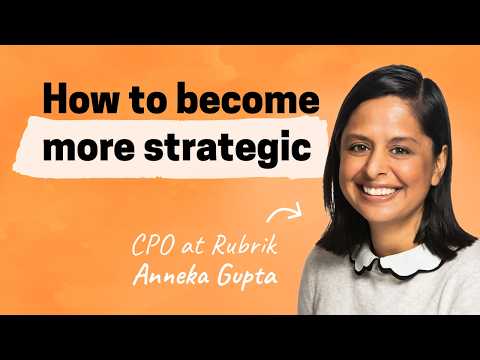
Becoming more strategic, navigating difficult colleagues, founder mode, more | Anneka Gupta
Anneka Gupta (guest), Lenny Rachitsky (host), Narrator
In this episode of Lenny's Podcast, featuring Anneka Gupta and Lenny Rachitsky, Becoming more strategic, navigating difficult colleagues, founder mode, more | Anneka Gupta explores anneka Gupta on strategy, founders, hard feedback, and joyful leadership Anneka Gupta, CPO at Rubrik and longtime product leader, shares her approach to making work fun, managing energy, and handling difficult situations and personalities. She reframes “being strategic” as combining a compelling, simple ‘why’ with championing hard, high‑leverage changes, and offers very tactical ways PMs can build this muscle (especially through summarization and incremental “one click better” thinking).
Anneka Gupta on strategy, founders, hard feedback, and joyful leadership
Anneka Gupta, CPO at Rubrik and longtime product leader, shares her approach to making work fun, managing energy, and handling difficult situations and personalities. She reframes “being strategic” as combining a compelling, simple ‘why’ with championing hard, high‑leverage changes, and offers very tactical ways PMs can build this muscle (especially through summarization and incremental “one click better” thinking).
Gupta digs into how to work with founder-mode CEOs, how to exercise ‘founder mode’ as a product leader, and how to make faster, better decisions by being both a historian of past decisions and biasing toward action and learning. She also explains her methods for giving and receiving hard feedback, navigating high-ego colleagues, and cultivating a positive mindset through humor, gratitude, and journaling.
Later, she discusses realistic paths into product management, what new PMs most misunderstand about the role, how she teaches PM at Stanford, and some early, practical ways AI is already helping PMs—especially with research summarization.
Key Takeaways
Being strategic = simple, compelling ‘why’ + championing hard, high-impact change.
People label you ‘strategic’ when you can clearly articulate the rationale behind direction and are willing to push for difficult, long-term-benefit moves—both are required; big ideas without a clear why, or a clear why attached to only small moves, don’t read as strategic.
Get the full analysis with uListen AI
Use summarization as a daily, practical strategy superpower.
In meetings, pause to synthesize what’s been said, propose a direction, and end with a question; this makes others feel heard, aligns diverse views, moves discussions out of circular debate, and is often perceived as high-level strategic thinking.
Get the full analysis with uListen AI
Manage your energy, not just your time, to handle hard situations well.
Gupta intentionally avoids tough work during her low-energy hours and doesn’t skip basics like lunch; structuring your day around when you have the most mental and emotional energy makes it far easier to maintain a positive, ‘have fun’ mindset under pressure.
Get the full analysis with uListen AI
Treat founders and senior leaders as levers, not obstacles, in ‘founder mode’.
When working with a founder in founder mode, deeply understand their objectives, use them as powerful allies to unblock big initiatives, and, when you disagree, reframe their ask back to the underlying goal and propose better options rather than opposing the idea head-on.
Get the full analysis with uListen AI
Bias toward making decisions and learning, not waiting for perfect information.
Aim for ~70% confidence, make a call with explicit hypotheses, and then learn from what happens; organizations that reward learning over outcomes build cultures where PMs feel safe to act, iterate, and correct course instead of staying in analysis paralysis.
Get the full analysis with uListen AI
Defuse difficult personalities by decoding their drivers and reframing them as teachers.
Ask colleagues what motivates a hard stakeholder, then connect your ask to what they care about; simultaneously, treat each interaction as a chance to learn something from them (communication style, influence, vision), which shifts your own mindset from frustration to curiosity and gratitude.
Get the full analysis with uListen AI
Anchor feedback in care, clarity, and perception, not attack.
When giving hard feedback, explicitly state that you care about the person’s success, be direct and specific, frame issues as ‘how you’re being perceived,’ and co-create concrete behavior changes; when receiving feedback, let yourself feel the sting, then return with curiosity instead of defensiveness.
Get the full analysis with uListen AI
Breaking into PM is easier from a product-adjacent role within the same company.
Gupta sees most successful transitions come from people in engineering, sales, support, or other adjacent roles who build credibility, take on PM-like projects, and then move internally—direct entry-level PM hires into big companies are comparatively rare.
Get the full analysis with uListen AI
Notable Quotes
“When people say, ‘I want someone that’s strategic,’ what they’re really saying is, ‘I want someone that can come up with and articulate a compelling and simple why… and who will champion hard things that are best for the long-term interest of the company.’”
— Anneka Gupta
“I try to embody the mindset of believing that I can work with anyone.”
— Anneka Gupta
“It’s not about making the right decision. It’s about making the decision.”
— Anneka Gupta
“The mindset that you bring to your work is actually the most important thing over anything else that you can do.”
— Anneka Gupta
“Everyone has something to teach and everyone has something to learn.”
— Anneka Gupta
Questions Answered in This Episode
How can I practically start building the ‘summarization’ habit in my own meetings without feeling like I’m overstepping?
Anneka Gupta, CPO at Rubrik and longtime product leader, shares her approach to making work fun, managing energy, and handling difficult situations and personalities. ...
Get the full analysis with uListen AI
When working with a strong founder in founder mode, how do I decide which battles to fight and which pet projects to let go?
Gupta digs into how to work with founder-mode CEOs, how to exercise ‘founder mode’ as a product leader, and how to make faster, better decisions by being both a historian of past decisions and biasing toward action and learning. ...
Get the full analysis with uListen AI
What are some concrete examples of ‘one click better’ strategic moves that product teams can make in the next 90 days?
Later, she discusses realistic paths into product management, what new PMs most misunderstand about the role, how she teaches PM at Stanford, and some early, practical ways AI is already helping PMs—especially with research summarization.
Get the full analysis with uListen AI
How can a team systematically reward learning over outcomes so people truly feel safe making 70% confidence decisions?
Get the full analysis with uListen AI
If I’m early in my career and not in product yet, what specific projects or behaviors would most convince a PM leader to take a chance on me internally?
Get the full analysis with uListen AI
Transcript Preview
When people say, "I want someone that's strategic," what they're really saying is, "I want someone that can come up with and articulate a compelling and simple why behind the decisions and the direction of the company and product." So that's number one. And the second piece is, "I want someone that's going to champion and be a change agent to do things that may be hard, but actually best for the long-term interest of the product or company, even though those things are not gonna be easy to execute on." And I think if you have one without the other, ultimately people are not gonna see you as strategic.
(instrumental music) Today my guest is Anika Gupta. Anika is chief product officer at Rubrik, a lecturer on product management at Stanford University's Graduate School of Business, and on the board of Tinuiti. Previously, she was president, GM, and head of product at LiveRamp, where she spent 11 years and joined as one of their earliest employees. A bunch of former guests recommended Anika come on this podcast, and you will soon see why. In our conversation, Anika shares a ton of powerful advice on navigating difficult personalities, giving and hearing hard feedback, bringing humor and gratitude to every situation, managing your energy versus managing your time, super tactical tips for how to become more strategic and how to make better decisions, and also how to break into product management for people that are trying to become product managers. There's something in this episode for everyone and I am excited for you to learn from Anika. If you enjoy this podcast, don't forget to subscribe and follow it in your favorite podcasting app or YouTube. It's the best way to avoid missing future episodes and it helps the podcast tremendously. With that, I bring you Anika Gupta. Anika, thank you so much for being here and welcome to the podcast.
Thanks for having me.
So I'm gonna start with a question that I've started to ask guests that come on the podcast that have had extraordinarily successful careers and also just consistently successful careers. So here's the question. What do you believe are one or two skills or mindsets or habits that you think most contributed to your success that you think might be helpful for other people to learn and build to help them have more successful careers?
So it's funny. Before we kicked this off, you talked about the Post-it that you have on your computer that says-
Yeah.
... have fun.
Mm-hmm.
And my one mindset, uh, that I really have leaned into after someone actually gave me advice on this is to figure out how to have fun in my job even in the most difficult of times. And the reason why I say that is because when you're hit with really hard times, it's easy to operate from a mindset of scarcity and to look at everything as an unachievable hurdle to overcome. And when I was able to switch my mindset and say, "Well, I'm actually gonna figure out a way to have fun with this," it actually changed my entire approach for how to deal with super difficult situations. And this advice specifically came up to me when I had a scenario where I had to essentially change out all of my direct reports in very short order. And I figured that out. It was a super daunting situation. I didn't know how I was gonna manage and at first I felt so scared by what was ahead of me and how much change I was gonna have to go through in a very short period of time. But when I got this advice, I started to try to reframe my thinking and it actually really made it so that I was able to get through that hard time and opened my mind up to so many more opportunities. So now I try to embody that in every situation that I come up, come across where I'm faced with something super, super challenging.
Install uListen to search the full transcript and get AI-powered insights
Get Full TranscriptGet more from every podcast
AI summaries, searchable transcripts, and fact-checking. Free forever.
Add to Chrome