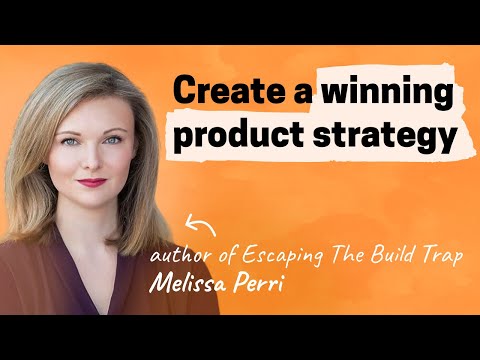
How to create a winning product strategy | Melissa Perri
Melissa Perri (guest), Lenny Rachitsky (host), Narrator
In this episode of Lenny's Podcast, featuring Melissa Perri and Lenny Rachitsky, How to create a winning product strategy | Melissa Perri explores melissa Perri Reveals How Real Product Strategy Transforms Growing Companies Melissa Perri shares lessons from working with thousands of PMs and hundreds of companies on how to build effective product organizations and strategies. She argues most problems blamed on “PM skill” are actually failures in setting goals, forming strategy, and deploying it clearly across teams. The conversation covers when to hire a CPO, how to recognize the absence of real strategy, how to craft and communicate vision and product strategy, and the emerging role of product operations. Throughout, she offers pragmatic, lightweight practices—like two-page strategy memos and structured cadences—that help teams align execution with business outcomes.
Melissa Perri Reveals How Real Product Strategy Transforms Growing Companies
Melissa Perri shares lessons from working with thousands of PMs and hundreds of companies on how to build effective product organizations and strategies. She argues most problems blamed on “PM skill” are actually failures in setting goals, forming strategy, and deploying it clearly across teams. The conversation covers when to hire a CPO, how to recognize the absence of real strategy, how to craft and communicate vision and product strategy, and the emerging role of product operations. Throughout, she offers pragmatic, lightweight practices—like two-page strategy memos and structured cadences—that help teams align execution with business outcomes.
Key Takeaways
Most product problems are strategic, not tactical or training-related.
Companies often think the issue is weak PMs, but Melissa finds 99% of the time the real problem is unclear goals and poorly deployed strategy—so even well-trained PMs lack context for what matters.
Get the full analysis with uListen AI
Hire a CPO when complexity and scale outgrow execution-focused leadership.
Signs you need a CPO include: multi-product portfolios, geographic or market expansion, major pivots/mergers, 7–8+ PMs, and executives or boards saying they don’t understand what product/tech is doing.
Get the full analysis with uListen AI
You can diagnose missing strategy by how teams answer “what and why.”
If teams work extremely hard but key metrics don’t move, executives see product as a black box, and PMs can’t clearly connect their work to company goals, you have a strategy deployment problem—the “missing middle” between vision and team execution.
Get the full analysis with uListen AI
Write simple, concrete strategy and vision docs everyone can link to.
Melissa advocates short memos (1–2 pages) that explain where the company is going, how it’s positioned, what it will and won’t do, and prioritized strategic intents—cascaded down into product initiatives and team-level solutions, often supported by clear visuals.
Get the full analysis with uListen AI
Vision must be specific, differentiating, and future-oriented—not a tagline.
Good visions describe how the company will be different in 5–10 years, why it will win, who it serves, and what it explicitly will not do, so people can picture the future and make aligned trade-offs today.
Get the full analysis with uListen AI
PMs build strategic skill by acting like executives before they are one.
Instead of waiting for permission, PMs should ask, “What would I do if I were the CPO? ...
Get the full analysis with uListen AI
Product Operations is essential to scaling product practice effectively.
As orgs grow, Product Ops standardizes cross-team processes (like roadmapping and rituals), centralizes internal and external insights (data, customer and market research), and ensures PMs can access what they need while leaders can roll up comparable, strategy-aligned outputs.
Get the full analysis with uListen AI
Notable Quotes
“I met a lot of organizations that think most of their issues are in the training of their people, and 99% of the time, I see that it's actually in the way that they're setting their goals and deploying their strategy.”
— Melissa Perri
“If your executives and your board are telling you, 'I don't really know what's going on in tech or product,' the person who's communicating those things to them is usually not chief product officer level.”
— Melissa Perri
“Teams are working like dogs, releasing, releasing, releasing, and none of the metrics are moving. That's a great example of when there is no strategy.”
— Melissa Perri
“A vision should be concrete enough where people can picture what it will be in their head. It can't be a fluffy, 'Be the backbone of healthcare.'”
— Melissa Perri
“You can hire a consultant, but if you don't listen to the consultant, nothing's gonna change.”
— Melissa Perri
Questions Answered in This Episode
How can a founder honestly assess whether they personally should remain the top product leader, or if it’s time to bring in a CPO?
Melissa Perri shares lessons from working with thousands of PMs and hundreds of companies on how to build effective product organizations and strategies. ...
Get the full analysis with uListen AI
What are some concrete examples of strong two-page strategy or vision memos, and how do they differ from typical OKR or roadmap decks?
Get the full analysis with uListen AI
How should a company phase in Product Operations—what’s the minimum viable Product Ops function at a 5-, 20-, or 50-PM org?
Get the full analysis with uListen AI
What should PMs do when they recognize a strategy gap but their leadership is resistant to acknowledging or addressing it?
Get the full analysis with uListen AI
How can executives avoid over-standardizing processes in the name of Product Ops while still achieving the comparability and alignment Melissa describes?
Get the full analysis with uListen AI
Transcript Preview
I met a lot of organizations that think most of their issues are in the training of their people, and 99% of the time, I see that it's actually in the way that they're setting their goals and deploying their strategy. Because once you train those people, they have no context on what to work towards. So, it's such an... a holistic approach when you actually go through these transformations or try to set up a product organization. So you either need somebody in there to do it or you gotta really be ready to move when somebody comes in to help you. (instrumental music)
Through her speaking, consulting, interim CPO roles, and teaching at both Harvard Business School and online, Melissa Perry has seen more product orgs up close than possibly any human alive. In our chat, we cover the most common problems that product teams face and how to overcome them, when to hire your first PM, how to hone your craft as a PM, signs you're doing a bad job as a PM. Also, how to structure your product teams and product development process, signs your team doesn't have a strategy and how to come up with one. Also, how to come up with a product vision, and so much more. I loved chatting with Melissa and I learned a ton, and I can't wait for you to hear this episode. (instrumental music) If you're setting up your analytics stack but you're not using Amplitude, what are you doing? Amplitude is the number one most popular analytics solution in the world, used by both big companies like Shopify, Instacart, and Atlassian, and also most tech startups. Amplitude has everything you need, including a powerful and fully self-service analytics product, an experimentation platform, and even an integrated customer data platform to help you understand your users like never before. Give your teams self-service product data to understand your users, drive conversions, and increase engagement, growth, and revenue. Ditch your vanity metrics, trust your data, work smarter, and grow your business. Try Amplitude for free. Just visit amplitude.com to get started. This episode's brought to you by RevenueCat. RevenueCat makes it easy to build, analyze, and grow in-app subscriptions on iOS, Android, and the web. Their platform lets you focus on growth rather than getting bogged down in subscription infrastructure. RevenueCat provides a backend and wrapper around AppleStoreKit and Google Play Billing to handle the implementation and upkeep of in-app purchases. RevenueCat is your source of truth for customer status across platforms and provides out-of-the-box analytics for key subscription metrics like monthly recurring revenue, lifetime value, retention, and more. With RevenueCat, you also get pre-built integrations with best-in-class tools like Amplitude, AppsFlyer, and Firebase. That means reliable, consistent data sync to your entire product and growth stack in minutes. See why companies like Notion, Bisco, and Life360 use RevenueCat to power in-app subscriptions. Learn more at revenuecat.com. (instrumental music) Melissa, welcome. Thank you so much for joining me.
Install uListen to search the full transcript and get AI-powered insights
Get Full TranscriptGet more from every podcast
AI summaries, searchable transcripts, and fact-checking. Free forever.
Add to Chrome