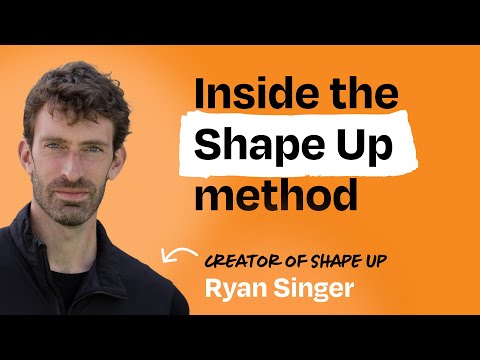
A better way to plan, build, and ship products | Ryan Singer (creator of “Shape Up")
Ryan Singer (guest), Lenny Rachitsky (host), Narrator, Narrator
In this episode of Lenny's Podcast, featuring Ryan Singer and Lenny Rachitsky, A better way to plan, build, and ship products | Ryan Singer (creator of “Shape Up") explores ryan Singer explains Shape Up: timeboxed, collaborative, reality-based product delivery Ryan Singer, longtime product leader at 37signals/Basecamp and author of Shape Up, breaks down a practical alternative to Scrum and traditional Agile for planning and shipping software. The core of Shape Up is working backward from a fixed time budget (“appetite”), deeply shaping solutions with product, design, and engineering in the room, and then giving small teams end-to-end ownership to build without constant rituals. Singer contrasts Basecamp’s unique environment with most companies, emphasizing how to adapt Shape Up to “real life” constraints like non-coding designers, entrenched Scrum, and multiple stakeholders. The conversation spends significant time on how to run effective shaping sessions, when to consider Shape Up, common failure modes, and how this shifts the PM role upstream toward problem definition and product strategy.
Ryan Singer explains Shape Up: timeboxed, collaborative, reality-based product delivery
Ryan Singer, longtime product leader at 37signals/Basecamp and author of Shape Up, breaks down a practical alternative to Scrum and traditional Agile for planning and shipping software. The core of Shape Up is working backward from a fixed time budget (“appetite”), deeply shaping solutions with product, design, and engineering in the room, and then giving small teams end-to-end ownership to build without constant rituals. Singer contrasts Basecamp’s unique environment with most companies, emphasizing how to adapt Shape Up to “real life” constraints like non-coding designers, entrenched Scrum, and multiple stakeholders. The conversation spends significant time on how to run effective shaping sessions, when to consider Shape Up, common failure modes, and how this shifts the PM role upstream toward problem definition and product strategy.
Key Takeaways
Start from appetite, not estimates.
Instead of asking, “How long will this take? ...
Get the full analysis with uListen AI
Shaping must be collaborative and technical, not just docs or Figma.
Effective shaping isn’t a solo PM-writing-PRDs exercise; it’s a live, collaborative working session where product, design, and a senior engineer explore solution options, stress-test ideas, and surface hidden complexity before committing engineering time.
Get the full analysis with uListen AI
Define clear, bounded problems before designing solutions.
Broad asks like “build a calendar” must be narrowed to a specific problem (e. ...
Get the full analysis with uListen AI
Avoid shredding projects into tickets before the team understands the whole.
Shape Up rejects the “paper shredder” of decomposing work into dozens of tickets written by non-builders; instead, teams receive a cohesive, well-shaped concept and create their own implementation tasks and scopes (often ~9 major chunks).
Get the full analysis with uListen AI
Use timeboxes as a maximum horizon, not a rigid six-week dogma.
Six weeks is a practical upper bound for most substantial features, but the core idea is having a fixed, short horizon you can see across—some work may need one, two, or four weeks depending on size and context.
Get the full analysis with uListen AI
If projects keep overrunning, the problem is usually poor shaping, not lazy teams.
Teams that constantly miss dates or cut quality typically lack clarity about what they’re building, hidden complexity, and trade-offs; solving this requires better upstream framing and shaping, not more ceremonies or micromanagement.
Get the full analysis with uListen AI
In Shape Up, PMs move upstream toward strategy and problem framing.
Rather than spending their days managing tickets and rituals, PMs in Shape Up environments focus on understanding customer demand, framing problems tightly, negotiating scope with leadership, and partnering in shaping sessions.
Get the full analysis with uListen AI
Notable Quotes
“We are not going to start something unless we can see the end from the beginning.”
— Ryan Singer
“We’re not going to take a big concept and then say, ‘What’s the estimate for this thing?’ We’re gonna go the other way around and say, ‘What is the maximum amount of time we’re willing to go before we actually finish something?’”
— Ryan Singer
“You can have the most beautiful rendering of the new bedroom, but if you haven’t checked if there’s electricity in that wall, it’s going to drastically change the cost and the time.”
— Ryan Singer
“If you have a feature factory that’s continually cranking out features, you’re probably quite healthy. Most teams aren’t even shipping reliably enough to be a factory.”
— Ryan Singer
“Changing is really hard. If the unfamiliarity of Shape Up is the big problem, maybe things are still fine—wait until it hurts more.”
— Ryan Singer
Questions Answered in This Episode
How would our current roadmap change if we had to express everything as appetites (time budgets) instead of estimates?
Ryan Singer, longtime product leader at 37signals/Basecamp and author of Shape Up, breaks down a practical alternative to Scrum and traditional Agile for planning and shipping software. ...
Get the full analysis with uListen AI
Who in our organization should be in the room for a shaping session, and what practical changes would that require in our current roles and responsibilities?
Get the full analysis with uListen AI
Looking at our last few major projects, where did hidden complexity surprise us, and how could better shaping have surfaced those risks earlier?
Get the full analysis with uListen AI
What would it take to run a single Shape Up-style pilot project alongside our existing Scrum/Agile process without disrupting everything?
Get the full analysis with uListen AI
How should the product manager role in our company evolve if we adopt Shape Up and, over time, more AI-assisted building tools?
Get the full analysis with uListen AI
Transcript Preview
(instrumental music) I often use this analogy of, like, if you're doing a home renovation, you can have like the most beautiful rendering of the new bedroom, and were gonna have these lamps on the side of the bed that are coming out from the wall. But if you haven't checked if there's electricity in that wall there or not, it's gonna drastically change the cost and the time and everything. What we need to do in a, in a shaping session is we come out with some kind of diagram where engineers, product, and design, they're saying, "We understand that." So the first thing is we are not going to start something unless we can see the end from the beginning. We're not going to take a big concept and then say, "What's the estimate for this thing?" We're gonna go the other way around, and we're gonna say, "What is the maximum amount of time we're willing to go before we actually finish something?" How do we come up with a idea that's going to work in the amount of time that the business is interested in spending?
(instrumental music) Today, my guest is Ryan Singer. Ryan was one of the first few hires at 37signals, and through his experience of building Basecamp and his 17 years of building products at 37signals, he wrote a book called Shape Up, which shares a very different approach to building software. Appetites instead of deadlines, a big focus on bringing design engine product together into a room to shape the plan, versus writing long PRDs or trying to finalize designs before you start building. I've noticed more and more teams adopting the Shape Up method, and especially with AI starting to change how we work and build product, there's a shift coming in how product teams will operate. And so I thought this was the perfect time to do a deep dive into the Shape Up method. This episode is basically gonna give you everything you need to give Shape Up a shot on your team or at your company to see if it fixes the problems that you're having shipping great products. A big thank you to desk trainer, Bob Mesta, and Chris Speck for suggesting questions and topics for this conversation. If you enjoy this podcast, don't forget to subscribe and follow it in your favorite podcasting app or YouTube. Also, if you become a paid subscriber of my newsletter, you get an entire year free of Perplexity Pro, Notion, Superhuman, Linear, and Granola. Check it out at lennysnewsletter.com. With that, I bring you Ryan Singer. This episode is brought to you by WorkOS. If you're building a SaaS app, at some point, your customers will start asking for enterprise features like SAML authentication and SCIM provisioning. That's where WorkOS comes in, making it fast and painless to add enterprise features to your app. Their APIs are easy to understand so that you can ship quickly and get back to building other features. Today, hundreds of companies are already powered by WorkOS, including ones you probably know, like Vercel, Webflow, and Loom. WorkOS also recently acquired Warrant, the fine-grained authorization service. Warrant's product is based on a groundbreaking authorization system called Zanzibar, which was originally designed for Google to power Google Docs and YouTube. This enables fast authorization checks at enormous scale while maintaining a flexible model that can be adapted to even the most complex use cases. If you're currently looking to build role-based access control or other enterprise features like single sign-on, SCIM, or user management, you should consider WorkOS. It's a drop-in replacement for Auth0 and supports up to one million monthly active users for free. Check it out at workos.com to learn more. That's workos.com. This episode is brought to you by Merge. Product leaders, yes, like you, cringe when they hear the word integration. They're not fun for you to scope, build, launch, or maintain, and integrations probably aren't what led you to product work in the first place. Lucky for you, the folks at Merge are obsessed with integrations. Their single API helps SaaS companies launch over 200 product integrations in weeks, not quarters. Think of Merge like Plaid, but for everything B2B SaaS. Organizations like Ramp, Drata, and Electric use Merge to access their customer's accounting data to reconcile bill payments, file storage data to create searchable databases in their product, or HRIS data to auto-provision and de-provision access for their customer's employees. And yes, if you need AI ready data for your SaaS product, then Merge is the fastest way to get it. So, want to solve your organization's integration dilemma once and for all? Book and attend a meeting at merge.dev/lenny and receive a $50 Amazon gift card. That's merge.dev/lenny. Ryan, thank you so much for being here, and welcome to the podcast.
Install uListen to search the full transcript and get AI-powered insights
Get Full TranscriptGet more from every podcast
AI summaries, searchable transcripts, and fact-checking. Free forever.
Add to Chrome