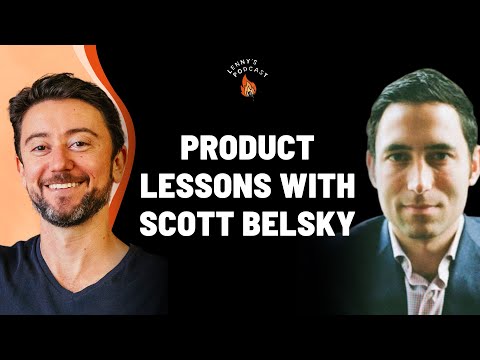
Lessons on product sense, AI, the first mile experience, and the messy middle | Scott Belsky (Adobe)
Scott Belsky (guest), Lenny Rachitsky (host)
In this episode of Lenny's Podcast, featuring Scott Belsky and Lenny Rachitsky, Lessons on product sense, AI, the first mile experience, and the messy middle | Scott Belsky (Adobe) explores scott Belsky on product sense, AI, and surviving the messy middle Scott Belsky, Adobe’s former CPO and current Chief Strategy Officer, shares how he thinks about product sense, first‑mile experiences, and building durable consumer products, alongside his optimistic but pragmatic view of AI. He argues that great product sense comes from deep customer empathy, psychology-driven design, and ruthless reduction of scope and features. The conversation explores how AI will collapse organizational stacks, massively expand exploration surface area for PMs and designers, and shift work from workflows to flow. Belsky also unpacks his “messy middle” framework, how founders should decide whether to quit or persist, and what he looks for when angel investing.
Scott Belsky on product sense, AI, and surviving the messy middle
Scott Belsky, Adobe’s former CPO and current Chief Strategy Officer, shares how he thinks about product sense, first‑mile experiences, and building durable consumer products, alongside his optimistic but pragmatic view of AI. He argues that great product sense comes from deep customer empathy, psychology-driven design, and ruthless reduction of scope and features. The conversation explores how AI will collapse organizational stacks, massively expand exploration surface area for PMs and designers, and shift work from workflows to flow. Belsky also unpacks his “messy middle” framework, how founders should decide whether to quit or persist, and what he looks for when angel investing.
Key Takeaways
Anchor product sense in customer empathy, not attachment to solutions.
Teams often fall in love with their ideas instead of deeply understanding the user’s life and context; shoulder‑to‑shoulder observation of customers in their real environment builds intuition and reveals the real problems to solve.
Get the full analysis with uListen AI
Obsess over the first mile: onboarding, orientation, and defaults.
In the first 30 seconds users are “lazy, vain, and selfish,” so products must quickly make them feel successful without tours or friction; continuously re‑design first‑mile flows as new, less‑forgiving customer cohorts arrive.
Get the full analysis with uListen AI
Do half as much: ship fewer features, options, and markets.
Optimize for the problems you want, not completeness—focus on getting users to core value, then let them complain about missing features later; Belsky’s Behance experience shows killing features often increases usage of the core metric.
Get the full analysis with uListen AI
Design for surprise, delight, and clear object models in consumer products.
Users talk about what products do unexpectedly well, not what they do as expected; lasting consumer products pair a deep psychological insight or network effect with a simple, obvious model of where you are, what to do now, and next.
Get the full analysis with uListen AI
AI will collapse organizational stacks and expand exploration surface area.
AI tools let PMs, designers, and others self‑serve analysis, design variations, and content, reducing dependence on specialized intermediaries and allowing individuals and small teams to explore many more ideas in less time.
Get the full analysis with uListen AI
Treat AI as an intern and a playground, not a threat.
Belsky sees AI as an “intern” that drafts, suggests, and broadens possibility space; PMs should actively play with tools (ChatGPT, generative design, AI presentations) to build intuition and avoid getting stuck in old workflows.
Get the full analysis with uListen AI
Use conviction as the test for whether to push through or quit.
In the messy middle, founders should ask if they now have more or less conviction than at the beginning; if conviction has grown, persist and reframe the struggle as normal, but if it’s gone, life is short—quit, pivot, and redeploy the team.
Get the full analysis with uListen AI
Notable Quotes
“In the first 30 seconds of using a new product, you are lazy, vain, and selfish.”
— Scott Belsky
“People don’t talk about a product doing exactly what they expected it to do. They talk about a product doing what they didn’t expect.”
— Scott Belsky
“Optimize for the problems you want to have.”
— Scott Belsky
“Nothing extraordinary is ever achieved through ordinary means.”
— Scott Belsky
“If you’ve lost conviction, you should not be doing what you’re doing in the world of entrepreneurship.”
— Scott Belsky
Questions Answered in This Episode
How can a mature product team practically audit and redesign its first‑mile experience for today’s newer, less‑forgiving user cohorts?
Scott Belsky, Adobe’s former CPO and current Chief Strategy Officer, shares how he thinks about product sense, first‑mile experiences, and building durable consumer products, alongside his optimistic but pragmatic view of AI. ...
Get the full analysis with uListen AI
What frameworks or signals can help a PM decide which half of planned features to cut without over‑relying on intuition?
Get the full analysis with uListen AI
In what concrete ways should product teams reorganize as AI collapses the stack between roles like PM, design, data, and engineering?
Get the full analysis with uListen AI
How can consumer product founders design “magic moments” and durable network effects that platforms cannot easily copy as mere features?
Get the full analysis with uListen AI
What specific rituals or practices help a team maintain conviction and morale during the messy middle without becoming blind to the option of quitting or pivoting?
Get the full analysis with uListen AI
Transcript Preview
Yeah. You know, I've had this conversation quite a few times over the years with founders and friends who were running a company going sideways or, or, or worse, and have had this question, should I continue or not? I always have the same answer. I basically say, "How much conviction do you have in the solution you're building? I know in the beginning, before you knew all you know now, you had tons of conviction. That's what caused you to leave your job. Now, knowing all you know, do you have more or less conviction in the problem and, and the solution you're building?" And I'll tell you, like, I get different answers. You know, some people are like, "Oh, Scott, I mean, I have more conviction. Like, all that I've learned, all the validation I've received from customers, we just haven't figured it out yet. It's driving me crazy. We've tried three times and it's still like, each product fails, but I have more conviction than ever before." And for those people I'm like, "You know what? You're just in the messy middle. Stick with it." You know, this is, this is, uh, par for the course. But, you know, oftentimes I'll hear a, "Honestly, if I knew now what I... If I knew then what I know now, I would not have done this." Like, "Holy shit." I'm like, "Then quit! Like, your life is short. You have a great team. Pivot, do something completely different." If you've lost conviction, you should not be doing what you're doing in the world of entrepreneurship.
(Instrumental music) Welcome to Lenny's Podcast, where I interview world class product leaders and growth experts to learn from their hard won experiences building and growing today's most successful products. Today, my guest is Scott Belsky. Scott is an absolute product legend. He's a former founder starting a company called Behance that he sold to Adobe, where he worked up the ranks to chief product officer, and more recently to chief strategy Officer and Executive Vice President of Design and Emerging Products. He's also an author of the beloved book, The Messy Middle. He's also an angel investor in companies like Pinterest, Uber, Airtable, Flexport, Warby Parker, and many more. In our wide ranging conversation, Scott shares his advice on how to build product sense, why you should only build half the features that you want, what it takes to build a successful consumer product, and we spend a lot of time on how AI is likely to change the world of product and the world broadly. Scott is such an insightful and articulate thinker, and I learned a lot from this conversation. With that, I bring you Scott Belsky after a short word from our sponsors. This episode is brought to you by Braintrust, where the world's most innovative companies go to find talent fast so that they can innovate faster. Let's be honest, it's a lot of work to build a company. And, if you want to stay ahead of the game, you need to be able to hire the right talent quickly and confidently. Braintrust is the first decentralized talent network where you can find, hire and manage high quality contractors in engineering, design and product for a fraction of the cost of agencies. Braintrust charges a flat rate of only 10%, unlike agency fees of up to 70%, so you can make your budget go four times further. Plus, they're the only network that takes 0% of what the talent makes, so they're able to attract and retain the world's best tech talent. Take it from DoorDash, Airbnb, Plaid, and hundreds of other high growth startups that have shaved their hiring process for months to weeks at less than a quarter of the cost by hiring through Braintrust's network of 20,000 high quality, vetted candidates ready to work. Whether you're looking to fill in gaps, upscale your staff, or build a team for that dream project that finally got funded, contact Braintrust and you'll get matched with three candidates in just 48 hours. Visit usebraintrust.com/lenny or find them in my show notes for today's episode. That's usebraintrust.com/lenny for when you need talent yesterday. This episode is brought to you by Eppo. Eppo is a next generation A-B testing platform built by Airbnb alums for modern growth teams. Companies like DraftKings, Zapier, ClickUp, Twitch and Cameo rely on Eppo to power their experiments. Wherever you work, running experiments is increasingly essential, but there are no commercial tools that integrate with a modern grow team stack. This leads to wasted time building internal tools or trying to run your own experiments through a clunky marketing tool. When I was at Airbnb, one of the things that I loved most about working there was our experimentation platform where I was able to slice and dice data by device types, country, user stage. Eppo does all that and more, delivering results quickly, avoiding annoying prolonged analytic cycles, and helping you easily get to the root cause of any issue you discover. Eppo lets you go beyond basic click-through metrics and instead use your North Star metrics, like activation, retention, subscription and payments. Eppo supports tests on the front end, on the back end, email marketing, even machine learning plans. Check out Eppo at GetE-P-P-O.com. That's GetEppo.com and 10X your experiment velocity. Scott, welcome to the podcast.
Install uListen to search the full transcript and get AI-powered insights
Get Full TranscriptGet more from every podcast
AI summaries, searchable transcripts, and fact-checking. Free forever.
Add to Chrome