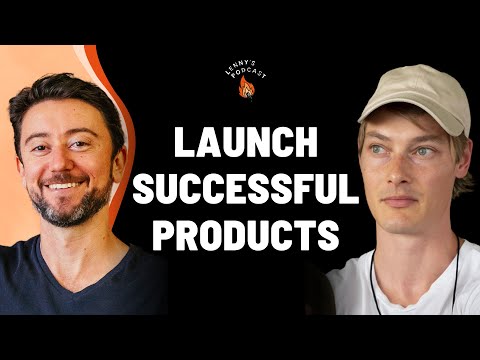
How to launch and grow your product | Ryan Hoover of Product Hunt and Weekend Fund
Ryan Hoover (guest), Lenny Rachitsky (host), Narrator, Narrator
In this episode of Lenny's Podcast, featuring Ryan Hoover and Lenny Rachitsky, How to launch and grow your product | Ryan Hoover of Product Hunt and Weekend Fund explores ryan Hoover Reveals How To Launch, Fund, And Survive Startups Ryan Hoover, founder of Product Hunt and GP at Weekend Fund, reflects on his journey building Product Hunt, transitioning into investing, and the emotional toll and rewards of being a founder.
Ryan Hoover Reveals How To Launch, Fund, And Survive Startups
Ryan Hoover, founder of Product Hunt and GP at Weekend Fund, reflects on his journey building Product Hunt, transitioning into investing, and the emotional toll and rewards of being a founder.
He shares detailed, tactical advice on when (and why) to fundraise, how to approach launches—especially on Product Hunt—and why copywriting, positioning, and momentum matter more than gimmicks like dark mode.
Hoover and host Lenny Rachitsky dig into how to generate and vet startup ideas, why consumer products are so hard, and the importance of starting with a very narrow target audience.
They close with lessons from early-stage investing, different paths into angel/VC investing, and Hoover’s evolving views on work, relationships, and what matters most in life and business.
Key Takeaways
Only start a company if you’re willing to commit a decade.
Hoover suggests founders should see a realistic path to working on an idea for ~10 years; this is a litmus test for whether you actually care enough, given how hard and emotionally taxing startups are.
Get the full analysis with uListen AI
Treat early work as experiments, not companies, to reduce pressure and learn faster.
Product Hunt began as a small experiment (a newsletter) rather than a “startup,” which let Hoover focus on learning, traction, and fit before incorporating or raising capital.
Get the full analysis with uListen AI
Know exactly why you’re raising money—and from whom.
Many founders default to fundraising without a clear purpose; Hoover emphasizes aligning capital with specific needs (e. ...
Get the full analysis with uListen AI
Great launches are about clear human language, strong visuals, and defined goals.
Founders overuse PR-speak; Hoover argues you should describe your product like you would to a friend, keep explanations short, use the gallery to tell a visual story, and be explicit about whether your launch goal is users, recruiting, fundraising, or feedback.
Get the full analysis with uListen AI
Start with a narrow audience so you can build a truly great solution.
Serving “everyone” weakens both product and messaging; beginning with a focused group makes it easier to nail the experience and positioning, and you can expand into broader markets over time as Airbnb did.
Get the full analysis with uListen AI
Momentum inside a company is reflexive and incredibly powerful.
Teams that are shipping and winning create more energy and progress, while stagnation breeds more stagnation; Hoover has come to see protecting and amplifying momentum as one of the most important parts of building early-stage companies.
Get the full analysis with uListen AI
Investing (or learning to invest) is accessible via many paths, not just raising a fund.
Hoover outlines multiple entry points—angel investing, scout programs, SPVs, small funds, or even “pretend” investing via memos and fantasy portfolios—to build judgment and signal your abilities before you manage real capital.
Get the full analysis with uListen AI
Notable Quotes
“Do you see yourself working on this for a decade?”
— Ryan Hoover
“An experiment is really not about success. It’s to learn.”
— Ryan Hoover
“I think having a product background is one of the most important aspects of early-stage startup investing.”
— Ryan Hoover
“Momentum matters so much, and momentum is reflexive.”
— Ryan Hoover
“You can always raise venture later. It’s a one-way door, and I kind of want to delay that door for whatever I build next.”
— Ryan Hoover
Questions Answered in This Episode
How can founders balance authenticity about their struggles with the need to project confidence to their teams and investors?
Ryan Hoover, founder of Product Hunt and GP at Weekend Fund, reflects on his journey building Product Hunt, transitioning into investing, and the emotional toll and rewards of being a founder.
Get the full analysis with uListen AI
What concrete signals should a founder look for to know their ‘experiment’ is worth turning into a venture-backed company?
He shares detailed, tactical advice on when (and why) to fundraise, how to approach launches—especially on Product Hunt—and why copywriting, positioning, and momentum matter more than gimmicks like dark mode.
Get the full analysis with uListen AI
In practice, how narrow is ‘narrow enough’ for an initial target audience without making the opportunity too small?
Hoover and host Lenny Rachitsky dig into how to generate and vet startup ideas, why consumer products are so hard, and the importance of starting with a very narrow target audience.
Get the full analysis with uListen AI
Given how difficult consumer products are, what conditions would make a consumer-social idea compelling enough to pursue today?
They close with lessons from early-stage investing, different paths into angel/VC investing, and Hoover’s evolving views on work, relationships, and what matters most in life and business.
Get the full analysis with uListen AI
If momentum is reflexive, what are the most effective levers a founder can pull in a low-momentum phase to turn things around?
Get the full analysis with uListen AI
Transcript Preview
I don't know how to articulate that- that feeling, but that flutter in your stomach that you wake up with in the morning of just anxiety and stress and- and worry. Um, being a CEO or founder makes it slightly harder, uh, in some ways because you still have to put on this mask. You have to put on this face of confidence externally and- and internally as well, where people need to trust you. You also don't want to subject them to the same anxiety that you're feeling and be 100% transparent.
(instrumental music) Ryan Hoover is the founder of Product Hunt, which you already know. He's also a former product manager, which I did not know. Currently, he's a full-time investor with his fund, The Weekend Fund. He's also an author of a bunch of great blog posts and an actual book called Hooked. He's also really good on Twitter, and in my opinion, a very special human being. Ryan Hoover, welcome to the podcast.
Hey, Lenny. Thanks for having me. I've been reading a lot of your blog posts over, I don't know, past two or three years now, and I'm glad to- to see you do the podcast now. It's cool.
Thank you, man. That compliment will go straight to my heart, and I will think about it often. I appreciate that-
Cu- cut that and put it on Twitter. There you go. Yeah. (laughs)
(laughs) That's the clip. We're done. (laughs)
Yeah. Um, podcast over. (laughs) .
This episode's brought to you by RevenueCat. RevenueCat makes it easy to build, analyze, and grow in-app subscriptions on iOS, Android, and the web. Their platform lets you focus on growth rather than getting bogged down in subscription infrastructure. RevenueCat provides a backend and wrapper around Apple Store Kit and Google Play Billing to handle the implementation and upkeep of in-app purchases. RevenueCat is your source of truth for customer status across platforms and provides out-of-the-box analytics for key subscription metrics, like monthly recurring revenue, lifetime value, retention, and more. With RevenueCat, you also get pre-built integrations with best in class tools like Amplitude, AppsFlyer, and Firebase. That means reliable, consistent data sync to your entire product and growth stack in minutes. See why companies like Notion, VSCO, and Life360 use RevenueCat to power in-app subscriptions. Learn more at revenuecat.com. Hey, Ashley, head of marketing at Flatfile. How many B2B SaaS companies would you estimate need to import CSV files from their customers?
At least 40%.
And how many of them screw that up? And what happens when they do?
Well, based on our data, about a third of people will consider switching to another company after just one bad experience during onboarding. So if your CSV importer doesn't work right, which is super common considering customer files are chock full of unexpected data and formatting, they'll leave.
I am 0% surprised to hear that. I've consistently seen that improving onboarding is one of the highest leverage opportunities for both sign up conversion and increasing long-term retention. Getting people to your aha moment more quickly and reliably is so incredibly important.
Install uListen to search the full transcript and get AI-powered insights
Get Full TranscriptGet more from every podcast
AI summaries, searchable transcripts, and fact-checking. Free forever.
Add to Chrome