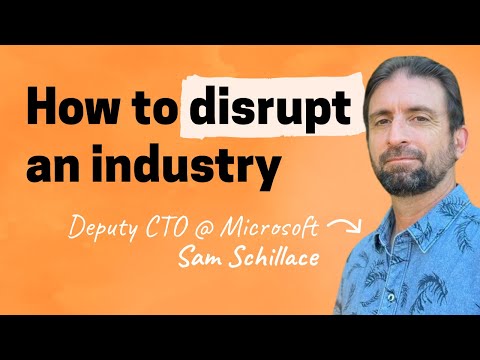
How to be more innovative | Sam Schillace (Microsoft deputy CTO, creator of Google Docs)
Sam Schillace (guest), Lenny Rachitsky (host), Narrator
In this episode of Lenny's Podcast, featuring Sam Schillace and Lenny Rachitsky, How to be more innovative | Sam Schillace (Microsoft deputy CTO, creator of Google Docs) explores sam Schillace on optimism, play, and building truly disruptive products Sam Schillace, Microsoft deputy CTO and creator of Writely (Google Docs), talks through how disruptive innovation actually happens, drawing on his experience building browser-based apps before they were considered viable.
Sam Schillace on optimism, play, and building truly disruptive products
Sam Schillace, Microsoft deputy CTO and creator of Writely (Google Docs), talks through how disruptive innovation actually happens, drawing on his experience building browser-based apps before they were considered viable.
He contrasts "why not" thinking (finding reasons something won't work) with "what if" thinking (exploring upside), arguing that optimism, cheap experimentation, and comfort with failure are core to breakthrough products.
Sam explains why user value and convenience always trump cool tech, how to recognize truly disruptive ideas (strong love and strong hate), and why people should lean into work that feels almost guilty to get paid for.
He also shares his view that generative AI is a category shift as big as the internet, predicts conversational, agentic software will replace static apps, and describes how Microsoft’s culture and leadership are navigating this shift.
Key Takeaways
Disruptive ideas feel dumb at first—and polarize people.
Sam notes that every truly new idea initially looks wrong or toy-like; the strongest signal of real disruption is a bifurcated response where some people love it and others absolutely hate or dismiss it, rather than broad indifference.
Get the full analysis with uListen AI
Shift from "why not" to "what if" when evaluating new tech.
"Why not" questions list obstacles (cost, reliability, edge cases), but "what if" questions force you to imagine the upside if it works—an essential muscle for spotting opportunities in things like browser apps back then or AI now.
Get the full analysis with uListen AI
Optimize for user value and convenience, not clever technology.
Users are lazy and only adopt products that clearly make their lives easier; Sam argues you must look beyond how cool something is and obsess over how much effort it takes to discover, learn, and habitually use your product.
Get the full analysis with uListen AI
Make experiments cheap so optimism can be practical.
You’ll always be wrong in your head; the only way to learn is to try things. ...
Get the full analysis with uListen AI
Follow the work you’d feel guilty getting paid for.
People undervalue what comes easily to them and assume work must be unpleasant; Sam recommends leaning hard into the activities that are fun, energizing, and valued by others, as that’s where outsized career impact tends to come from.
Get the full analysis with uListen AI
Treat AI as a platform, not a feature bolt‑on.
Sam believes the most transformative products will be those that can’t function without AI—reimagining workflows, UIs, and capabilities around agents and reasoning—rather than simply sprinkling AI onto existing software.
Get the full analysis with uListen AI
The future of software is conversational, agentic, and dynamic.
He predicts that as models improve at planning, state, and multimodal interaction, we’ll move from static, document- and app-centric experiences to personalized agents and dynamic interfaces that configure themselves around our intent.
Get the full analysis with uListen AI
Notable Quotes
“You should go do the thing that you feel guilty to get paid for, and do the hell out of it.”
— Sam Schillace
“There’s just not that much of a prize for being pessimistic and right. It’s much better to be optimistic and wrong than pessimistic and right.”
— Sam Schillace
“Every new idea looked dumb at first. Unfortunately, the dumb ideas also look dumb at first.”
— Sam Schillace
“Users are lazy. Nobody cares that you’re friendly or nice or the logo is pretty—they care about making their life easier.”
— Sam Schillace
“AI isn’t a feature of your product. Your product is a feature of AI.”
— Sam Schillace
Questions Answered in This Episode
How can I tell whether the strong negative reactions to my idea are a sign it’s truly disruptive or just genuinely bad?
Sam Schillace, Microsoft deputy CTO and creator of Writely (Google Docs), talks through how disruptive innovation actually happens, drawing on his experience building browser-based apps before they were considered viable.
Get the full analysis with uListen AI
In my current product or company, what would it look like to treat AI as the platform and my existing app as just a feature?
He contrasts "why not" thinking (finding reasons something won't work) with "what if" thinking (exploring upside), arguing that optimism, cheap experimentation, and comfort with failure are core to breakthrough products.
Get the full analysis with uListen AI
What specific experiments could I run in the next month to practice "what if" thinking instead of defaulting to "why not"?
Sam explains why user value and convenience always trump cool tech, how to recognize truly disruptive ideas (strong love and strong hate), and why people should lean into work that feels almost guilty to get paid for.
Get the full analysis with uListen AI
Which parts of my job feel like something I’d almost do for free—and how might I redesign my career to do more of that?
He also shares his view that generative AI is a category shift as big as the internet, predicts conversational, agentic software will replace static apps, and describes how Microsoft’s culture and leadership are navigating this shift.
Get the full analysis with uListen AI
If software becomes agentic and conversational, what happens to traditional UI- and feature-based roadmaps and how should product teams adapt?
Get the full analysis with uListen AI
Transcript Preview
... we tend to undervalue the things we're good at. We tend to think work has to be unpleasant. And so if something is easy and fun, we don't tend to think it's valuable. So I think lots of people, like, gravitate in this direction of, like, let's go do unpleasant things and grind our way through the career 'cause, like, that's the way to make it, but the reality is, like, you should go do the thing that you feel guilty to get paid for, if there's a thing like that. And do the hell out of it, right? Like, do it- do it as hard as you can. If you get- if you get pleasure from doing something that people want to pay you for, do it the best you can do it, as hard as you can do it. And if that's messing around and playing around with cool ideas, like, do the hell out of that. Like, the work doesn't necessarily have to be hard.
(instrumental music) Today my guest is Sam Schillace. Sam has an incredible resume that is very hard to summarize succinctly. I'll give it a shot. Currently, he is corporate vice president and deputy chief technology officer at Microsoft, where he leads efforts in the consumer product space, infrastructure, and AI. Sam is most known for basically inventing Google Docs with his company Writely, which was acquired by Google, and became the foundation for what is now Google Workplace, which currently has over one billion active users a month. After joining Google, Sam ended up responsible for many of Google's consumer applications, including parts of Gmail, Maps, Automotive, Groups, Reader and more. He's also founded six startups, was senior vice president of engineering at Box through their IPO. He's also worked at Intuit, Macromedia. He was even a VC at Google Ventures for a time. As you'd suspect, we had a fairly wide-ranging conversation, but the core focus was around innovation. How to think big, how to come up with original ideas, why optimism is so important and powerful, and also a ton of career advice. Sam is hilarious and not what I imagined a corporate vice president at Microsoft would be like, which gives me even more respect for Microsoft. A big thank you to Brett Burson for making this introduction. With that, I bring you Sam Schillace, after a short word from our sponsors. This time of year is prime for career reflection and setting goals for professional growth. I always like to spend this time reflecting on what I accomplished the previous year, what I hope to accomplish the next year, and whether this is the year I look for a new opportunity. That's where today's sponsor, Teal, comes in. Teal provides you with the tools to run an amazing job search, with an AI-powered resume builder, job tracker, cover letter generator, and Chrome extension that integrates with over 40 job boards. Teal is the all-in-one platform you need to run a more streamlined and efficient job search, and stand out in this competitive market. There's a reason nearly one million people have trusted Teal to run their job search. If you're thinking of making a change in the new year, leverage Teal to grow your career on your own terms. Get started for free at tealhq.com/lenny. That's tealhq.com/lenny. This episode is brought to you by Vanta, helping you streamline your security compliance to accelerate your growth. Thousands of fast-growing companies like Gusto, Calm, Quora, and Modern Treasury trust Vanta to help build, scale, manage, and demonstrate their security and compliance programs, and get ready for audits in weeks, not months. By offering the most in-demand security and privacy frameworks such as SOC 2, ISO 27001, GDPR, HIPAA, and many more, Vanta helps companies obtain the reports they need to accelerate growth, build efficient compliance processes, mitigate risks to their businesses, and build trust with external stakeholders. Over 5,000 fast-growing companies use Vanta to automate up to 90% of the work involved with SOC 2 and these other frameworks. For a limited time, Lenny's Podcast listeners get $1,000 off Vanta. Go to vanta.com/lenny. That's V-A-N-T-A dot com slash Lenny to learn more and to claim your discounts. Get started today. Sam, thank you so much for being here, and welcome to the podcast.
Install uListen to search the full transcript and get AI-powered insights
Get Full TranscriptGet more from every podcast
AI summaries, searchable transcripts, and fact-checking. Free forever.
Add to Chrome