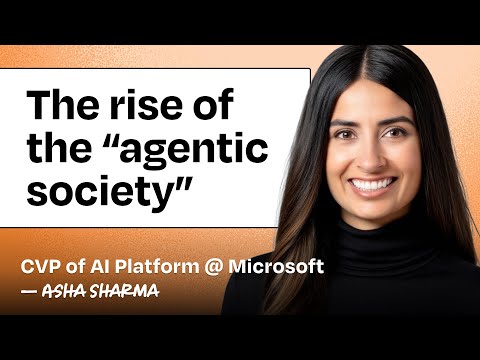
How 80,000 companies build with AI: Products as organisms and the death of org charts | Asha Sharma
Lenny Rachitsky (host), Asha Sharma (guest), Narrator
In this episode of Lenny's Podcast, featuring Lenny Rachitsky and Asha Sharma, How 80,000 companies build with AI: Products as organisms and the death of org charts | Asha Sharma explores aI Agents Reshape Products, Organizations, And The Future Of Work Asha Sharma, CVP of Microsoft AI Platform, describes a shift from static "products as artifacts" to dynamic "products as organisms" that continuously learn and improve through post-training loops and reinforcement learning. She argues that all software will become model-forward and increasingly agentic, with GUIs giving way to code-native, composable interfaces and multi-model systems. This evolution will transform how companies build, plan, and organize—pushing organizations toward full-stack, polymath builders and flatter, task-centric “work charts” powered by agents. Sharma also shares how she plans in a volatile AI landscape, the rising strategic importance of post-training, and leadership lessons from Satya Nadella and her own cross-industry experience.
AI Agents Reshape Products, Organizations, And The Future Of Work
Asha Sharma, CVP of Microsoft AI Platform, describes a shift from static "products as artifacts" to dynamic "products as organisms" that continuously learn and improve through post-training loops and reinforcement learning. She argues that all software will become model-forward and increasingly agentic, with GUIs giving way to code-native, composable interfaces and multi-model systems. This evolution will transform how companies build, plan, and organize—pushing organizations toward full-stack, polymath builders and flatter, task-centric “work charts” powered by agents. Sharma also shares how she plans in a volatile AI landscape, the rising strategic importance of post-training, and leadership lessons from Satya Nadella and her own cross-industry experience.
Key Takeaways
Treat products as living systems, not static feature sets.
Modern AI products should be designed as organisms that continuously ingest data, update reward models, and improve outcomes over time—making the learning loop itself the core intellectual property of the company.
Get the full analysis with uListen AI
Invest heavily in post-training and reinforcement learning, not just base models.
As large models reach scale (e. ...
Get the full analysis with uListen AI
Build for model systems and composability instead of a single-model, GUI-first mindset.
Different tasks need different models (latency, quality, domain), and future interfaces will favor code-native, composable primitives and text streams that agents can orchestrate, rather than fixed, hand-crafted GUIs.
Get the full analysis with uListen AI
Make your organization AI-fluent and relentlessly focused on measurable impact.
Successful companies get everyone using AI in their workflows, start with existing processes (e. ...
Get the full analysis with uListen AI
Shift from rigid hierarchies to task-centric, agent-augmented “work charts.”
As embedded and embodied agents take on more tasks, organizations can have fewer layers and more dynamic, task-based routing of work—humans decide where AI is applied while agents execute and continuously improve.
Get the full analysis with uListen AI
Cultivate full-stack, polymath builders and optimize for the loop, not the lane.
With hundreds of tools and models emerging weekly, cross-functional builders who understand UX, system design, costs, and reward shaping can own end-to-end loops, vastly increasing speed and throughput versus traditional fragmented orgs.
Get the full analysis with uListen AI
Plan in “seasons” with slack for disruption, not rigid multi-year roadmaps.
In a rapidly shifting AI landscape, Sharma frames strategy as seasons (e. ...
Get the full analysis with uListen AI
Notable Quotes
“Products aren’t just static artifacts anymore; they’re living organisms that think, live, and learn.”
— Asha Sharma
“It’s all about the loop, not the lane.”
— Asha Sharma
“We’re just starting to scratch the surface of what an agentic society actually looks like.”
— Asha Sharma
“We’re approaching this world in which the marginal cost of a good output is approaching zero.”
— Asha Sharma
“Optimism is a renewable resource.”
— Asha Sharma, reflecting on Satya Nadella’s leadership
Questions Answered in This Episode
How should a traditional SaaS company practically begin transforming its product into a “living organism” without overhauling everything at once?
Asha Sharma, CVP of Microsoft AI Platform, describes a shift from static "products as artifacts" to dynamic "products as organisms" that continuously learn and improve through post-training loops and reinforcement learning. ...
Get the full analysis with uListen AI
What concrete metrics and eval frameworks best capture the health of an AI product loop beyond typical engagement or NPS?
Get the full analysis with uListen AI
How can large, hierarchical organizations transition to a task-centric, agent-augmented “work chart” without creating chaos or risking safety/security?
Get the full analysis with uListen AI
What new governance, observability, and RL infrastructure is required when millions of agents are running concurrently across an enterprise?
Get the full analysis with uListen AI
For individual builders, what are the most valuable skills to develop now to become the kind of full-stack, polymath product creator Sharma describes?
Get the full analysis with uListen AI
Transcript Preview
You said that we're just starting to scratch the surface of what an agentic society actually looks like.
We're approaching this world in which the marginal cost of the good output is approaching zero. We're going to see exponential demand for productivity and outputs. The way that you scale to that is with agents. When all of that happens, the org chart starts to become the work chart. You just don't need as many layers.
We were chatting about this concept you have that we're moving from product as artifact to product as organism.
Because these models are so effective at this point, you want to start to tune them to certain types of outcomes. All of a sudden, these are these living organisms that just get better with the more interactions that happen, and I think this is the new IP of every single company, products that think and live and learn.
Planning right now is just crazy. How does anyone plan a roadmap when there's just like, okay, GPT-5's out?
We think about it as, what season are we in? Season one might have been prototyping of AI, and then it was all around models and reasoning models, and now, it's the advent of agents.
(instrumental music) Today, my guest is Asha Sharma. Asha's chief vice president of product for Microsoft AI Platform, where she oversees their AI infrastructure, foundation models, and agent tool chains, while also leading applied engineering, responsible AI, and growth for the core AI division. She was previously COO at Instacart and VP of product at Meta, where she ran Messenger, Instagram Direct, Messenger Kids, and Remote Presence. She also sits on the boards of The Home Depot and Coupang, and she's a second-degree black belt in TaeKwonDo. Asha has a really unique and rare role that allows her to see more than most anyone else in the world where things are heading with AI and what works and doesn't work for companies that are building large-scale AI products. In our conversation, Asha shares a bunch of trends and predictions that she's seeing that I haven't heard anyone else talk about, why we're moving from a product as artifact to product as organism world, why GUIs are being replaced by code-native interfaces, why post-training is the new pre-training, the coming agentic society, what it takes to be a successful builder today and going forward, and also her single biggest leadership lesson that she learned from Satya, who she works closely with. If you enjoy this podcast, don't forget to subscribe and follow it in your favorite podcasting app or YouTube. Also, if you become an annual subscriber of my newsletter, you get a year free of 15 incredible products, including Lovable, Replit, Bolt, n8n, Linear, Superhuman, Descript, Whisperflow, Gamma, Perplexity, Warp, Granola, Magic Patterns, Raycast, ChatBRD, and Mobbin. Check it out at lennysnewsletter.com and click Product Pass. With that, I bring you Asha Sharma. This episode is brought to you by Interpret. Interpret is a customer intelligence platform used by leading CX and product orgs like Canva, Notion, Perplexity, Strava, Hinge, and Linear to leverage the voice of the customer and build best-in-class products. Interpret unifies all customer conversations in real time, from Gong recordings to Zendesk tickets to Twitter threads, and makes it available for your team for analysis and for action. What makes Interpret unique is its ability to build and update a customer-specific knowledge graph that provides the most granular and accurate categorization of all customer feedback and connects that customer feedback to critical metrics like revenue and CSAT. If modernizing your voice of customer program to a generational upgrade is a 2025 priority like customer-centric industry leaders like Canva, Notion, Perplexity, and Linear, reach out to the team at interpret.com/lenny. That's E-N-T-E-R-P-R-E-T.com/lenny. Today's episode is brought to you by Dx, the developer intelligence platform designed by leading researchers. To thrive in the AI era, organizations need to adapt quickly, but many organization leaders struggle to answer pressing questions like, which tools are working? How are they being used? What's actually driving value? Dx provides the data and insights that leaders need to navigate this shift. With Dx, companies like Dropbox, Booking.com, Adyen, and Intercom get a deep understanding of how AI is providing value to their developers and what impact AI is having on engineering productivity. To learn more, visit Dx's website at getdx.com/lenny. That's getdx.com/lenny. Asha, thank you so much for being here, and welcome to the podcast.
Install uListen to search the full transcript and get AI-powered insights
Get Full TranscriptGet more from every podcast
AI summaries, searchable transcripts, and fact-checking. Free forever.
Add to Chrome