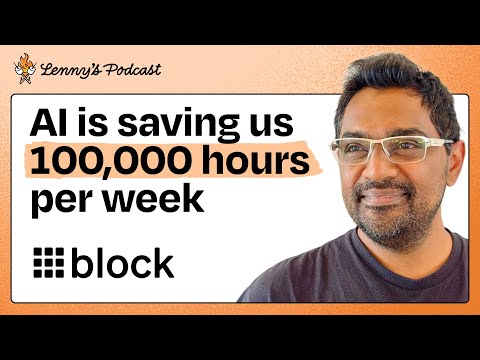
How Block is becoming the most AI-native enterprise in the world | Dhanji R. Prasanna
Lenny Rachitsky (host), Dhanji R. Prasanna (guest), Narrator, Narrator
In this episode of Lenny's Podcast, featuring Lenny Rachitsky and Dhanji R. Prasanna, How Block is becoming the most AI-native enterprise in the world | Dhanji R. Prasanna explores inside Block’s AI Revolution: Goose Agents, Culture Shifts, Real Productivity CTO Dhanji R. Prasanna explains how Block became one of the most AI‑native large enterprises, centered around their open-source AI agent platform, Goose. Goose and its mobile cousin Gosling are already saving employees roughly 8–10 hours per week on average in AI-forward teams, with early data suggesting 20–25% manual hours saved company‑wide. The transformation wasn’t just about tools: Block redefined itself as a technology company, reorganized from GM-based business silos into a functional org, and pushed leaders to personally use AI in their daily work. Along the way, Dhanji shares counterintuitive lessons on org design, when not to build tools, and why code quality is largely orthogonal to product success.
Inside Block’s AI Revolution: Goose Agents, Culture Shifts, Real Productivity
CTO Dhanji R. Prasanna explains how Block became one of the most AI‑native large enterprises, centered around their open-source AI agent platform, Goose. Goose and its mobile cousin Gosling are already saving employees roughly 8–10 hours per week on average in AI-forward teams, with early data suggesting 20–25% manual hours saved company‑wide. The transformation wasn’t just about tools: Block redefined itself as a technology company, reorganized from GM-based business silos into a functional org, and pushed leaders to personally use AI in their daily work. Along the way, Dhanji shares counterintuitive lessons on org design, when not to build tools, and why code quality is largely orthogonal to product success.
Key Takeaways
Organizational structure is more decisive than tools for AI impact.
Block’s biggest unlock was moving from GM-run business silos to a functional structure where all engineers and designers report into single leaders, enabling shared platforms, consistent standards, and a unified AI strategy.
Get the full analysis with uListen AI
AI is already saving substantial time—this is the new baseline, not the peak.
AI-forward teams using Goose report 8–10 hours saved per week, and Block estimates 20–25% manual hours saved across the company, yet Dhanji emphasizes these are early, conservative numbers that will only grow as models improve.
Get the full analysis with uListen AI
Non-technical teams may gain the most from AI agents right now.
Functions like risk, legal, and support are using Goose to build internal tools and automate workflows themselves, compressing weeks of engineering requests into hours and dramatically reducing bottlenecks on central eng teams.
Get the full analysis with uListen AI
Leaders must use AI personally to drive real adoption.
Jack Dorsey, Dhanji, and the executive team all use Goose and other AI tools daily; their firsthand experience with what AI can and can’t do has been more impactful than any top-down mandate or slide deck.
Get the full analysis with uListen AI
Agents should work continuously and explore multiple options, not just respond on demand.
Dhanji envisions a near future where LLM agents run for hours or overnight—building multiple versions of features, refactoring code, and even improving themselves—so that humans wake up to options instead of empty backlogs.
Get the full analysis with uListen AI
Don’t overestimate code quality’s role in product success.
Drawing on YouTube’s famously messy early codebase and Google Video’s technically superior but failed alternative, Dhanji argues that solving real user problems and shipping matter far more than architectural purity.
Get the full analysis with uListen AI
Start small and question whether a problem should exist before automating it.
From Cash App and Bitcoin within Block to Goose itself, many successes began as small hack-week projects, while some of the biggest failures (e. ...
Get the full analysis with uListen AI
Notable Quotes
“Our number one priority is to automate Block.”
— Dhanji R. Prasanna
“This is the worst it will ever be. This is now the baseline.”
— Dhanji R. Prasanna
“A lot of engineers think that code quality is important to building a successful product. The two have nothing to do with each other.”
— Dhanji R. Prasanna
“All these LLMs are sitting idle overnight and on weekends while humans aren’t there. There’s no need for that.”
— Dhanji R. Prasanna
“If you’re not waking up in the morning feeling energized about what you’re going to do that day in your professional life, then change something.”
— Dhanji R. Prasanna
Questions Answered in This Episode
How can a company practically evaluate whether to reorganize into a functional structure to become more AI-native, and what early signs indicate it’s worth the disruption?
CTO Dhanji R. ...
Get the full analysis with uListen AI
What governance and safety mechanisms does Block use to let agents like Goose act autonomously on production systems without causing harm?
Get the full analysis with uListen AI
How should teams decide which internal tools to build with agents versus which SaaS products to keep buying, especially given the long-term maintenance burden?
Get the full analysis with uListen AI
What concrete steps can a mid-level manager take in the next 90 days to foster the kind of AI experimentation culture Dhanji describes at Block?
Get the full analysis with uListen AI
If code quality and architecture aren’t primary drivers of success, where should engineering leaders focus their energy to maximize product impact in an AI-heavy world?
Get the full analysis with uListen AI
Transcript Preview
There's a lot of talk about productivity gains through AI. There's this camp of people that are like, "It's overhype. Nothing's working. Nobody is actually adopting this at scale."
We see a significant amount of gain. We find engineering teams that are very, very AI forward are reporting about 8 to 10 hours saved per week.
Whenever I hear a stat like this, I think an important element is this is the worst it will ever be. This is now the baseline.
The truth is the value is changing every day, so you need to ride that wave along with it.
There's a story I heard you share on a different podcast where there's an engineer who has Goose watch him.
He'll be talking to a colleague on Slack or an email and they'll be discussing some feature that they think is useful to implement. And a few hours later he'll find that Goose has already tried to build that feature and opened a PR for it on Git.
What level of engineer is most benefiting from these tools?
What's been surprising and really amazing, the non-technical people using AI agents and programming tools to build things. The people that are able to embrace it to optimize for their particular workday and their particular set of tasks are really showing the most impact from these tools.
How do you think things will look in a couple years in terms of how engineers work that's different from today?
All these LLMs are sitting idle overnight and on weekends while humans aren't there. Like, there's no need for that. They should be working all the time. They should be trying to build in anticipation of what we want.
What's maybe the most counterintuitive lesson you've learned about building products or building teams?
A lot of engineers think that code quality is important to building a successful product. The two have nothing to do with each other.
Today my guest is Dhanji Prasanna. Dhanji is Chief Technology Officer at Block where he oversees a team of over 3,500 people. With Dhanji's leadership, Block has become one of the most AI native large companies in the world and has basically achieved what many eng and product leaders are trying to achieve within their companies. In our conversation we chat about their internal open source agent called Goose that, by their measure, is saving employees on average 8 to 10 hours a week of work time, and that number is going up; how AI is specifically making their teams more productive, and the teams that are benefiting most. Interestingly, it's not the engineering team. What it took to shift the culture to be very AI oriented; the very boring change they made internally that boosted productivity even more than any AI tool; also lessons from building Google Wave and Google+ and Cash App and so much more. This episode is for anyone curious to see what a highly AI forward technology-driven large company looks like and can act like. If you enjoy this podcast, don't forget to subscribe and follow it in your favorite podcasting app or YouTube. It helps tremendously. Also, if you become an annual subscriber of my newsletter, you get a year free of 16 incredible products, including Devin, Replit, Lovable, Bolt, N8n, Linear, Superhuman, Descript, WhisperFlow, Gamma, Perplexity, Warp, Granola, Magic Patterns, Raycast, ChatBRD and Mobbing. Head on over to lennysnewsletter.com and click Product Pass. With that, I bring you Dhanji Prasanna after a short word from our sponsors. This episode is brought to you by Sinch, the customer communications cloud. Here's the thing about digital customer communications. Whether you're sending marketing campaigns, verification codes or account alerts, you need them to reach users reliably. That's where Sinch comes in. Over 150,000 businesses including eight of the top 10 largest tech companies globally use Sinch's API to build messaging, email and calling into their products. And there's something big happening in messaging that product teams need to know about: rich communication services, or RCS. Think of RCS as SMS 2.0. Instead of getting texts from a random number, your users will see a verified company name and logo without needing to download anything new. It's a more secure and branded experience. Plus you get features like interactive carousels and suggestive replies. And here's why this matters: U.S. carriers are starting to adopt RCS. Sinch is already helping major brands send RCS messages around the world, and they're helping Lenny's podcast listeners get registered first before the rush hits the U.S. market. Learn more and get started at sinch.com/lenny. That's S-I-N-C-H.com/lenny. This episode is brought to you by Figma, makers of Figma Make. When I was a PM at Airbnb, I still remember when Figma came out and how much it improved how we operated as a team. Suddenly, I could involve my whole team in the design process, get feedback on design concepts really quickly. And it just made the whole product development process so much more fun. But Figma never felt like it was for me. It was great for giving feedback and designs, but as a builder, I wanted to make stuff. That's why Figma built Figma Make. With just a few prompts, you can make any idea or design into a fully functional prototype or app that anyone can iterate on and validate with customers. Figma Make is a different kind of bytecoding tool. Because it's all in Figma, you can use your team's existing design building blocks, making it easy to create outputs that look good and feel real and are connected to how your team builds. Stop spending so much time telling people about your product vision, and instead show it to them. Make code-backed prototypes and apps fast with Figma Make. Check it out at figma.com/lenny. (instrumental music) Dhanji, thank you so much for being here and welcome to the podcast.
Install uListen to search the full transcript and get AI-powered insights
Get Full TranscriptGet more from every podcast
AI summaries, searchable transcripts, and fact-checking. Free forever.
Add to Chrome