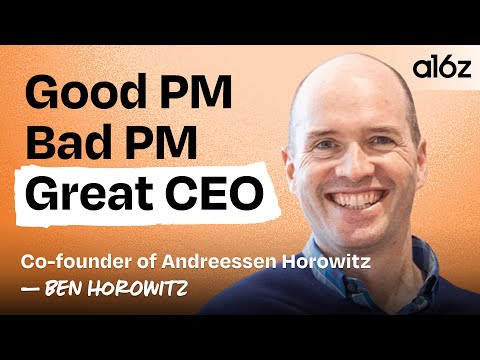
$46B of hard truths: Why founders fail and why you need to run toward fear | Ben Horowitz (a16z)
Ben Horowitz (guest), Lenny Rachitsky (host), Narrator, Narrator, Narrator
In this episode of Lenny's Podcast, featuring Ben Horowitz and Lenny Rachitsky, $46B of hard truths: Why founders fail and why you need to run toward fear | Ben Horowitz (a16z) explores ben Horowitz on fear, failure, and building truly great leaders Ben Horowitz joins Lenny to unpack why being a founder-CEO is psychologically brutal, and why the biggest killer of companies is leaders hesitating when faced with two bad options. He argues that success and failure are both built from long chains of small decisions, and that great CEOs run toward fear, maintain confidence through repeated mistakes, and make unpopular calls that add real value.
Ben Horowitz on fear, failure, and building truly great leaders
Ben Horowitz joins Lenny to unpack why being a founder-CEO is psychologically brutal, and why the biggest killer of companies is leaders hesitating when faced with two bad options. He argues that success and failure are both built from long chains of small decisions, and that great CEOs run toward fear, maintain confidence through repeated mistakes, and make unpopular calls that add real value.
They dig into what makes someone fit (or unfit) to start and remain CEO of a company, how to think about hiring senior leaders and developing 'managerial leverage', and why product management is fundamentally a leadership role akin to a 'mini CEO.'
Horowitz also shares his perspective on the current AI wave (why it’s likely not a classic bubble and where the biggest opportunities lie), the strategic importance of U.S. AI leadership, and the firm’s philosophy of backing controversial but extraordinarily strong founders like Adam Neumann.
The conversation closes with lessons on culture from prison gangs and hip hop pioneers, Horowitz’s Paid in Full Foundation, and the central importance of a founder’s inner psychology and self-belief.
Key Takeaways
Hesitation is often more destructive than a bad decision.
CEOs rarely face a good vs. ...
Get the full analysis with uListen AI
Your primary job as a leader is to run toward fear.
The hardest, scariest issues—firing a senior leader, re-architecting a product, confronting brutal tradeoffs—are exactly where CEOs add value. ...
Get the full analysis with uListen AI
Founders fail when they lose confidence faster than they gain competence.
Early CEOs inevitably make expensive mistakes; if they internalize those failures, they start hesitating and senior reports rush into the vacuum, creating politics and dysfunction. ...
Get the full analysis with uListen AI
Great CEOs seek leverage from executives; they don’t try to “fix” them.
As CEO you can’t personally develop every function because you’re often not an expert in them. ...
Get the full analysis with uListen AI
Product management is fundamentally a leadership role, not a task list.
Horowitz’s ‘Good Product Manager / Bad Product Manager’ argues that PMs are effectively mini-CEOs for their product: they win by shipping products customers love, coordinating engineering, market insight, and execution—even though no one reports to them. ...
Get the full analysis with uListen AI
You shouldn’t start a company for money; you need an irrational drive.
Horowitz insists that even large financial outcomes often don’t feel ‘worth’ the pain of founding. ...
Get the full analysis with uListen AI
AI isn’t a classic bubble, but the landscape is early and uneven.
Unlike the dot-com bust, today’s leading AI companies have real products and explosive revenue growth. ...
Get the full analysis with uListen AI
Notable Quotes
“The worst thing that you do as a leader is you hesitate on the next decision.”
— Ben Horowitz
“If everybody agrees with the decision, then you didn’t add any value.”
— Ben Horowitz
“The only reason to start a company is because you have an irrational desire to do so, because it’s not worth the money.”
— Ben Horowitz (quoting John Reed and agreeing)
“You don’t make people great. You find people that make you great.”
— Ben Horowitz
“Life isn’t fair. As soon as you get that idea out of your mind, then you can just deal with it.”
— Ben Horowitz
Questions Answered in This Episode
How can a founder practically train themselves to ‘run toward fear’ and reduce hesitation when every option looks terrible?
Ben Horowitz joins Lenny to unpack why being a founder-CEO is psychologically brutal, and why the biggest killer of companies is leaders hesitating when faced with two bad options. ...
Get the full analysis with uListen AI
What early warning signs should a board or investor look for that a founder is losing confidence and the organization is sliding into politics?
They dig into what makes someone fit (or unfit) to start and remain CEO of a company, how to think about hiring senior leaders and developing 'managerial leverage', and why product management is fundamentally a leadership role akin to a 'mini CEO.'
Get the full analysis with uListen AI
For aspiring PMs, how do you transition from being a ‘spec writer’ to truly operating as a mini-CEO of your product?
Horowitz also shares his perspective on the current AI wave (why it’s likely not a classic bubble and where the biggest opportunities lie), the strategic importance of U. ...
Get the full analysis with uListen AI
In the AI stack, how can a new startup realistically build a defensible position against giants who control models, data centers, and distribution?
The conversation closes with lessons on culture from prison gangs and hip hop pioneers, Horowitz’s Paid in Full Foundation, and the central importance of a founder’s inner psychology and self-belief.
Get the full analysis with uListen AI
Where is the line between backing a controversial but strong founder (like Adam Neumann) and enabling truly unacceptable behavior, and how should investors decide?
Get the full analysis with uListen AI
Transcript Preview
(instrumental music) The worst thing that you do as a leader is you hesitate on the next decision. The thing that causes you to hesitate is both decisions are horrible. Probably one of my bigger ones on that was we went public with $2 million in trailing 12 months revenue at 18 months old. That's obviously a bad idea. But the truth of it was the alternative was going bankrupt, and that's a worse idea.
It's very difficult and painful to be a CEO, to be a founder. In spite of that, so many people want to start companies.
The psychological muscle you have to build to be a great leader is to be able to look in the abyss and go, "Okay, that way's slightly better. We're going to go that way." If everybody agrees with the decision, then you didn't add any value, 'cause they would have done that without you. So the only value you ever add is when you make a decision that most people don't like.
You are famous for writing one of the most popular pieces of literature for product managers.
What I was trying to get at in Good Product Manager, Bad Product Manager was the job is fundamentally a leadership job, and it's a tricky leadership job because nobody is actually reporting to you.
There's always this kind of sense that the PM is not the mini CEO, how dare you call yourself that. I actually think that's exactly what the PM is.
It doesn't matter if you write a good spec or you have a good interview or you do this or do that. What matters is that the product wins.
(instrumental music) Today my guest is Ben Horowitz. Ben is the Z in a16z, the world's largest venture capital firm with over $46 billion in committed capital. They're investors in OpenAI, Cursor, Anduril, Databricks, Figma, basically every generational tech company. He's also the author of two New York Times best-selling books, The Hard Thing About Hard Things and What You Do Is Who You Are. Ben is endlessly fascinating. He started a rap group when he was younger. He started his career as a product manager and wrote the now famous Good Product Manager, Bad Product Manager piece. In our wide-ranging conversation, we cover a ton of ground and Ben shares stories and insights that he's never shared anywhere else. A huge thank you to Shaka Senghor, Ali Ghodsi, and Adam Neumann for suggesting topics for this conversation. If you enjoy this podcast, don't forget to subscribe and follow it in your favorite podcasting app or YouTube. It helps tremendously. And if you become an annual subscriber of my newsletter, you get a year free of 15 incredible products, including a year free of Lovable, Replit, Bolt, N8N, Linear, Superhuman, Descript, Whisperflow, Gamma, Perplexity, Warp, Granola, Magic Patterns, Raycast, ChatPRD, and Mobben. Check it out at lennysnewsletter.com and click Product Pass. With that, I bring you Ben Horowitz. Today's episode is brought to you by DX, the developer intelligence platform designed by leading researchers. To thrive in the AI era, organizations need to adapt quickly, but many organization leaders struggle to answer pressing questions like which tools are working, how are they being used, what's actually driving value? DX provides the data and insights that leaders need to navigate this shift. With DX, companies like Dropbox, Booking.com, Adyen, and Intercom get a deep understanding of how AI is providing value to their developers and what impact AI is having on engineering productivity. To learn more, visit DX's website at getdx.com/lenny. That's getdx.com/lenny. This episode is brought to you by Basecamp. Basecamp is the famously straightforward project management system from 37signals. Most project management systems are either inadequate or frustratingly complex, but Basecamp is refreshingly clear. It's simple to get started, easy to organize, and Basecamp's visual tools help you see exactly what everyone is working on and how all work is progressing. Keep all your files and conversations about projects directly connected to the projects themselves so that you always know where stuff is and you're not constantly switching contexts. Running a business is hard. Managing your projects should be easy. I've been a longtime fan of what 37Signals has been up to and I'm really excited to be sharing this with you. Sign up for a free account at basecamp.com/lenny. Get somewhere with Basecamp. (instrumental music) Ben, thank you so much for being here and welcome to the podcast.
Install uListen to search the full transcript and get AI-powered insights
Get Full TranscriptGet more from every podcast
AI summaries, searchable transcripts, and fact-checking. Free forever.
Add to Chrome