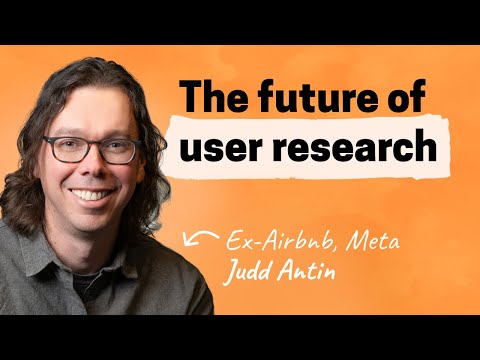
The UX Research reckoning is here | Judd Antin (Airbnb, Meta)
Judd Antin (guest), Lenny Rachitsky (host)
In this episode of Lenny's Podcast, featuring Judd Antin and Lenny Rachitsky, The UX Research reckoning is here | Judd Antin (Airbnb, Meta) explores uX research’s reckoning: from feel-good theater to business-critical partner Judd Antin argues that UX research is undergoing a necessary reckoning after years of misalignment, over-hiring, and limited business impact. He introduces a framework of macro, middle-range, and micro research, contending that teams over-invest in vague, "interesting but not actionable" middle-range studies. Antin believes research is more valuable than ever—if researchers become deeply business-literate, multi-method, and embedded end-to-end with product teams, and if companies stop treating research as a reactive service. He also calls out widespread “user-centered performance,” where teams perform customer obsession to justify decisions they’ve already made, rather than genuinely seeking to learn and be proven wrong.
UX research’s reckoning: from feel-good theater to business-critical partner
Judd Antin argues that UX research is undergoing a necessary reckoning after years of misalignment, over-hiring, and limited business impact. He introduces a framework of macro, middle-range, and micro research, contending that teams over-invest in vague, "interesting but not actionable" middle-range studies. Antin believes research is more valuable than ever—if researchers become deeply business-literate, multi-method, and embedded end-to-end with product teams, and if companies stop treating research as a reactive service. He also calls out widespread “user-centered performance,” where teams perform customer obsession to justify decisions they’ve already made, rather than genuinely seeking to learn and be proven wrong.
Key Takeaways
Most teams are over-investing in vague middle-range research that feels insightful but doesn’t move metrics.
Middle-range studies (e. ...
Get the full analysis with uListen AI
UX research must evolve into a business-critical, multi-method discipline.
Antin argues the strongest researchers are ‘Swiss army knives’ with skills in generative and evaluative research, survey design, applied statistics, and basic data/AI tooling—and they speak the language of funnels, OKRs, and strategy as fluently as user needs.
Get the full analysis with uListen AI
Researchers need to be explicitly profit- and strategy-oriented, not just user-empathy oriented.
He urges researchers to deeply understand company strategy, financials, and metrics (e. ...
Get the full analysis with uListen AI
Embedding researchers from beginning to end of the product process is far more effective than treating them as a late-stage service.
When researchers help define questions, prioritize work, and sit in key decision meetings, they can direct effort toward high-impact problems and run fast, targeted studies—rather than being asked to ‘validate’ pre-baked decisions at the end.
Get the full analysis with uListen AI
“User-centered performance” is pervasive and undermines genuine learning.
Teams frequently do research, listening sessions, or focus groups to signal customer-obsession and get a ‘check-the-box’ validation, while having no real willingness to change course; Antin argues that true research aims to falsify assumptions, not reassure egos.
Get the full analysis with uListen AI
Good research speeds teams up by preventing expensive missteps, especially at the micro level.
Fast, tightly scoped usability and micro-experiment studies can produce high-ROI wins (e. ...
Get the full analysis with uListen AI
Companies should integrate and de-silo their insights functions and stop over-relying on NPS.
Antin advocates for unified insights across UX research, data science, and customer feedback, and recommends simple customer satisfaction measures over NPS, which he criticizes as methodologically weak, noisy, and often incomparable across companies.
Get the full analysis with uListen AI
Notable Quotes
“User-centered performance is work we do to signal to each other how customer-obsessed we are, not because we want to make a different decision.”
— Judd Antin
“We don’t validate, we falsify. We are looking to be wrong.”
— Judd Antin
“The user research discipline of the last 15 years is dying. The reckoning is here.”
— Judd Antin
“Good research doesn’t slow us down—it speeds us up.”
— Judd Antin
“If they cannot have that decision-making meeting without the researcher there, that means you’ve developed influence.”
— Judd Antin
Questions Answered in This Episode
How can a product team concretely distinguish between genuinely impactful research and “user-centered performance” in their current roadmap?
Judd Antin argues that UX research is undergoing a necessary reckoning after years of misalignment, over-hiring, and limited business impact. ...
Get the full analysis with uListen AI
If you’re the only researcher supporting many PMs, what practical steps can you take to push back on low-impact middle-range requests without burning bridges?
Get the full analysis with uListen AI
What are the first three business artifacts or metrics a researcher should study when joining a new company to become more profit-focused?
Get the full analysis with uListen AI
How should a startup founder decide when it’s time to hire their first researcher, and what profile should they prioritize for maximum leverage?
Get the full analysis with uListen AI
Given the critique of NPS, how can organizations transition to better CX metrics without losing continuity in their historical tracking and benchmarks?
Get the full analysis with uListen AI
Transcript Preview
User-centered performance refers to customer obsession or user-centered practice that is symbolic rather than focused on learning. It's hugely common, I would argue. It's work we do to signal to each other how customer-obsessed we are, not 'cause we want to make a different decision. If your, like, listeners are like, "I don't do that," I'm kind of like, think about it for a second. This is extremely common. Every time a PM comes to a researcher at the end of a product process and says, "Can you just run a quick user study, you know, just to validate our assumptions?" That's user-centered performance. It's too late to matter. We got to ship it, right? What they want is to check the box. One of my big kind of mantras was, we don't validate, we falsify. We are looking to be wrong. Many PMs, many designers are not in that place. They do not want to be wrong. They're looking to validate and that's user-centered performance.
(instrumental music) Today, my guest is Judd Anton. Judd helped build the user research practice at Facebook, he was a long time head of research at Airbnb, and his direct reports have gone on to lead research teams at Figma, Notion, Slack, Robinhood, Duolingo, Fair, and other amazing companies. These days, Judd spends his time consulting, helping companies with organizational challenges, product strategy, design, research, hiring, onboarding and crisis management. In our conversation, we unpack a conclusion that Judd has come to recently about how the user research field is going through a reckoning and what needs to change both within the user research field and how companies leverage user research going forward. Judd shares what the user research field has gotten wrong over the last decade, how PMs and designers rely on user research too often and to answer the wrong questions, where user research will continue to provide significant value and how to best leverage your researchers, why it's important for researchers to think about the business goals more versus just what the users need, what to look for when you're hiring a user researcher, how PMs can be better partners to researchers, and also a phenomenon that I love that Judd describes and often witnesses that he calls user-centered performance where everyone acts like they care about the user, but they're just doing it for show and already know what they want to do. This episode has a lot of spicy takes and will probably upset some people, but Judd is sharing some real talk here that I think we all need to hear. With that, I bring you Judd Anton after a short word from our sponsors. This time of year is prime for career reflection and setting goals for professional growth. I always like to spend this time reflecting on what I accomplished the previous year, what I hope to accomplish the next year, and whether this is the year I look for a new opportunity. That's where today's sponsor, Teal, comes in. Teal provides you with the tools to run an amazing job search. With an AI-powered resume builder, job tracker, cover letter generator, and Chrome extension that integrates with over 40 job boards, Teal is the all-in-one platform you need to run a more streamlined and efficient job search and stand out in this competitive market. There's a reason nearly one million people have trusted Teal to run their job search. If you're thinking of making a change in the new year, leverage Teal to grow your career on your own terms. Get started for free at tealhq.com/lenny. That's tealhq.com/lenny. This episode is brought to you by Vanta, helping you streamline your security compliance to accelerate your growth. Thousands of fast-growing companies like Gusto, Calm, Quora, and Modern Treasury trust Vanta to help build, scale, manage, and demonstrate their security and compliance programs and get ready for audits in weeks, not months. By offering the most in-demand security and privacy frameworks such as SOC 2, ISO 27001, GDPR, HIPAA, and many more, Vanta helps companies obtain the reports they need to accelerate growth, build efficient compliance processes, mitigate risks to their businesses, and build trust with external stakeholders. Over 5,000 fast-growing companies use Vanta to automate up to 90% of the work involved with SOC 2 and these other frameworks. For a limited time, Lenny's podcast listeners get $1,000 off Vanta. Go to vanta.com/lenny. That's V-A-N-T-A.com/lenny to learn more and to claim your discounts. Get started today. (instrumental music) Judd, thank you so much for being here. Welcome to the podcast.
Install uListen to search the full transcript and get AI-powered insights
Get Full TranscriptGet more from every podcast
AI summaries, searchable transcripts, and fact-checking. Free forever.
Add to Chrome